Dynamic frailty exposure and cognitive aging trajectories: A multicohort study
Declared no competing interests
Abstract
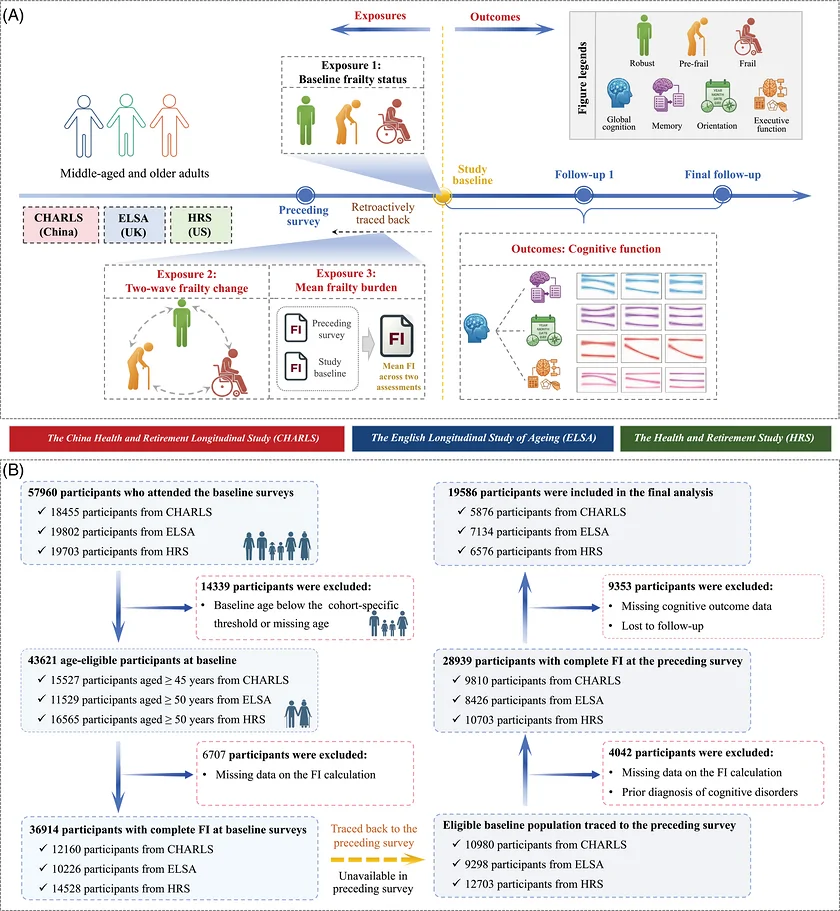
INTRODUCTION: The cognitive implications of longitudinal frailty exposure remain unclear. We examined associations of baseline frailty status, two-wave frailty change, and mean frailty burden with annual cognitive change and cognitive aging trajectories. METHODS: We analyzed data from three nationally representative cohorts: the China Health and Retirement Longitudinal Study, English Longitudinal Study of Ageing, and Health and Retirement Study (n = 19,586). Primary linear mixed-effects models used exposure-by-time interactions to estimate differences in annual global and domain-specific cognitive change. Cohort-specific estimates were pooled using random-effects meta-analysis. Secondary group-based trajectory modeling (GBTM) identified cognitive trajectory groups, and logistic regression assessed associations with group membership. RESULTS: Baseline pre-frailty and frailty were associated with more negative annual global cognitive change versus robust status (both pooled β = -0.023 SD/year, 95% CIs -0.030 to -0.016 and -0.031 to -0.014, respectively). Worsening from robust to pre-frail or frail status was associated with more negative change (pooled β = -0.025 SD/year, 95% CI -0.035 to -0.014). Higher mean frailty burden was associated with more negative change. Changes from initial pre-frailty or frailty showed no clear pooled associations. In secondary GBTM analyses, baseline frailty status, higher mean frailty burden, and frailty worsening were associated with less-favorable trajectory groups. Frailty improvement was directionally associated with more-favorable groups. DISCUSSION: Baseline frailty status, worsening from robust status, and higher mean frailty burden were associated with less-favorable cognitive aging across complementary rate-based and trajectory analyses. Repeated frailty assessments may provide information for characterizing cognitive aging.