Some immune cells linked to poorer kidney function in older women
A cross-sectional analysis of 8,970 adults aged 56 and older found different links between immune cell proportions and estimated kidney function in women and men.
Our read
Mechanisms- Studied:
- Cross-sectional study of 8,970 adults aged 56 years and older
- What changed:
- Kidney function was lower in older women with higher proportions of CD8⁺ effector memory T cells
- The catch:
- Kidney dysfunction could cause the immune cell changes rather than result from them
- In the record:
- One of 5 papers on CD4+ effector memory T cells on record: 3 with results in people.
Editor of record: Boris Djordjevic · AgingResearch.News
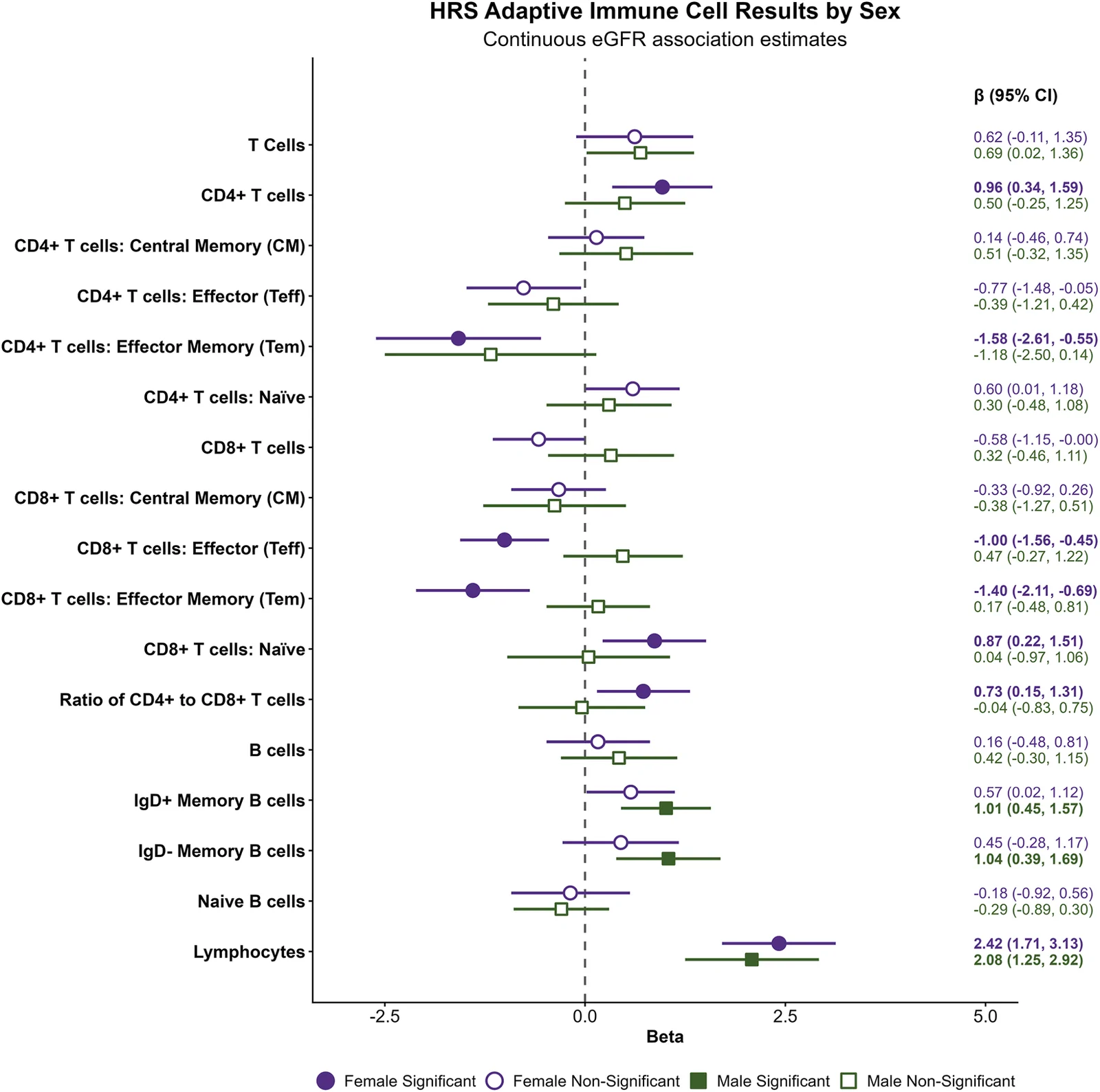
An observational, cross-sectional study analyzed 2016 data from 8,970 US adults aged 56 and older, including 5,159 women and 3,811 men. Researchers measured 17 immune cell groups and estimated kidney filtration using blood markers. They adjusted for age, health conditions, smoking and other factors.
Higher proportions of CD8 effector memory T cells—immune cells primed by past threats—were linked to lower estimated kidney function in women. CD8 effector T cells, which act against threats, showed a similar link. Neither group had a clear link in men. A formal comparison supported a sex difference for effector memory cells but was less conclusive for effector cells. In men, higher proportions of memory B cells, another type of immune cell that remembers past threats, were linked to higher estimated kidney function.
Why it matters
Age-related immune changes are linked to persistent inflammation. The authors suggest these T-cell groups may serve as sex-specific markers of kidney vulnerability in postmenopausal women.
Caveats
The cross-sectional design cannot show cause and effect or whether these cell patterns predict later kidney decline. The analysis covered adults aged 56 and older, not younger adults.
From the paper
- Participants
The unweighted analytic sample (n) included 8,970 HRS participants aged 56 years and older, including 53.9% females (n = 5,159) and 46.1% males (n = 3,811; ).
- Result
… in females a one-SD increase in log-transformed CD8⁺ Teff was associated with 1.00 mL/min/1.73 m² lower eGFR (β = −1.00 per SD, 95% CI = −1.56, −0.45, PFDR = 0.004), and in CD8⁺ Tem with 1.40 mL/min/1.73 m² lower eGFR (β = −1.40, 95% CI = −2.11, −0.69, PFDR = 0.002) …
Quoted word for word from the full text on PubMed Central.
- Immune response
- CD8+ effector memory T cells
- CD8+ effector T cells
- CD4/CD8 ratio
- CD4+ effector memory T cells
- Humans
The paper
University of Minnesota
Frontiers in Aging, Aug 25, 2026, Open access

Comments
Be the first to comment.