Automated CT bone readings were similar across five US systems
A retrospective cohort study of 123,001 adults found comparable spinal bone measurements across five healthcare systems, supporting a shared screening threshold.
Our read
Biomarkers- Studied:
- Cohort study of 123,001 adults (Multicenter)
- What changed:
- L1 trabecular attenuation did not differ among the five medical systems
- The catch:
- The study did not correlate L1 HU values with patient outcomes
- Stake:
- An author holds shares in Abbott.
- Why it’s aging research:
- It bears on staying healthy in midlife and later life.
Editor of record: Boris Djordjevic · AgingResearch.News
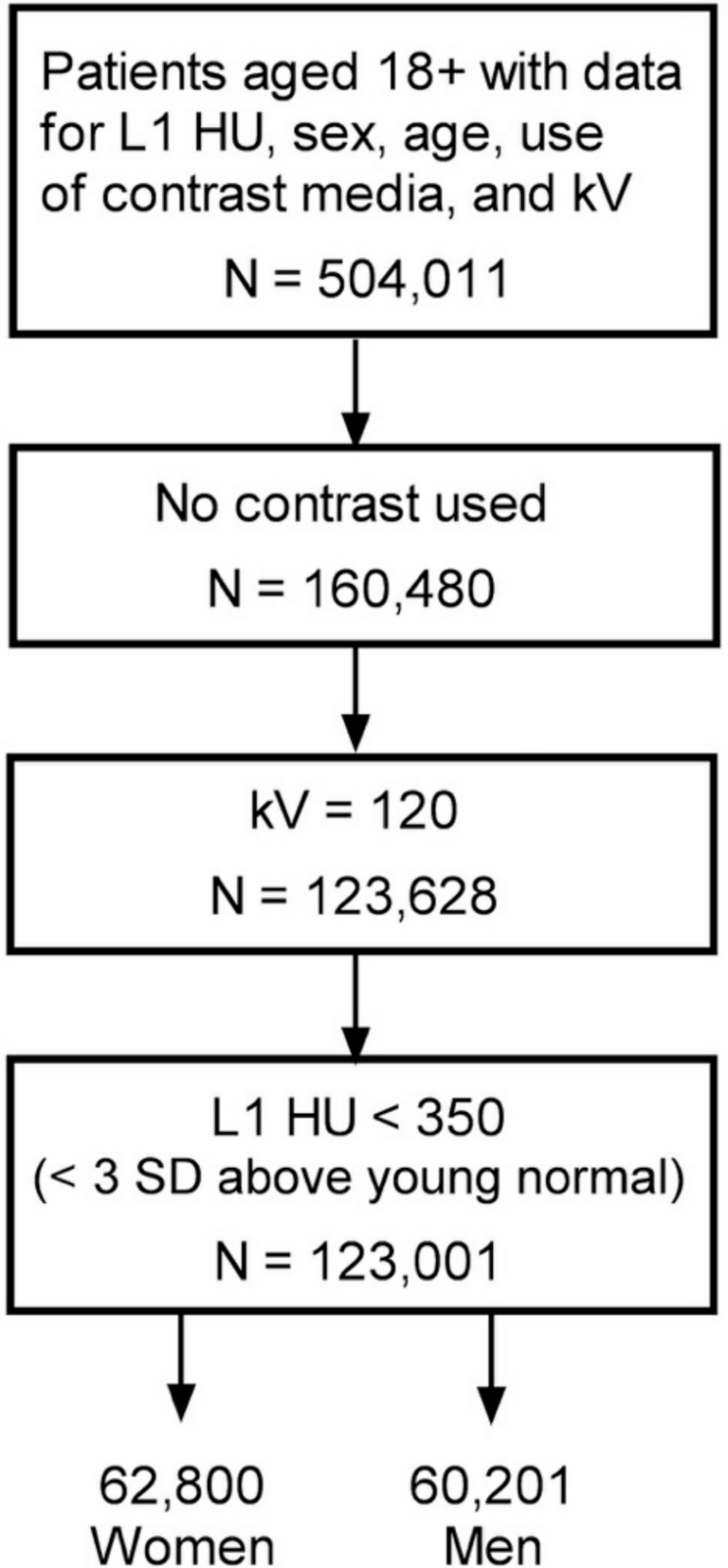
The observational study analyzed abdominal computed tomography (CT) scans from 123,001 adults over 18 at five US medical systems; 51.1% were women and 79.6% were White. Researchers retrospectively examined each person's first available scan, taken for any clinical reason.
An automated tool measured how strongly spongy bone in the first lower-back vertebra absorbed X-rays, expressed in Hounsfield units. Measurements showed similar patterns across systems, including relationships with age, sex, race and scanner. Differences between systems were not statistically significant after adjustment for multiple comparisons. The authors concluded that a threshold of 100 Hounsfield units could support osteoporosis screening across sites. After adjustment to US Census age distributions, 15% of White women aged 50 or older had readings of 100 or lower, compared with 7% of Black women in that age group.
Why it matters
Osteoporosis weakens bones and is a concern in older adults. The study addressed whether scans taken for other reasons could provide a consistent basis for identifying people who need osteoporosis assessment.
Caveats
This retrospective comparison assessed scan measurements rather than whether screening prevented fractures. It excluded scans with injected contrast or settings other than 120 kilovolts, and several racial groups were underrepresented.
From the paper
- Participants
The final multi-center cohort included 123,001 adults (51.1% women, 79.6% White).
- Limitation
As noted, some racial groups were significantly under-represented in the study population and require more concentrated samples.
Quoted word for word from the full text on link.springer.com.
The paper
Multi-center validation of automated CT-based L1 vertebral Hounsfield unit
University of Wisconsin–Madison
Osteoporosis International, Sep 5, 2026, Open access


Comments
Be the first to comment.