Digital Engagement and Predictors of Semaglutide Persistence and Weight Loss in Severe Obesity: 48-Week Observational Study
48 weeks, dose-response, declared ties to: Novo Nordisk, Eli Lilly and Company and Aviitam
Abstract
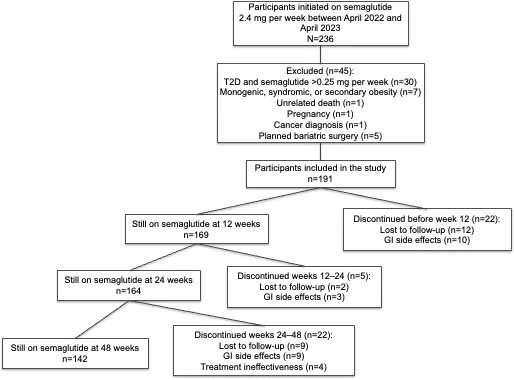
BACKGROUND: Real-world persistence with antiobesity pharmacotherapy is suboptimal: only 32% to 50% of patients persist with glucagon-like peptide-1 receptor agonists at 12 months, and fewer than 15% reach the 2.4 mg/week target dose. Digital platforms may support engagement, but their role remains poorly characterized. OBJECTIVE: This study aimed to evaluate whether baseline engagement with a structured digital assessment platform (Aviitam) predicts 48-week persistence and mediates weight-loss outcomes in adults with severe obesity initiating semaglutide 2.4 mg/week and to identify clinical and behavioral predictors of pharmacological response. METHODS: In this prospective 48-week single-center observational cohort, all consecutive adults (≥18 y) with a BMI ≥40 kg/m² initiating semaglutide 2.4 mg/week through the French early-access program were enrolled. Baseline engagement with the Aviitam digital assessment platform was operationalized as a 3-level ordinal variable (never used, partial use, and full completion of validated questionnaires), reflecting the patient's responses to a nonenforced preclinical request. The primary outcome was 48-week persistence; secondary outcomes were full-dose attainment, percentage weight change, and dose-response. Adjusted logistic and linear regressions estimated the engagement-persistence and engagement-weight-loss associations. A Baron-Kenny mediation analysis with bootstrap CIs decomposed the engagement-weight-loss association. Missing 48-week weights were imputed using multiple imputation (m=20) as a sensitivity analysis. Among persistent participants who completed all 7 baseline questionnaires (n=91), behavioral-scale associations with weight change were analyzed using Benjamini-Hochberg false-discovery-rate correction. RESULTS: Of 191 participants (mean age 51.7, SD 6.8 y; 61/191, 31.9% male; mean BMI 45.7, SD 6.8 kg/m²), 37 (19.4%) had never used the platform, 32 (16.8%) used it partially, and 122 (63.9%) fully completed the questionnaires. At 48 weeks, 142 (74.3%) remained on semaglutide, and 124 (87.3%) of them reached the 2.4 mg/week dose. Persistence followed a monotonic gradient across engagement levels (22/37, 59.5%; 23/32, 71.9%; 97/122, 79.5%; P=.02), and each engagement increment was associated with higher odds of persistence (adjusted odds ratio 1.62, 95% CI 1.05-2.50; P=.03), unchanged under multiple imputation. Mean weight loss was 11.8% (SD 8.4%) in the full cohort and 14.6% (SD 7.3%) among persistent participants, with a steep dose-response (mean 3.9%, SD 5.8% in discontinuers to mean 15.3%, SD 7.2% at 2.4 mg/week; P<.001). Mediation analysis showed 48-week persistence mediated approximately 69% of the engagement-weight-loss association; the direct effect was nonsignificant. The Intuitive Eating Scale-2 was the only behavioral predictor surviving false-discovery-rate correction (q=0.05). CONCLUSIONS: Baseline engagement with a structured digital assessment platform predicts 48-week semaglutide persistence in a graded manner; low-engagement patients can be identified at initiation and supported with targeted strategies to maintain persistence and achieve full-dose titration.
The paper
Centre Hospitalier Universitaire de Montpellier; Inserm
Journal of Medical Internet Research, 26 Aug 2026