Sleep patterns linked to fat-tissue hormones in older adults
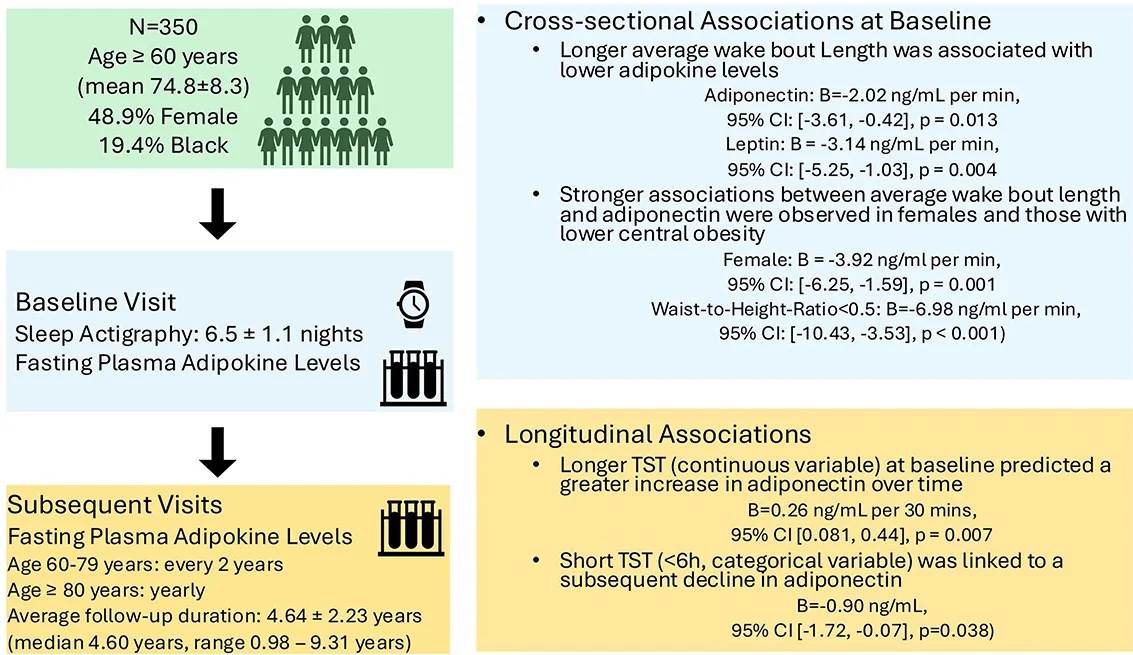
Sleeping 30 minutes above average was linked to a rise of 0.26 nanograms per milliliter in adiponectin, a fat-tissue hormone, over time.
Our read
Populations- Studied:
- Cohort study of 350 older adults, median 4.60 years
- What changed:
- Longer average wake bout length was associated with lower adiponectin levels at baseline
- The catch:
- Actigraphy did not account for sleep-related breathing disorders such as obstructive sleep apnea
- In the record:
- One of 3 papers on average wake bout length on record: none yet with results in people.
- Why it’s aging research:
- It bears on staying healthy in midlife and later life.
Editor of record: Boris Djordjevic · AgingResearch.News
In an observational study, 350 adults aged 60–96 from the Baltimore Longitudinal Study of Aging, including 171 women, wore wrist devices to estimate sleep. They recorded an average of 6.5 nights. Researchers measured adiponectin and leptin, hormones made by fat tissue, in fasting blood samples. Of the participants, 269 had follow-up visits over an average of 4.64 years.
Longer sleep was associated with a greater increase in adiponectin over time. Sleeping less than six hours was linked to a decline compared with six to nine hours. At baseline, longer average periods awake during the night were linked to lower levels of both hormones. The adiponectin association was stronger in women and people with lower waist size relative to height. Sleep duration was not linked to changes in leptin.
Why it matters
The authors suggest that hormones made by fat tissue may be one route through which sleep affects heart and metabolic health in older adults.
Caveats
The observational design cannot show that sleep caused hormone changes or improved health. The cohort enrolled generally healthy people, which limits how broadly the findings apply to older adults with major health limitations.
From the paper
- Participants
Among the 350 participants, the mean age was 74.8 ± 8.3 (range 60–96) years, 171 (48.9%) were female, and 68 (19.4%) reported their race as black.
- Result
For example, in Model 3, each 30-min increase in TST above the sample mean was associated with a 0.26 ng/mL increase in adiponectin (B = 0.26, 95% CI [0.081, 0.44], p =.007).
Results, Cross-sectional and longitudinal associations between sleep parameters and adipokines
- Limitation
While the sample size in this research was adequate to examine primary associations between sleep and adipokines in older adults, it is smaller than prior studies performed on sleep and adipokines in younger and middle-aged adults …
Quoted word for word from the full text on PubMed Central.
The paper
Thomas Jefferson University; Johns Hopkins University
Sleep Advances, Jul 23, 2026, Open access
Comments
Be the first to comment.