The effect of sleep status on all-cause mortality and premature death among middle-aged and older adults: A national cohort study
Declared no competing interests
Abstract
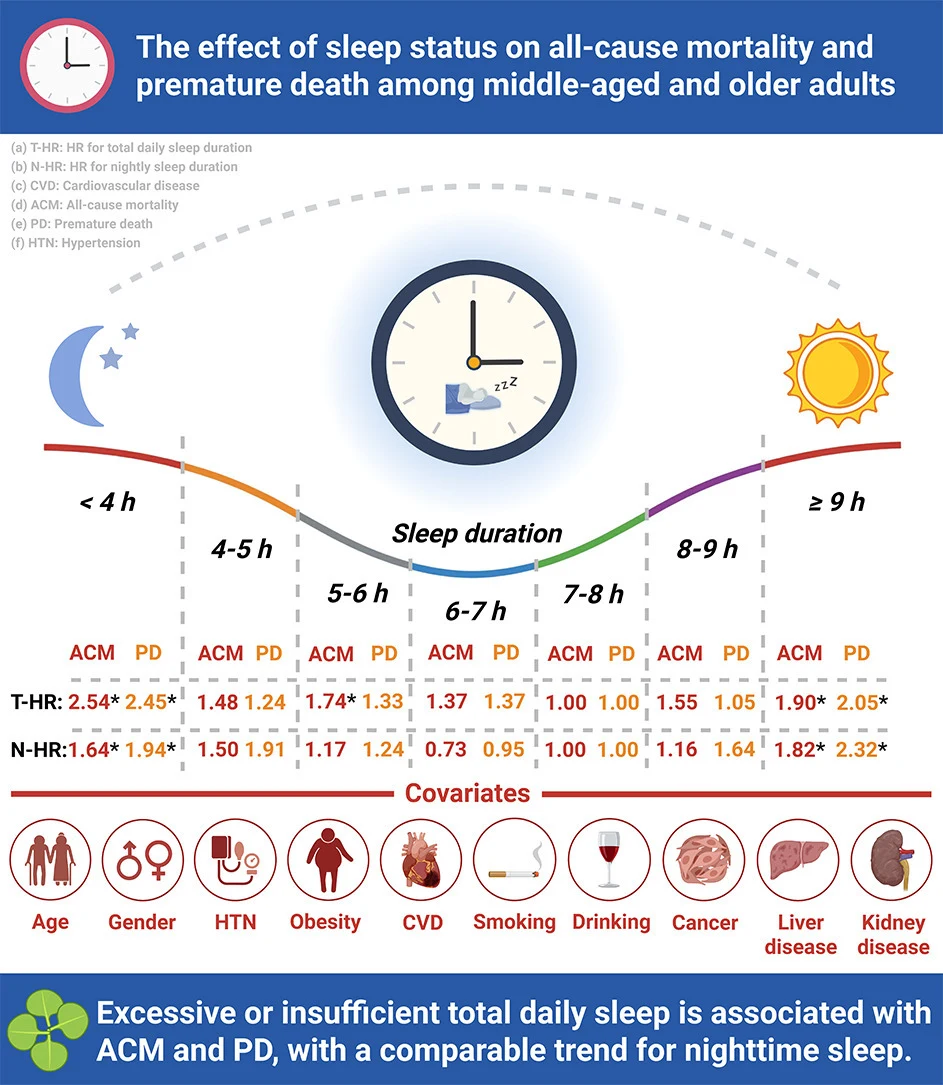
BACKGROUND: Aging in middle-aged and older adults is often accompanied by marked alterations in sleep quality and structure, characterized by increased prevalence of poor sleep quality and reduced sleep duration. Accumulating evidence suggests that the alterations in sleep status may be associated with elevated risks of mortality. However, the optimal sleep structure that confers the greatest protective effect against mortality remains unclear. Therefore, a comprehensive investigation into the relationship between sleep status and all-cause mortality as well as premature death among middle-aged and older populations is of considerable public health relevance. METHODS: We utilized a nationally representative dataset from the China Health and Retirement Longitudinal Study for our study. A total of 16,375 participants were included in the study. Sleep status-including sleep disturbance, total daily sleep duration, nighttime sleep duration, and napping duration-was used as the independent variable, while all-cause mortality and premature death were used as the dependent variables. The Kaplan-Meier curves, Restricted cubic spline analyses, Cox proportional hazards regression models and sensitivity analyses were employed to estimate the associations between sleep status and the risks of all-cause mortality and premature death. RESULTS: The Kaplan-Meier curves demonstrated that both total daily sleep duration and nighttime sleep duration were significantly associated with the risks of all-cause mortality and premature death (P < 0.05). Moreover, Restricted cubic spline analysis revealed a significant U-shaped association between total sleep duration and the risks of all-cause mortality and premature death, as well as a similar U-shaped association between nighttime sleep duration and these risks (P < 0.05). Furthermore, multivariable Cox regression analyses showed that a total daily sleep duration of ≥9 h (HR = 1.904, 95% CI: 1.181-3.070) or <4 h (HR = 2.537, 95%CI: 1.495-4.308), as well as a nighttime sleep duration of ≥9 h (HR = 1.824, 95% CI: 1.100-3.024) or <4 h (HR = 1.637, 95% CI: 1.007-2.662), were significantly associated with an elevated risk of all-cause mortality compared with 7-8 h of sleep (P < 0.05). Besides, a total sleep duration of ≥9 h (HR = 2.047, 95% CI: 1.175-3.566) or <4 h (HR = 2.445, 95%CI: 1.260-4.743), and a nighttime sleep duration of ≥9 h (HR = 2.320, 95% CI: 1.190-4.521) or <4 h (HR = 1.943, 95%CI: 1.003-3.762), were significantly associated with an increased risk of premature death (P < 0.05). Sensitivity analyses yielded largely consistent results. CONCLUSION: Excessive total daily sleep duration (≥9 h) or insufficient sleep duration (<4 h) was significantly associated with increased risks of all-cause mortality and premature death. A comparable trend was observed for nighttime sleep duration. Daytime napping and sleep disturbance were not significantly associated with mortality.
The paper
Zhejiang Chinese Medical University; Jena University Hospital
Archives of Gerontology and Geriatrics, 19 Aug 2026