Association of GLP-1 receptor agonists, SGLT 2 inhibitors, DPP-4 inhibitors, and sulfonylureas with incident cancer in type 2 diabetes
Abstract
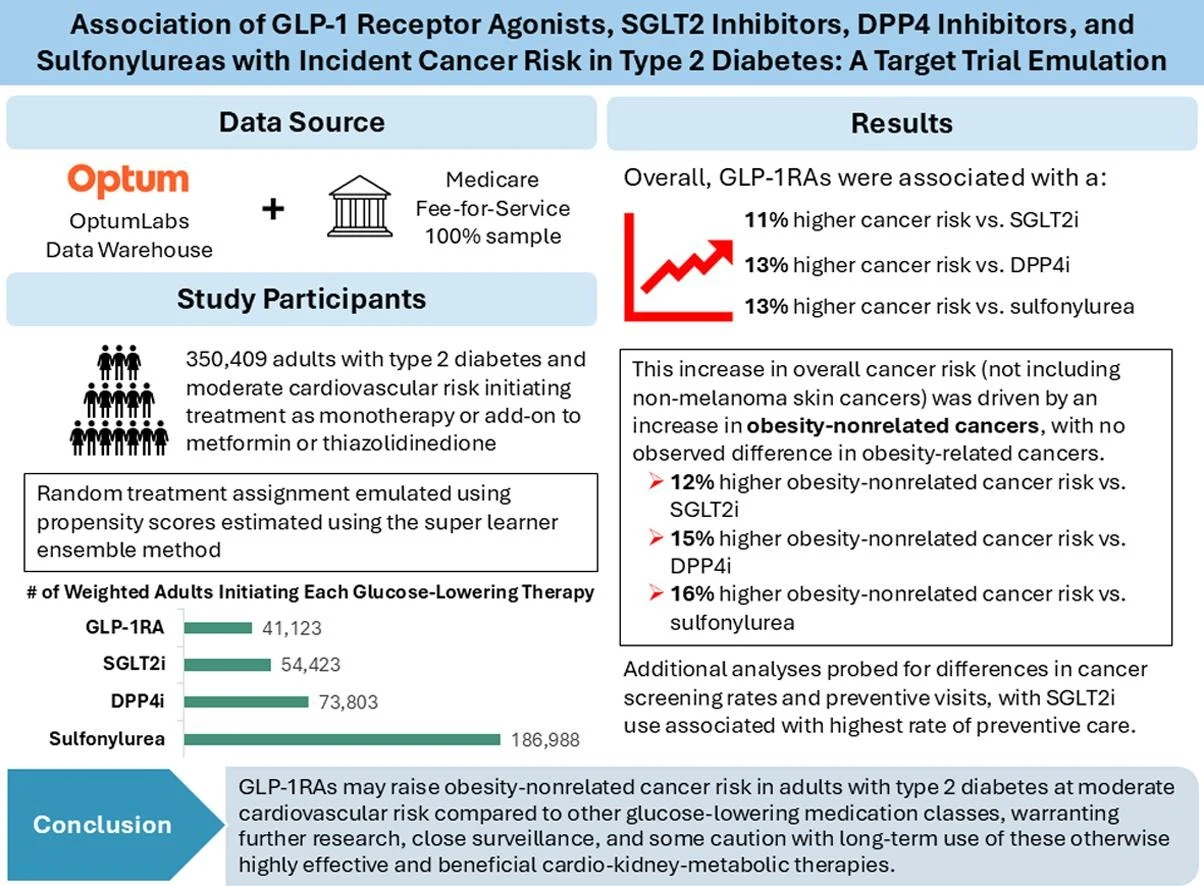
AIMS: Limited evidence exists regarding cancer risk associated with non-metformin glucose-lowering medication classes, particularly among obesity-related and obesity-nonrelated cancers. METHODS: We compared cancer risk following initiation of glucagon-like peptide-1 receptor agonists (GLP-1RA), sodium-glucose cotransporter 2 inhibitors (SGLT2i), dipeptidyl peptidase-4 inhibitors (DPP4i), or sulfonylureas by emulating a target trial using claims data from Optum Labs Data Warehouse and traditional Medicare (100% sample) among adults with type 2 diabetes and moderate cardiovascular risk between January 2014 and December 2021. Random treatment assignment was emulated using propensity scores, which were incorporated as inverse probability of treatment weights into proportional hazard models. Primary outcome was any new cancer diagnosis; we secondarily examined cancer subgroups. RESULTS: After inverse probability of treatment weighting, 41,123 patients started GLP-1RA, 54,423 started SGLT2i, 73,803 started DPP4i, and 186,988 started sulfonylureas. GLP-1RA were associated with higher risk of new cancer diagnosis compared to DPP4i (HR 1.13, 95%CI 1.05-1.21). SGLT2i (HR 0.89, 95%CI 0.82-0.96) and sulfonylureas (HR 0.87, 95%CI 0.81-0.92) had lower risks of cancer compared to GLP-1RA. Results were driven by obesity-nonrelated cancers, with no difference between study drugs for obesity-related cancers. CONCLUSIONS: The increased risk of obesity-nonrelated cancers following GLP-1RA therapy warrants further investigation and caution among at-risk individuals.
The paper
University of Maryland, Baltimore
Diabetes Research and Clinical Practice, 17 Aug 2026