Diagnostic accuracy of the WHO ICOPE step 1 screening tool in Korean community-dwelling older adults: a cross-sectional validation study
Abstract
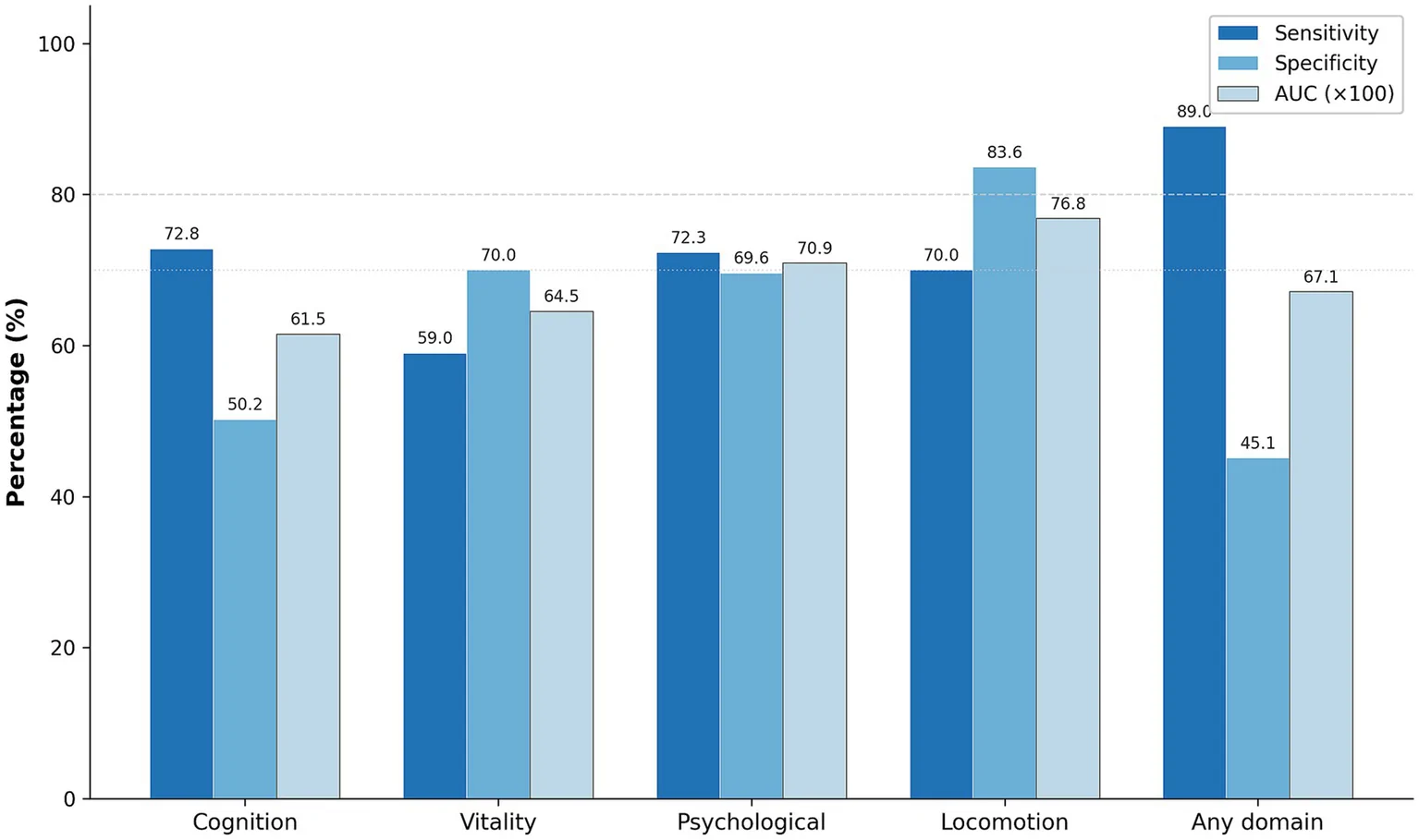
BACKGROUND: The WHO ICOPE Step 1 tool screens decline in intrinsic capacity (IC), but its diagnostic accuracy has not been examined in Korea. This study evaluated four assessable non-sensory Step 1 domains against Korean-validated reference standards in Korean community-dwelling older adults. METHODS: We conducted a cross-sectional study of 464 community-dwelling older adults (mean age 78.4 years; 67.9% female) from 11 community-based recruitment sites in urban and rural Jinju, South Korea. ICOPE Step 1 items were evaluated against reference standards in four assessable domains: cognition (Cognitive Impairment Screening Test [CIST], with age- and education-adjusted cutoffs), vitality (Mini-Nutritional Assessment Short-Form [MNA-SF] ≤ 11), psychological well-being (Geriatric Depression Scale [GDS-15] ≥ 8), and locomotion (Short Physical Performance Battery [SPPB] ≤ 9). Hearing and vision were reported descriptively because objective sensory reference standards were unavailable. Sensitivity, specificity, positive and negative predictive values, area under the curve (AUC), and Cohen's kappa were calculated for each domain and for overall screening. Post-hoc analyses examined modified SPPB, BMI-augmented vitality screening, cognition calibration, adjusted urban-rural differences, recruitment-source sensitivity, and prevalence-adjusted predictive values. RESULTS: Overall, Step 1 screening across four domains showed sensitivity of 89.0%, specificity of 45.1%, and AUC of 0.671 for any IC decline. In the original SPPB-based analysis, locomotion showed the highest apparent accuracy (sensitivity 70.0%, specificity 83.6%, AUC = 0.768, κ = 0.499), but modified SPPB analysis excluding the chair-stand component reduced AUC to 0.670, confirming incorporation bias. Psychological well-being showed AUC = 0.709, whereas cognition showed limited specificity (50.2%; low-education subgroup 45.7%). Adding BMI ≤ 20 kg/m² to vitality screening increased sensitivity from 59.0 to 68.2% with minimal specificity loss. Adjusted analyses showed setting-dependent detection differences, especially lower locomotion detection in urban residents. CONCLUSION: Four assessable non-sensory ICOPE Step 1 domains showed acceptable overall case-finding sensitivity but heterogeneous domain-specific accuracy. Implementation should use education-stratified cognitive confirmation, BMI-augmented vitality screening, cautious interpretation of chair-rise locomotion results, and future objective validation of sensory domains.
The paper
Gyeongsang National University
Frontiers in Public Health, 30 Jul 2026