Development of a Global Functionality Index Integrating Physical Performance and Wearable-Derived Outdoor Walking Metrics in Older Adults
Abstract
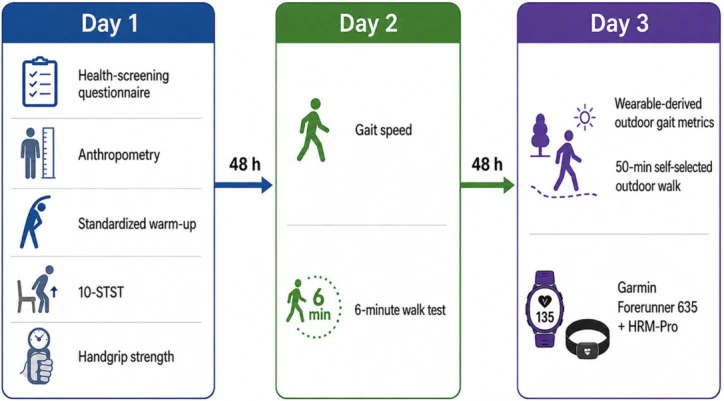
OBJECTIVE: To develop and internally evaluate a Global Functionality Index (GFI) in older adults and to examine the combined influence of age, sex, and body mass index (BMI) on functional capacity. METHODS: A total of 110 older adults (70.89 ± 5.93 years) completed a physical performance battery including gait, muscle strength, and endurance assessments. Wearable-derived outdoor walking speed was measured using a Garmin Forerunner 635 and HRM-Pro band. Exploratory principal component analysis, k-means clustering, and multivariable linear and logistic regression were performed. RESULTS: Women had lower GFI values than men (p < 0.001). Although overall GFI differences by age group were not significant, women aged 70 years and older showed significantly lower GFI values than women younger than 70 years (p = 0.018). In the multivariable linear models, age and sex were the main independent correlates of GFI (both p < 0.001), whereas BMI showed a borderline, non-significant association (p = 0.066). In logistic regression, age was associated with membership in the lowest GFI quartile (p = 0.008), while BMI showed a borderline, non-significant association (p = 0.065). Cluster analysis identified three distinct functional profiles. CONCLUSIONS: The GFI represents a derived multidimensional index of functional capacity that integrates laboratory-based performance tests and wearable-derived outdoor performance metrics. These findings support the preliminary interpretation of the GFI as a sample-dependent research index derived within this cohort; they do not establish external or predictive validity.