Sex-Dependent S1P-Related Gene Expression in Brown Adipose Tissue Across Exercise and Thermal Conditions
Abstract
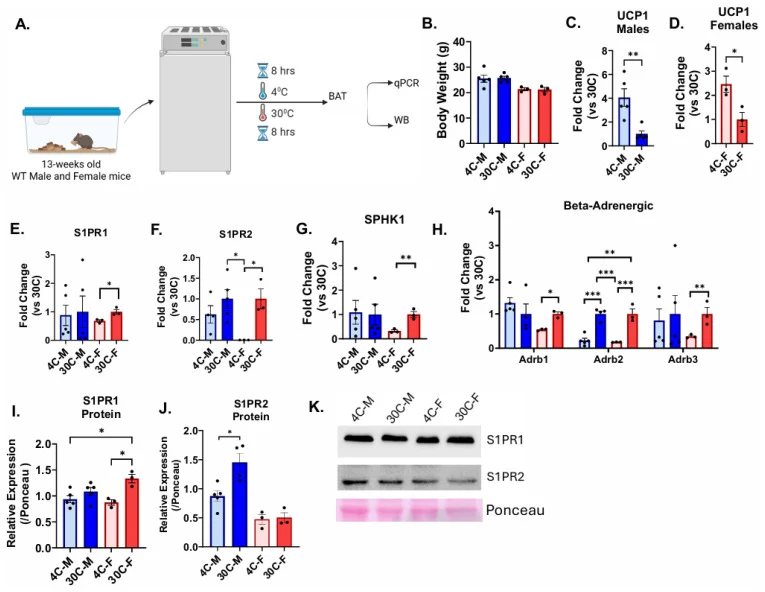
Sphingosine-1-phosphate (S1P) signaling has emerged as a regulator of metabolic homeostasis, but its relationship to brown adipose tissue (BAT) adaptation across physiological conditions remains unclear. We examined how S1P-related gene expression in BAT and subcutaneous white adipose tissue (scWAT) varies with acute exercise, chronic exercise, ambient temperature, aging, sex, and UCP1 deficiency. Young and aged wild-type mice, as well as aged UCP1 knockout (UCP1KO) mice, were studied across acute or chronic exercise paradigms and thermal conditions ranging from 4 °C to 30 °C. In BAT, acute exercise was associated with lower S1pr1, S1pr2, and Sphk1 expression in young females, whereas aged males showed lower S1pr2 and Sphk1 after exercise. In scWAT, exercise-associated induction of S1P-related transcripts was most evident in aged males. Female BAT also displayed broader temperature- and chronic exercise-associated differences in S1pr2, Sphk1, and β-adrenergic receptor transcripts, whereas male BAT showed fewer transcriptional changes. In UCP1KO mice, these exercise-associated patterns were altered or attenuated. Together, these findings identify a context-dependent adipose S1P-related transcriptional program that differs by sex, age, depot, ambient temperature, exercise condition, and UCP1 status.
The paper
The Ohio State University Wexner Medical Center
International Journal of Molecular Sciences, 27 Jul 2026