Dietary Food-Group Diversity Is Associated with Lower Frailty Severity in Older Adults Undergoing Geriatric Outpatient Assessment
Abstract
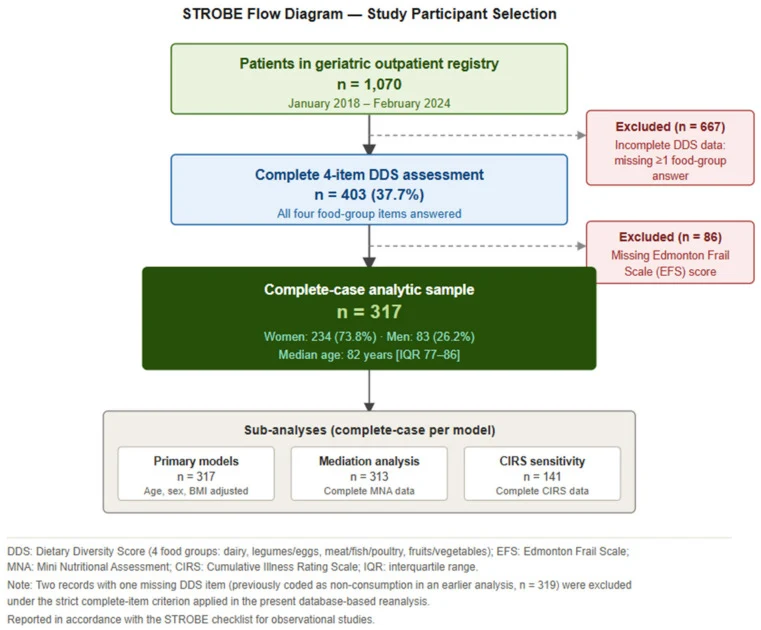
BACKGROUND: Dietary diversity has been proposed as a modifiable determinant of healthy ageing, but its association with objectively assessed frailty in geriatric outpatients remains poorly characterised. We examined the cross-sectional association between a four-item Dietary Diversity Score (DDS) and frailty severity, and whether nutritional status statistically mediates this association. METHODS: Cross-sectional study of 317 older adults (median age 82 years, 73.8% female) attending a geriatric outpatient unit in Northern Italy. Consumption of four food groups (dairy, legumes/eggs, meat/fish/poultry, fruits/vegetables) was summed into a DDS (0-4). Frailty was measured with the Edmonton Frail Scale (EFS). Mediation by the Mini Nutritional Assessment (MNA) was tested with bootstrapping; individual food-group associations across eight outcomes were corrected for multiple testing (Benjamini-Hochberg). RESULTS: Each additional food group was associated with a 0.61-point-lower EFS score after adjusting for age, sex and BMI (β = -0.608; p = 0.001; adjusted R² ≈ 0.04-0.07) and 36% lower odds of higher frailty severity (OR = 0.64; p < 0.001). MNA statistically explained 86.2% of the DDS-EFS association (bootstrap 95%CI excluding zero), and the significant mediation paths remained robust after FDR correction (q ≤ 0.0015). Legumes/eggs showed the strongest food-specific association with EFS and MNA after correction (q ≤ 0.002); fruit/vegetable associations with inflammatory and nutritional biomarkers did not survive correction and are exploratory. CONCLUSIONS: Dietary diversity is associated with lower frailty severity in geriatric outpatients, largely explained by nutritional status; the modest explanatory power reflects frailty's multifactorial aetiology, and prospective studies are needed to test causality.
The paper
University of Milan; University of Pavia
Foods, 28 Jul 2026