Muscle fat linked to death risk in metabolic fatty liver disease
In 10,490 UK Biobank adults with metabolic fatty liver disease, an observational analysis linked muscle fat to death and brain blood vessel disease.
24,976 participants
Limit: Participants had to survive until MRI, but follow-up began earlier, creating survival bias
Edited by Boris Djordjevic · AgingResearch.News
Researchers conducted an observational study of 24,976 UK Biobank adults who had abdominal magnetic resonance imaging scans. The group included 10,490 with metabolic dysfunction-associated steatotic liver disease, a form of fatty liver disease accompanied by metabolic problems. Models considered liver fat, abdominal fat and muscle measurements together while accounting for demographic, metabolic and blood-test measures.
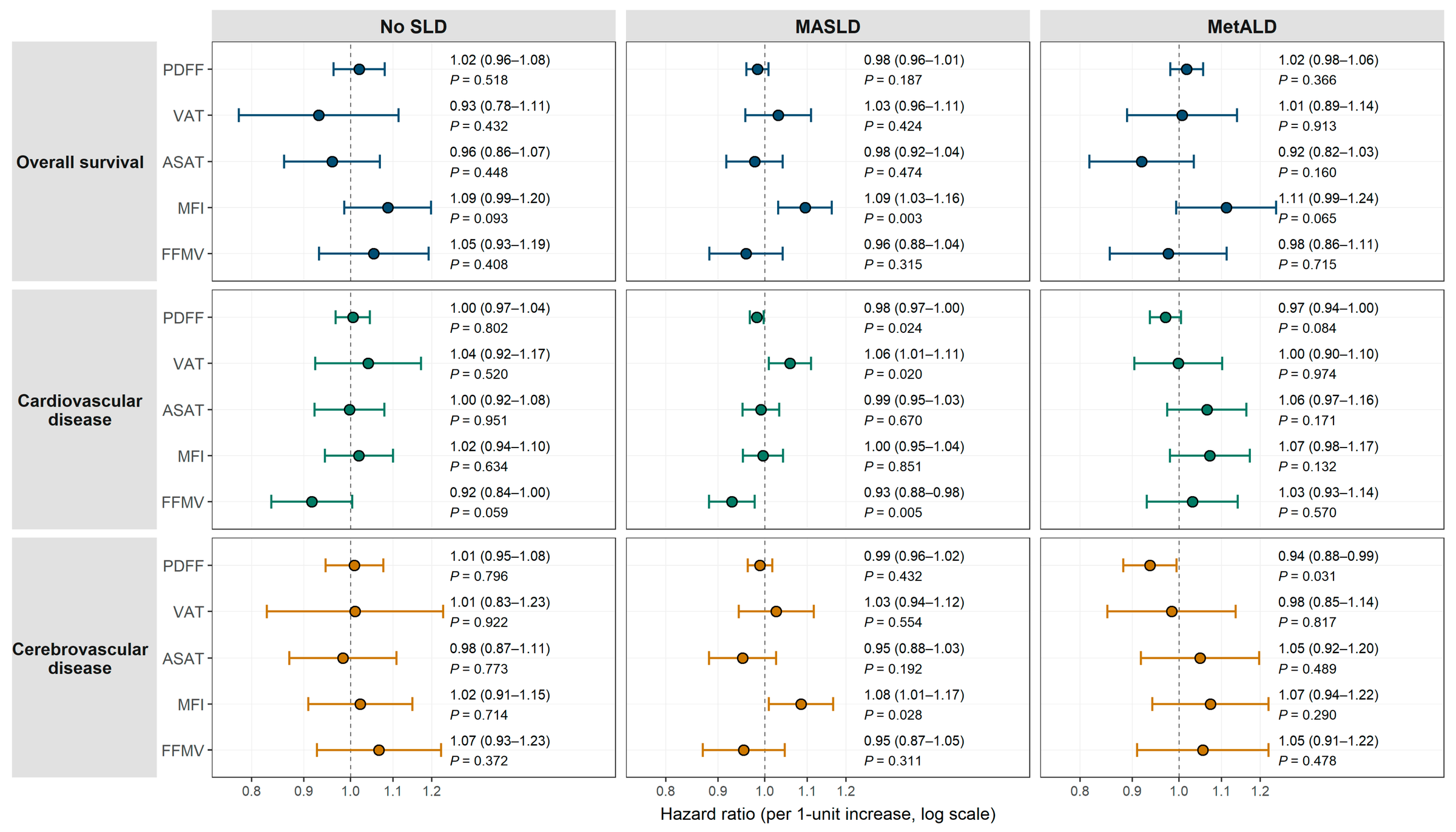
Among adults with this liver condition, more fat within muscle was associated with death from any cause and developing disease of the brain’s blood vessels. Greater thigh muscle volume, excluding fat, was associated with lower risk of cardiovascular disease, which affects the heart and blood vessels. Fat around abdominal organs was also associated with cardiovascular disease. Liver fat was not independently associated with death or brain blood vessel disease, but was associated with lower cardiovascular risk.
Why it matters
The study addressed risk assessment for death and vascular disease, outcomes relevant to healthy aging. The authors suggested potential value in assessing body composition rather than relying on liver fat alone.
Caveats
This observational study cannot establish cause and effect. The authors said further validation was needed to determine whether combined body-composition measurements add clinical value.
From the paper
- Participants
The analytic sample comprised 24,976 adults, of whom 11,909 were classified as No SLD, 10,490 as MASLD, and 2577 as MetALD.
Results, 3.1. Baseline Characteristics and Distribution of MRI Markers
- Result
After full adjustment for demographic, metabolic, biochemical, and imaging covariates, PDFF was not associated with all-cause mortality (HR 0.98 per 1%, 95% CI 0.96–1.01; p = 0.187) or incident cerebrovascular disease (HR 0.99, 95% CI 0.96–1.02; p = 0.432) in MASLD.
Results, 3.2. Independent Associations of MRI Body Composition with Outcomes
- Limitation
Second, the temporal alignment between the initial UK Biobank assessment and subsequent MRI acquisition warrants careful consideration.
Quoted word for word from the full text on mdpi.com.
- Metabolic dysfunction-associated steatotic liver disease
- Cardiovascular disease
- Hepatic steatosis
- Cerebrovascular disease
- Abdominal subcutaneous adipose tissue
- Humans
The paper
Soonchunhyang University; Catholic University of Korea
Diagnostics, Oct 24, 2026, Open access, CC BY


