Community-driven interventions for the prevention of non-communicable diseases (NCDs) in urban South Asia: a scoping review
Abstract
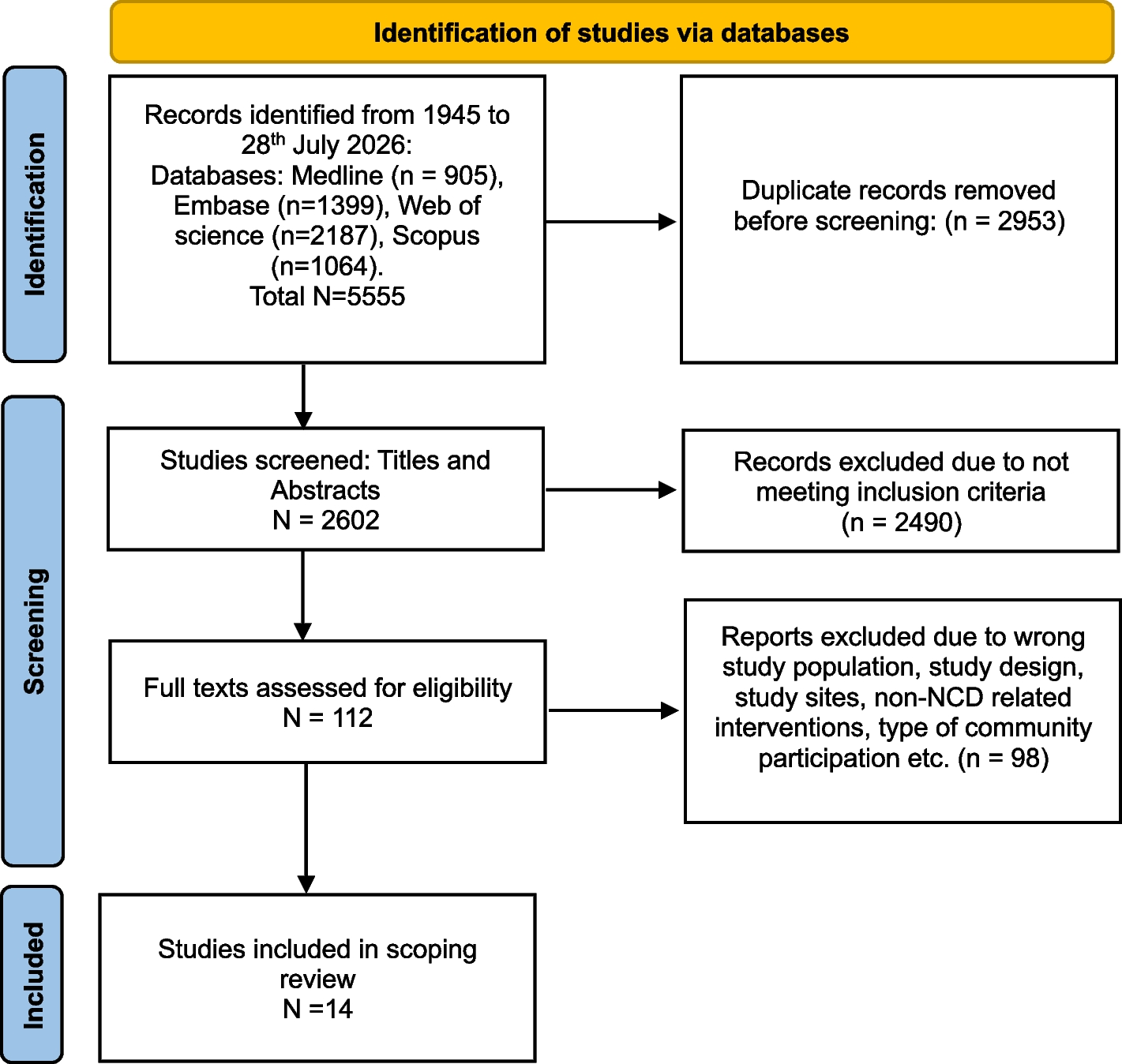
Background: Non-communicable diseases (NCDs) are a leading cause of premature mortality in South Asia, with urban populations experiencing rapidly rising risk due to demographic transition, environmental change, and widening social inequalities. While community participation is increasingly recognised as essential for effective NCD prevention, the nature, scope, and effectiveness of community-driven interventions in urban South Asia remain less synthesised. This scoping review aimed to systematically map community-driven interventions targeting NCD prevention in urban South Asian settings. We sought to examine how these interventions were implemented, the mechanisms through which they operated, and the contextual factors shaping their outcomes. Methods: To conduct the scoping review MEDLINE, Embase, Scopus, and Web of Science databases were searched from inception to July 28, 2026, alongside grey literature. Eligible studies reported community-driven interventions targeting NCDs or related risk factors among urban populations in South Asia. Data were charted and synthesised descriptively and thematically. Modes of community engagement were classified using Gram et al.’s “classroom–club–collective” typology. Results: 14 studies met the inclusion criteria: eleven from India, two from Nepal, and one from Sri Lanka. Interventions primarily targeted type 2 diabetes, hypertension, cardiovascular risk, mental health and tobacco use, with limited attention to chronic respiratory diseases and cancers. All studies reported positive short-term behavioural, psychosocial, or intermediate clinical outcomes. Communities were engaged in design, delivery, adaptation or mobilisation through peer educators, women’s self-help groups, mothers’ groups, trained community volunteers, and youth clubs/advocates. Community involvement in evaluation was rare. Implementation success was shaped by contextual constraints such as urban poverty, time scarcity, gender norms, and limited infrastructure. Contextual enablers included using trusted social networks, cultural adaptation, and local leadership. Most interventions were small-scale, short-term, and weakly integrated into health systems. Conclusion: The literature suggests potential for community-driven approaches to support NCD-related interventions in urban South Asia by mobilising local communities; however, current evidence remains insufficient to establish effectiveness. Scaling and sustaining such approaches will require greater institutional support, integration with urban health systems, and investment in longitudinal, mixed-methods implementation research that centres community leadership as a core component of NCD prevention and control strategies.
- Community-driven interventions
- Non-communicable disease
- Cancer
- Chronic respiratory disease
- Hypertension
- Humans
The paper
BMC Public Health, 12 Oct 2026, CC BY