Light exercise with blood flow restriction may aid strength and memory
An eight-week randomized trial in 36 oldest-old adults found favorable changes versus no exercise, but limited evidence of added benefit over matched light exercise.
Our read
Interventions- Studied:
- Randomized trial in 36 oldest-old adults with sarcopenia and mild cognitive impairment, 8 weeks (Blinded, registered ChiCTR2600119054)
- What changed:
- Handgrip strength improved with blood flow restriction training compared with no exercise
- The catch:
- Only 36 participants were split among the exercise and control groups
- In the record:
- The 8th paper on blood flow restriction resistance training with results in people; 12 on record in all.
- Why it’s aging research:
- It studies an intervention with evidence of extending healthy life.
Editor of record: Boris Djordjevic · AgingResearch.News
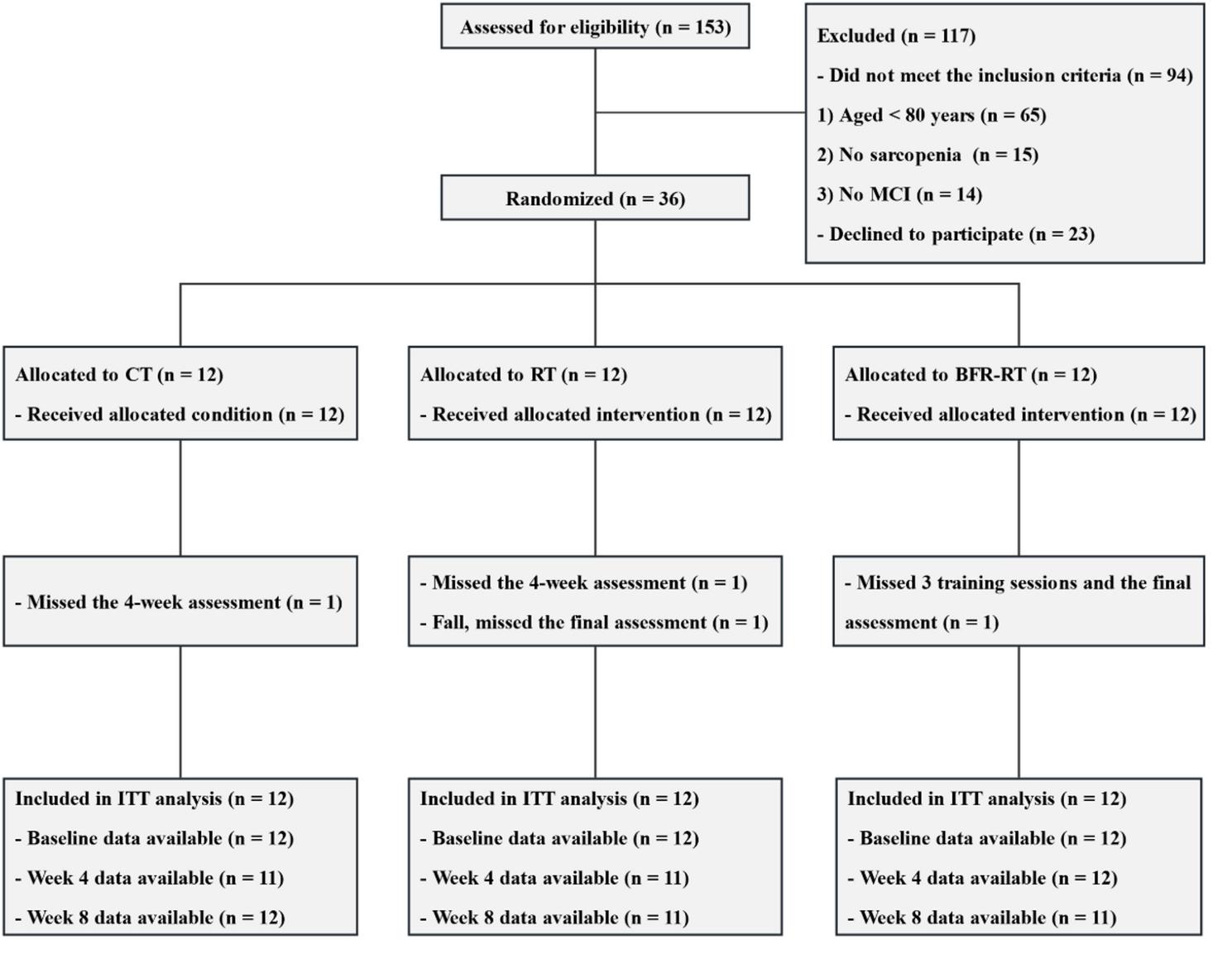
The randomized trial enrolled 36 oldest-old adults with sarcopenia, a condition involving muscle loss and weakness, and mild cognitive impairment, involving problems with memory or thinking. Researchers assigned them equally to light resistance exercise with blood flow restriction, matched exercise without restriction, or no exercise. Supervised exercise ran three times weekly for eight weeks at about 30% of the estimated maximum weight each person could lift once. The restriction group used 50% of the estimated pressure needed to stop arterial blood flow.
Compared with no exercise, exercise with restriction showed favorable changes in grip strength, four-meter walking time, verbal learning and recalling information after a delay. Evidence of added benefits over matched exercise was limited, with the clearest signal in grip strength. Attendance averaged 95.1% with restriction and 96.9% without it. No serious intervention-related adverse events occurred.
Why it matters
The trial addressed whether restricting blood flow during light exercise could support physical and memory-related function in oldest-old adults who may tolerate conventional resistance training poorly.
Caveats
This exploratory trial was small and lasted eight weeks; its findings concern oldest-old adults with both conditions. Blood biomarker findings were exploratory and did not support biological mechanisms specific to blood flow restriction.
Where the evidence stands
Blood flow restriction resistance training
- 7 independent labs in 5 countries
- 1 finding against
- Funders: Japan Society for the Promotion of Science and others
From the paper
- Participants
All 36 participants were included in the intention-to-treat analysis.
- Harms
Mean attendance was 96.9% in RT and 95.1% in BFR-RT, with no serious intervention-related adverse events.
Quoted word for word from the full text on link.springer.com.
- Blood flow restriction resistance training
- Sarcopenia
- Mild cognitive impairment
- 4 m-walk time
- Appendicular muscle mass index
- Humans
The paper
Southwest University
BMC Geriatrics, Nov 3, 2026, Open access, CC BY-NC-ND


Comments
Be the first to comment.