Association of the C-reactive protein-triglyceride glucose index with motoric cognitive risk syndrome in Chinese older adults: a cross-sectional study
Abstract
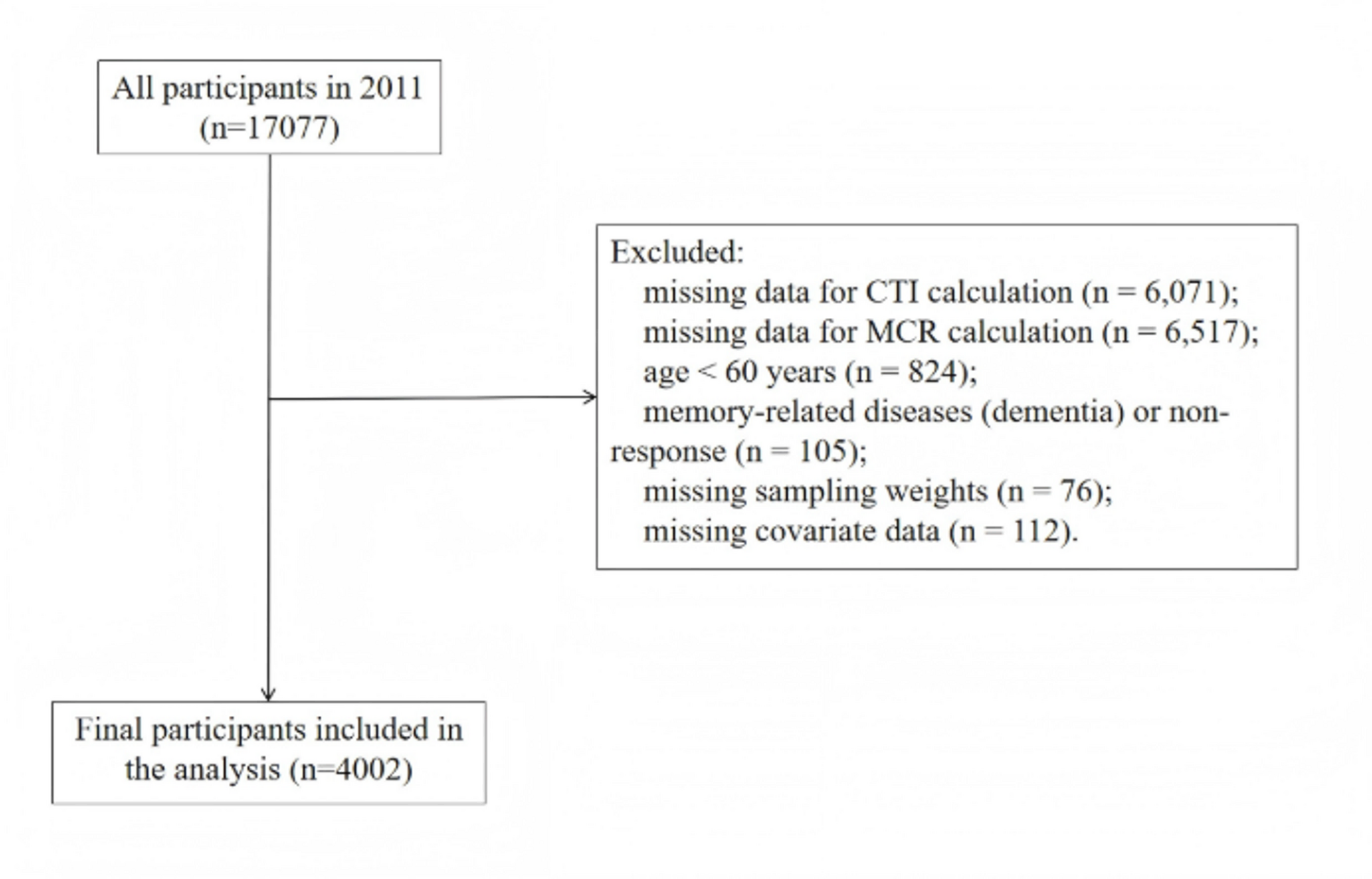
With the acceleration of global aging, cognitive impairment has become a major public health concern. Chronic low-grade inflammation and metabolic dysregulation may jointly contribute to cognitive decline, but their combined role in motoric cognitive risk syndrome (MCR) remains unclear. This study aimed to investigate the association between the C-reactive protein-triglyceride glucose index (CTI), a composite marker of inflammation and insulin resistance, and MCR. We utilized data from the baseline period of the China Health and Retirement Longitudinal Study (CHARLS) to examine the relationship between CTI and MCR. Multivariate logistic regression was employed to examine their association. Restricted cubic spline (RCS) regression models were used to observe potential nonlinear relationships. Subgroup analyses were also conducted. The study included 4,002 participants, with 12.6% (503 participants) diagnosed with MCR. Participants with MCR had a mean CTI score of 4.87. Logistic regression results indicated a positive correlation between CTI and MCR. This association persisted after adjusting for all covariates, with an odds ratio (OR) and 95% confidence interval (CI) of 1.449 (1.095–1.921) for the highest versus lowest CTI quartile, and this association remained robust in weighted sensitivity analysis (OR = 1.490, 95% CI: 1.076–2.064). RCS analysis revealed a nonlinear, N-shaped relationship between CTI and MCR (P-overall < 0.001, P-nonlinear = 0.012). CTI is positively correlation with MCR. Not applicable.
The paper
First Affiliated Hospital of Fujian Medical University
BMC Geriatrics, 13 Oct 2026, Open access, CC BY-NC-ND