Health ratings showed no clear trend from ages 70 to 100
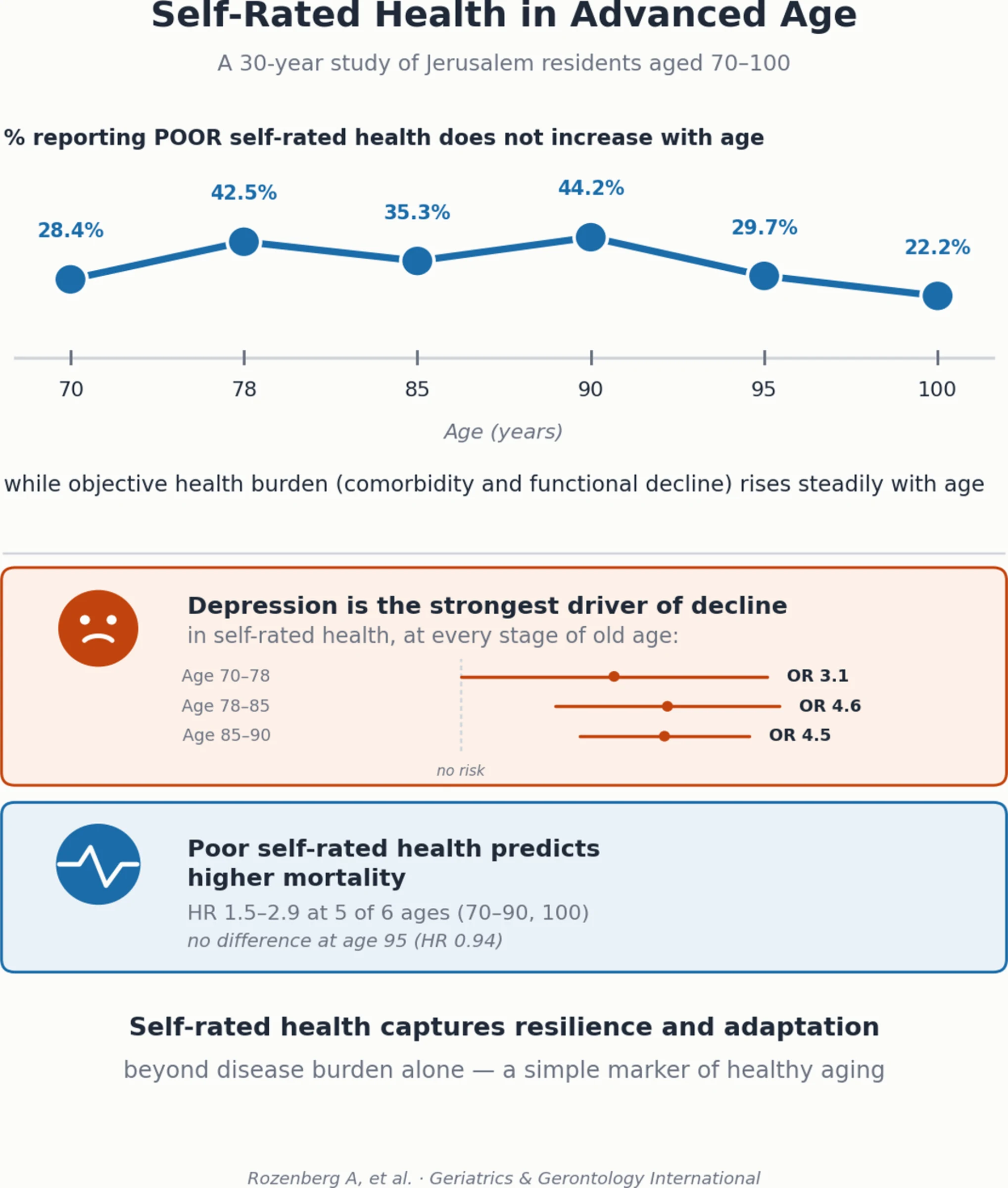
At assessments from ages 70 to 100, 22% to 44% said they did not feel healthy, without a clear trend over time.
Our read
Populations- Studied:
- Cohort study of community-dwelling Jerusalem adults, 1990–2021
- What changed:
- Poor self-rated health ranged from 22% to 44%, with no clear trend as people aged
- The catch:
- Comparisons at age 100 included only survivors, leaving out people who died earlier
- Why it’s aging research:
- It looks at how biology varies with age or lifespan.
Editor of record: Boris Djordjevic · AgingResearch.News
Community-dwelling Jerusalem adults born in 1920–1921 were assessed between ages 70 and 100 in a cross-sectional and longitudinal observational study spanning 1990–2021. Assessments included 604 people at 70, 1,024 at 78, 1,222 at 85, 729 at 90, 508 at 95 and 205 at 100. A “no” answer to “Do you feel healthy?” counted as poor self-rated health.
Poor ratings showed no clear trend with age. Depression was consistently the strongest factor linked to worsening ratings, with 3–4.6 times the risk compared with people without depression. Poor ratings were linked to shorter life expectancy after adjustment for known risk factors. People with good ratings and a high burden of disease lived longer than those with poor ratings and a low disease burden.
Why it matters
The authors interpreted the results as supporting the idea that perceived health reflects resilience and adaptation in later life, beyond disease burden alone.
Caveats
People with good and poor health ratings may have differed in ways the risk-factor adjustments did not capture. The findings concern one community-dwelling Jerusalem birth cohort, and comparisons at age 100 included only people who survived that long.
Where the evidence stands
Physical inactivity
- 223 independent labs in 56 countries
- 8 findings against
- Funders: National Institute on Aging and others
- 7 of 346 findings with company ties
The paper
Faculty of Medicine Hebrew University of Jerusalem
Geriatrics & Gerontology International, Nov 6, 2026
Comments
Be the first to comment.