Canagliflozin linked to urine protein shifts in kidney disease
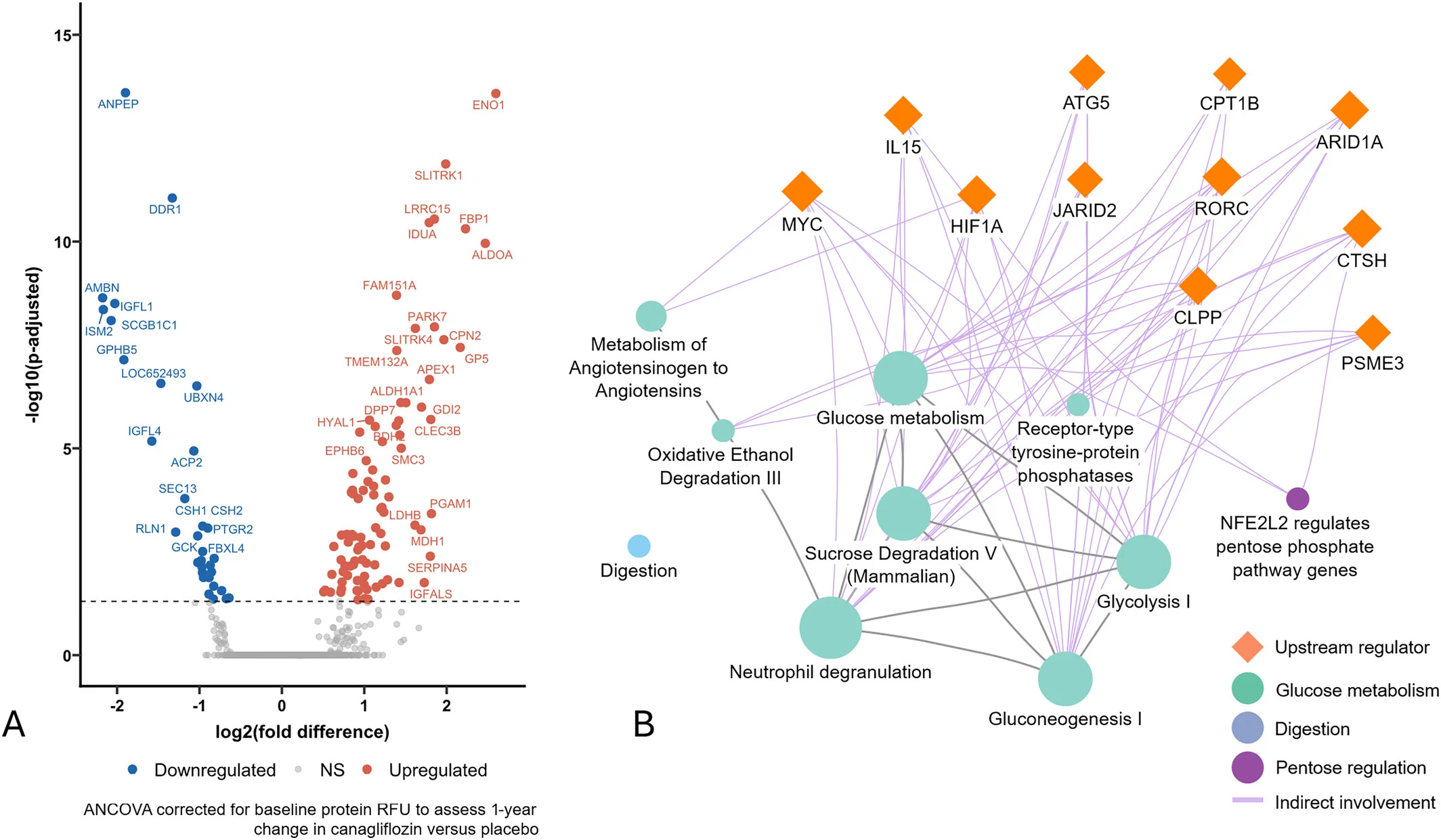
After one year, 124 urinary proteins changed with canagliflozin compared with placebo in people with type 2 diabetes and chronic kidney disease.
Our read
Interventions- Studied:
- Case-control study of 337 patients with type 2 diabetes and CKD, 1 year, against placebo
- What changed:
- Urine levels of 124 proteins changed with canagliflozin compared with placebo
- The catch:
- Protein measurements could be distorted by nonspecific aptamer binding and probe cross-reactivity
- In the record:
- The 49th paper on canagliflozin with results in people; 183 on record in all.
Editor of record: Boris Djordjevic · AgingResearch.News
Urine samples from 392 people with type 2 diabetes and chronic kidney disease were analyzed in a nested case–control study within the randomized, placebo-controlled CREDENCE trial. Participants had been assigned to canagliflozin at 100 milligrams daily or placebo. The analysis compared samples collected at the start and after one year, selecting people with rapid or slow declines in kidney function.
Compared with placebo, canagliflozin was associated with increases in 92 urinary proteins and decreases in 32. Analysis of the protein patterns suggested increased activity in pathways that process nutrients. Separate kidney biopsy data from young people with type 2 diabetes linked drugs in the same class to higher activity of genes involved in metabolism in cells farther along the kidney’s filtering tubes.
Why it matters
For diabetic kidney disease, the authors suggest that shifting the work of recovering sodium to later sections of the kidney’s filtering tubes may contribute to these drugs’ kidney-protective effects.
Caveats
The authors note that the kidney biopsies came from younger people with mostly preserved kidney function, limiting comparisons between their gene activity and the trial participants’ urinary proteins.
Where the evidence stands
Canagliflozin
- 58 independent labs in 19 countries
- 12 findings against
- 100 trials, 50 with no results posted
- Funders: National Institute on Aging and others
- 89 of 291 findings with company ties
- 75 of 100 trials sponsored by its developers
SGLT2 inhibitors
- 711 independent labs in 74 countries
- 423 findings against
- 918 trials, 275 with no results posted
- Funders: National Natural Science Foundation of China and others
- 608 of 3,833 findings with company ties
- 455 of 918 trials sponsored by its developers
From the paper
- Participants
A total of 392 participants with available urine samples from the CREDENCE trial were included in this analysis, 250 participants were treated with canagliflozin and 142 with placebo.
- Limitation
First, this analysis was performed on a selected subset of patients from the CREDENCE trial, limiting the generalizability to broader populations with CKD and Type 2 diabetes.
Quoted word for word from the full text on dom-pubs.onlinelibrary.wiley.com.
The paper
Department of Clinical Pharmacy and Pharmacology University Medical Centre Groningen Groningen the Netherlands
Diabetes, Obesity & Metabolism, Nov 15, 2026, Open access, CC BY-NC
Comments
Be the first to comment.