Even light drinking linked to higher death risk in Korean adults
Light drinkers had higher relative death risk than occasional drinkers over a median 19.2 years, with an adjusted hazard ratio of 1.146.
Our read
Populations- Studied:
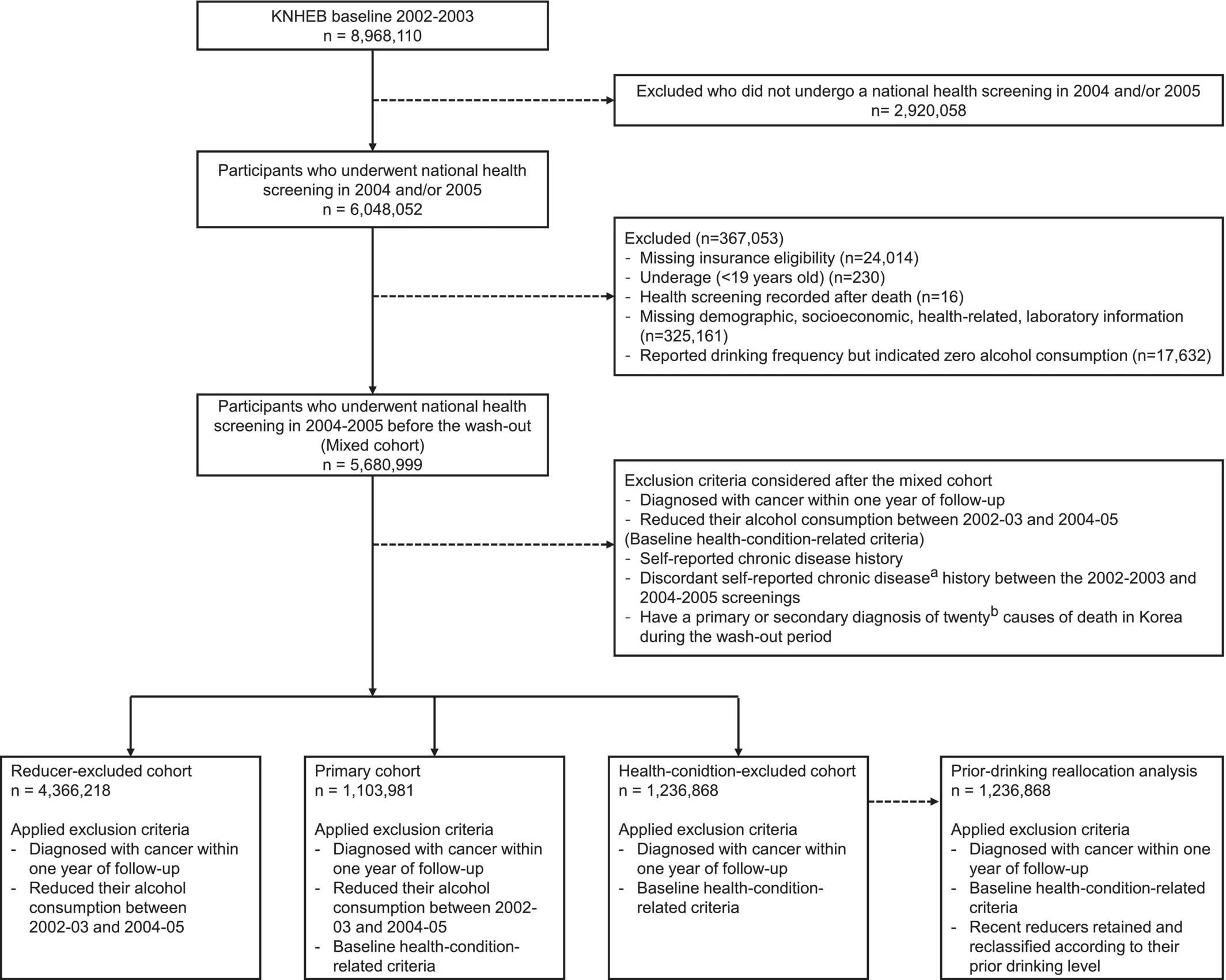
- Cohort study of 1,103,981 Korean adults, median 19.2 years, against occasional drinkers (Dose-response)
- What changed:
- Death from any cause was higher among light drinkers than occasional drinkers (adjusted hazard ratio 1.146)
- The catch:
- Binge drinking and social connectedness could confound the mortality comparison
- In the record:
- The 999th paper on alcohol with results in people; 2,879 on record in all. Its result on mortality agrees with 36 of 50 other findings on record; 12 point the other way and 2 found no change.
Editor of record: Boris Djordjevic · AgingResearch.News
Korean adults—1,103,981 people in the primary analysis—were followed for a median 19.2 years in a prospective nationwide cohort study. The analysis excluded people with major disease histories, those who had reduced their drinking since a previous screening and those diagnosed with cancer within the first year. Researchers used occasional drinkers as the comparison group because they could not separate lifelong abstainers from former drinkers.
Among drinkers, higher alcohol intake was associated with higher death risk overall, from cancer and from alcohol-related diseases. Light drinkers reported an average of 8.9 grams of alcohol daily, compared with 2.6 grams among occasional drinkers. The researchers adjusted for age, sex, income, residence, smoking and exercise. Estimates for abstainers varied across analyses.
Why it matters
The study addressed whether low-level drinking is linked to longer survival, a question relevant to health in later life. The authors concluded that the findings did not support viewing low-level drinking as protective.
Caveats
The authors note that unmeasured differences in binge drinking or social connections could have influenced the associations. The primary cohort excluded people with histories of 20 major diseases and people who had reduced drinking, limiting applicability to those groups.
Where the evidence stands
Alcohol
- 526 independent labs in 75 countries
- 150 findings against
- 1 trial
- Funders: National Institutes of Health and others
- 75 of 1,213 findings with company ties
- 1 of 1 trial sponsored by its developers
From the paper
- Participants
After applying the strict baseline exclusion criteria, 1 103 981 participants were included in the primary analytic cohort.
- Follow-up
During a median follow-up of 19.2 years (interquartile range, IQR = 18.7–19.5 years), 50 429 participants (4.6%) died from all causes.
- Result
Compared with occasional drinkers, a J-shaped association was also observed for all-cancer mortality, although the aHR for abstainers was not statistically significant (aHR = 1.038, 95% CI = 0.985–1.095).
- Limitation
To our knowledge, this study is among the most stringent observational investigations to examine the long-term association between alcohol consumption and mortality while explicitly attempting to reduce sick-quitter bias.
Quoted word for word from the full text on onlinelibrary.wiley.com.
The paper
Institute of Health and Environment Seoul National University Seoul Republic of Korea
Addiction, Nov 9, 2026, Open access, CC BY-NC
Comments
Be the first to comment.