High homocysteine induces aging-like brain changes in mice
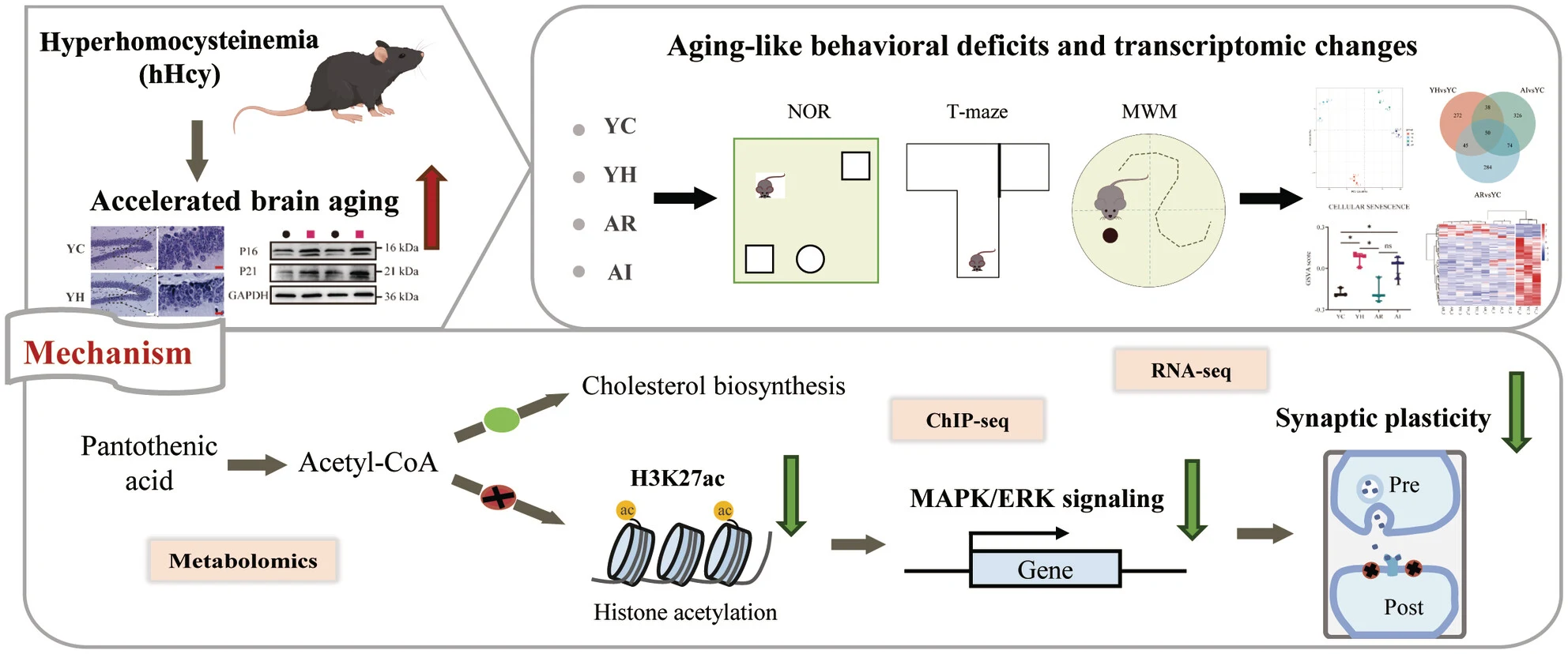
Young male mice fed a diet containing 2% methionine for eight weeks developed memory deficits and molecular changes resembling features of brain aging.
Our read
Mechanisms- Studied:
- Experiments in young male C57BL/6 mice, 8 weeks, against young mice fed a standard diet (Randomized)
- What changed:
- Young mice fed a high-methionine diet had worse learning and memory than young mice fed a standard diet
- The catch:
- The high-methionine diet could affect brain function independently of homocysteine
- In the record:
- One of 10 papers on vorinostat on record: 3 with results in people, 6 in animals. Its result on cognitive function agrees with all 3 other findings on record.
Editor of record: Boris Djordjevic · AgingResearch.News
Eight-week-old male C57BL/6 mice were randomly assigned in an animal experiment to standard food or a diet containing 2% methionine for eight weeks, with 15 mice per group. The high-methionine diet raised homocysteine, a molecule involved in metabolism, in blood and brain and impaired memory.
The mice's behavior resembled that of cognitively impaired 19-month-old mice. Their gene activity patterns converged with those of older mice that retained cognitive function. In the hippocampus, a brain region involved in memory, the diet reduced histone H3 lysine 27 acetylation, a chemical tag on DNA-packaging proteins. This coincided with weaker activity in a signaling pathway involved in learning and memory. A drug that restored these tags reversed molecular and behavioral deficits, supporting a causal role for the tags' loss.
Why it matters
Brain aging involves changes in how genes are regulated. The authors suggest that maintaining this chemical tag may help preserve the resilience of connections between nerve cells.
Caveats
The authors note that the absence of control human brain samples limited validation in humans. The dietary experiment used young male mice.
Where the evidence stands
Vorinostat
- 7 independent labs in 3 countries
- 256 trials, 86 with no results posted
- Funders: National Natural Science Foundation of China and 8 more
Epigenetic regulation of gene expression
- 49 independent labs in 19 countries
- 1 finding against
- Funders: National Institutes of Health and others
- 8 of 60 findings with company ties
From the paper
- Limitation
First, the absence of control human brain samples limits our clinical validation.
Quoted word for word from the full text on onlinelibrary.wiley.com.
- Vorinostat
- Epigenetic regulation of gene expression
- Histone modification and chromatin remodeling
- Cognitive impairment
- H3K27ac
- Mice
The paper
Shanxi Medical University
Aging Cell, Nov 24, 2026, Open access, CC BY


Comments
Be the first to comment.