Immune cells may link aging and osteoporosis in humans
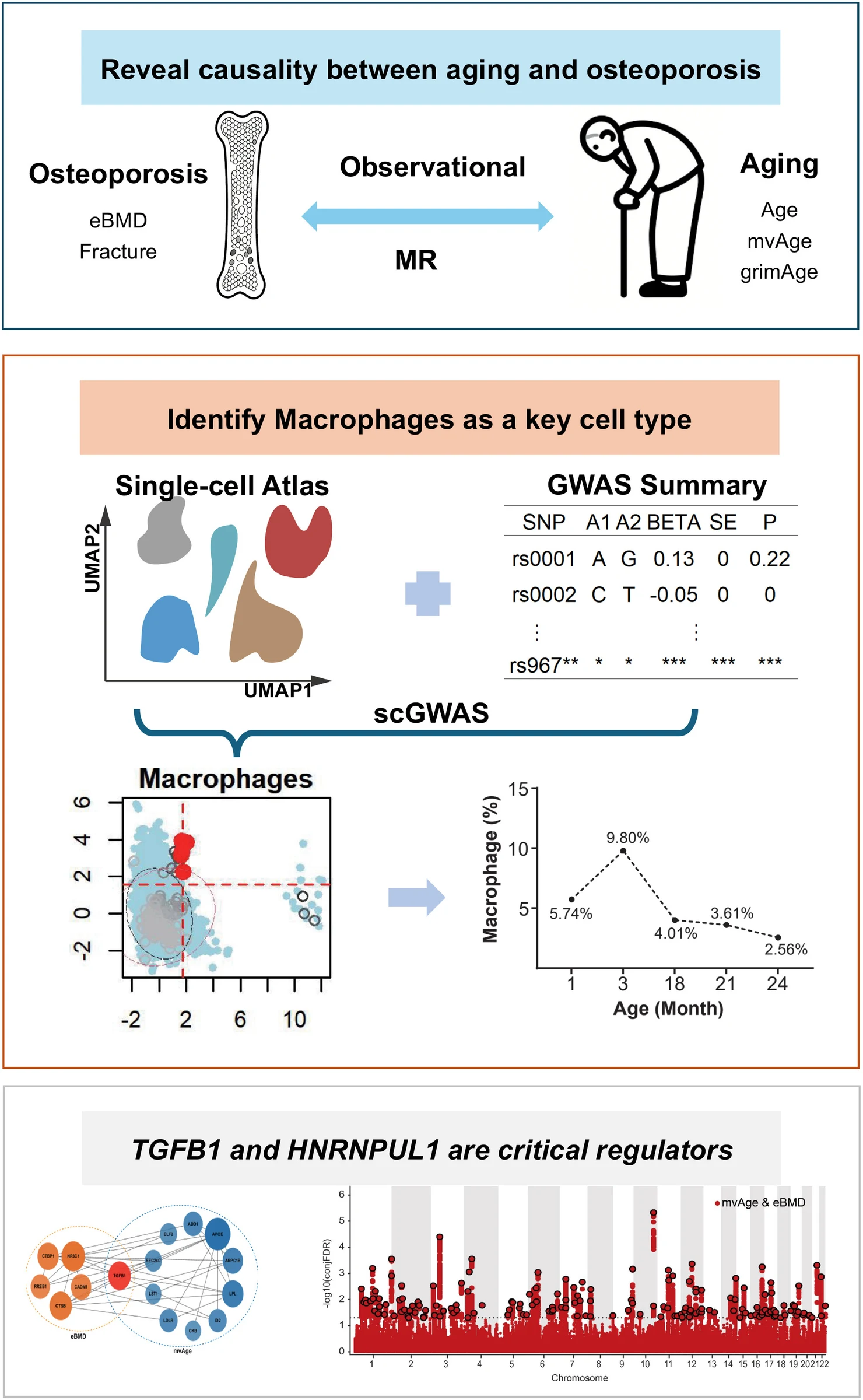
An observational analysis of 278,164 UK Biobank participants and analyses of human genetic data linked aging and osteoporosis-related traits in both directions.
Our read
Mechanisms- Studied:
- Computational study of human participants and bone marrow cells (Independent replication)
- What changed:
- Macrophages were linked to both aging and bone density; human validation linked macrophages most strongly to aging
- The catch:
- Macrophage associations relied on cell-population averages rather than individual-cell gene expression
- Why it’s aging research:
- It looks at how biology varies with age or lifespan.
Editor of record: Boris Djordjevic · AgingResearch.News
Among 278,164 UK Biobank participants, an observational analysis linked older age to lower heel bone density. People with lower density or a fracture history had lower survival rates. The work investigated osteoporosis, a condition that weakens bones.
A Mendelian randomization analysis, which uses genetic variants, linked aging measures and osteoporosis-related traits in both directions. Combining human genetic data with gene activity measured in individual mouse cells pointed to macrophages, a type of immune cell, as possible links. A separate analysis of human bone marrow data associated macrophages most strongly with an aging measure. In two mouse bone marrow datasets, the share of macrophages decreased with age. The authors proposed that these cells help connect aging and osteoporosis.
Why it matters
Osteoporosis is an age-related disorder. The proposed role for immune cells offers a focus for investigating how bone loss connects with the wider aging process.
Caveats
The proposed cell mechanism came from genetic and gene-activity associations, not experiments testing whether changing macrophages alters bone loss. The age-related decrease in their share was measured in mouse bone marrow, not people.
Where the evidence stands
TGFB1
- 57 independent labs in 22 countries
- 1 finding against
- 2 trials, 1 with no results posted
- Funders: National Natural Science Foundation of China and others
- 7 of 71 findings with company ties
- 2 of 2 trials sponsored by developers of drugs aimed at it
From the paper
- Result
Specifically, using IVW estimates as the primary metric, higher genetically determined GrimAge (aging) was associated with lower eBMD (OR = 0.96, 95% CI = 0.95–0.97) and higher fracture risk (OR = 1.03, 95% CI = 1.01–1.05).
Results, 3.1 A Bilateral Relationship Between Aging and BMD/Fracture
- Limitation
First, integrating GWAS summary statistics with single-cell sequencing data using methods such as sc-eQTL analysis would strengthen the validity of our observations.
Quoted word for word from the full text on onlinelibrary.wiley.com.
The paper
Suzhou Laboratory of Precision Health and Data Science The Second Affiliated Hospital of Soochow University Suzhou Jiangsu China
Aging Cell, Nov 6, 2026, Open access, CC BY

Comments
Be the first to comment.