More RNA from jumping DNA was not linked to shorter life in flies
Experiments in three fruit fly species challenged the idea that jumping DNA concentrated on the Y chromosome helps explain males’ shorter lives.
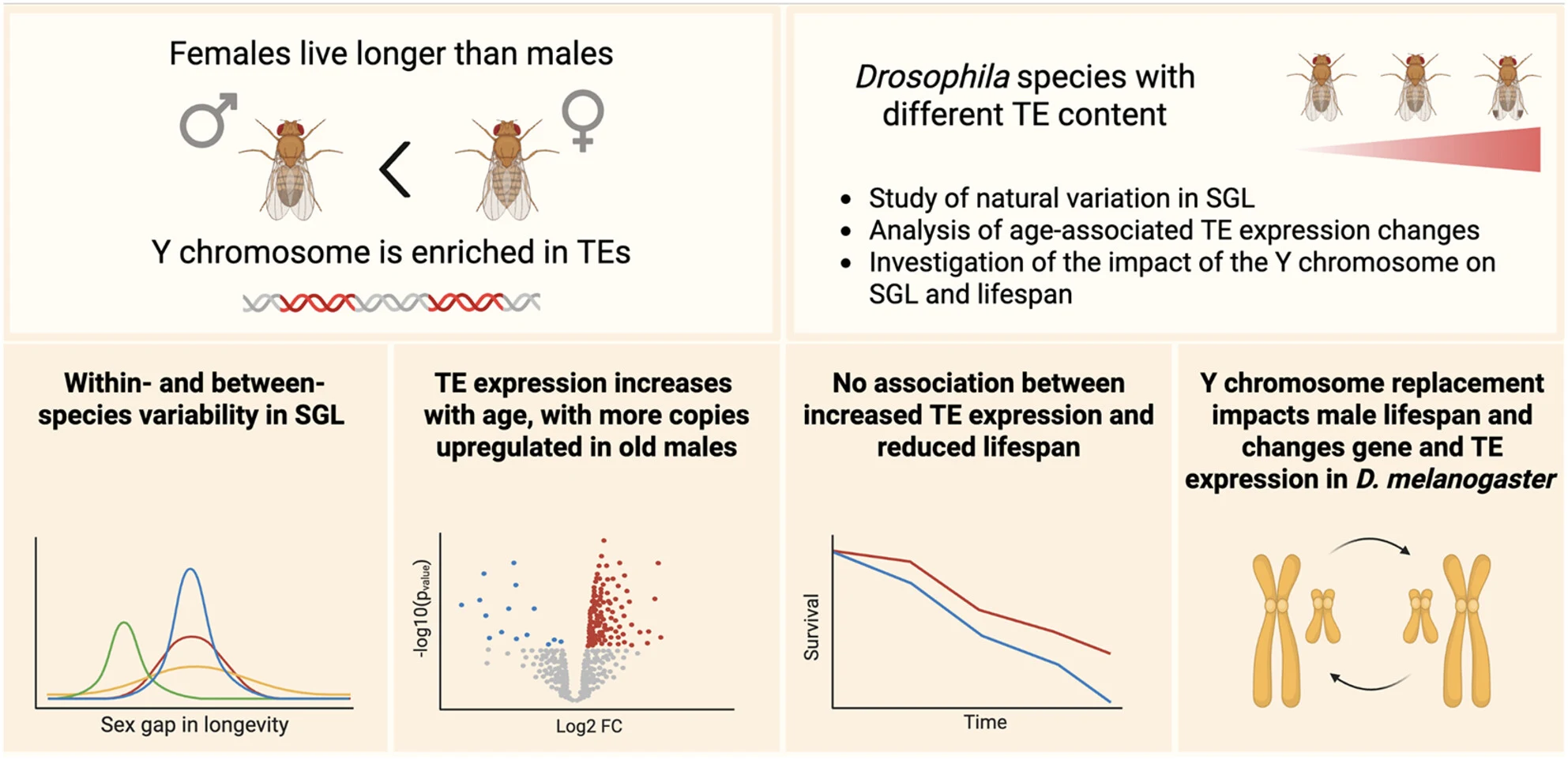
Our read
Mechanisms- Studied:
- Experiments in male and female Drosophila flies
- What changed:
- Higher RNA levels from jumping DNA were not consistently linked to shorter male lifespan across fly strains
- The catch:
- Different sampling ages for older males and females could distort RNA comparisons
- Why it’s aging research:
- Lifespan, survival or healthspan.
Editor of record: Boris Djordjevic · AgingResearch.News
Fruit flies from three species—Drosophila melanogaster, D. simulans and D. suzukii—underwent laboratory experiments. Researchers compared lifespan in 277 strains, using 50 males and 50 virgin females per strain. They measured ribonucleic acid (RNA), molecules copied from DNA, in six inbred strains.
Transposable elements, or “jumping DNA,” are sequences that can move within a genome. Their RNA output rose with age in D. melanogaster and D. suzukii, but not D. simulans, without an overall sex difference. Older males nevertheless had more individual jumping-DNA copies with increased output than older females. Higher output was not linked to shorter lifespan. Swapping Y chromosomes between D. melanogaster strains progressively shortened male lifespan in a strain-specific way, alongside increased jumping-DNA output and changes in gene activity.
Why it matters
The authors suggest that jumping DNA may matter less for sex differences in lifespan in species with little of it. They suggest Y chromosome effects depend more on variation in its tightly packed DNA and interactions between genes than on jumping-DNA abundance.
Caveats
The RNA measurements did not establish whether jumping DNA moved to new locations. They came from two inbred strains per species, with older sampling ages varying across strains.
Where the evidence stands
Chromatin and 3D genome organization
- 58 independent labs in 23 countries
- 2 findings against
- Funders: National Institutes of Health and others
- 12 of 87 findings with company ties
Transposable element activity
- 41 independent labs in 18 countries
- Funders: National Institute on Aging and others
- 12 of 62 findings with company ties
From the paper
- Result
In addition, lifespan differed significantly between the two strains in both males and females (Log-Rank test, p < 0.001 for each sex; hazard ratio = 0.24, 95% CI [0.18, 1.35] for males; hazard ratio = 0.58, 95% CI [0.46, 0.74] for females) (Figure 5C).
Quoted word for word from the full text on onlinelibrary.wiley.com.
- Y chromosome replacement
- Chromatin and 3D genome organization
- Transposable element activity
- TE-derived reads
- Transposable element expression
- Flies
The paper
Exploring the Role of Transposable Elements to Sex Gap in Longevity in Three Drosophila Species
UMR5558 Université Claude Bernard Lyon 1 Villeurbanne Rhône-Alpes France
Aging Cell, Nov 3, 2026, Open access, CC BY

Comments
Be the first to comment.