Heart rate changes had sex-specific links to irregular heartbeat
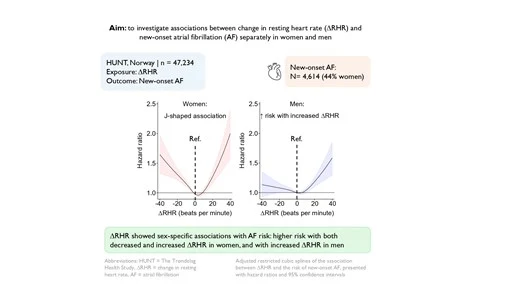
Women whose resting heart rate rose by more than 12 beats per minute had a 33% higher relative risk of atrial fibrillation than those whose rates stayed stable.
Our read
Populations- Studied:
- Cohort study of 47,234 Norwegian adults, against people with maintained resting heart rate
- What changed:
- Atrial fibrillation risk was higher with resting heart-rate increases >12 bpm versus stable rates: 33% in women, 17% in men
- The catch:
- Underlying health changes could contribute to both resting heart rate changes and atrial fibrillation risk
Editor of record: Boris Djordjevic · AgingResearch.News
Among 47,234 Norwegian adults, a longitudinal observational study linked changes in resting heart rate to the risk of developing atrial fibrillation, an irregular heartbeat. Participants attended two or three Trøndelag Health Study surveys between 1995 and 2017. During follow-up, 4,614 developed atrial fibrillation.
Compared with a maintained resting heart rate, decreases were associated with a 21% higher relative risk in women. Increases exceeding 12 beats per minute were associated with a 33% higher relative risk in women and a 17% higher risk in men. Women had the lowest risk when their starting heart rate was moderate and remained stable. In men, higher risk was primarily observed among those with a low starting heart rate.
Why it matters
Following heart rate over time addresses how atrial fibrillation risk develops as adults age, and whether the patterns differ between women and men.
Caveats
The longitudinal analysis leaves open whether underlying health changes contributed to both heart rate changes and atrial fibrillation risk. The findings concern Norwegian adults and may not apply equally to other populations.

Comments
Be the first to comment.