Menopause transition disrupts psychosis-linked circuits in animals
An animal study found that a brain region disrupted dopamine system function during the menopause transition, but no longer exerted this influence afterward.
Our read
Mechanisms- Studied:
- Experiments in animals undergoing the menopause transition, against animals after menopause
- What changed:
- Brain overactivity disrupted dopamine system function during perimenopause; this influence was absent after menopause
- The catch:
- Dopamine circuit dysfunction is a proxy for psychosis, not a measure of psychotic symptoms
Editor of record: Boris Djordjevic · AgingResearch.News
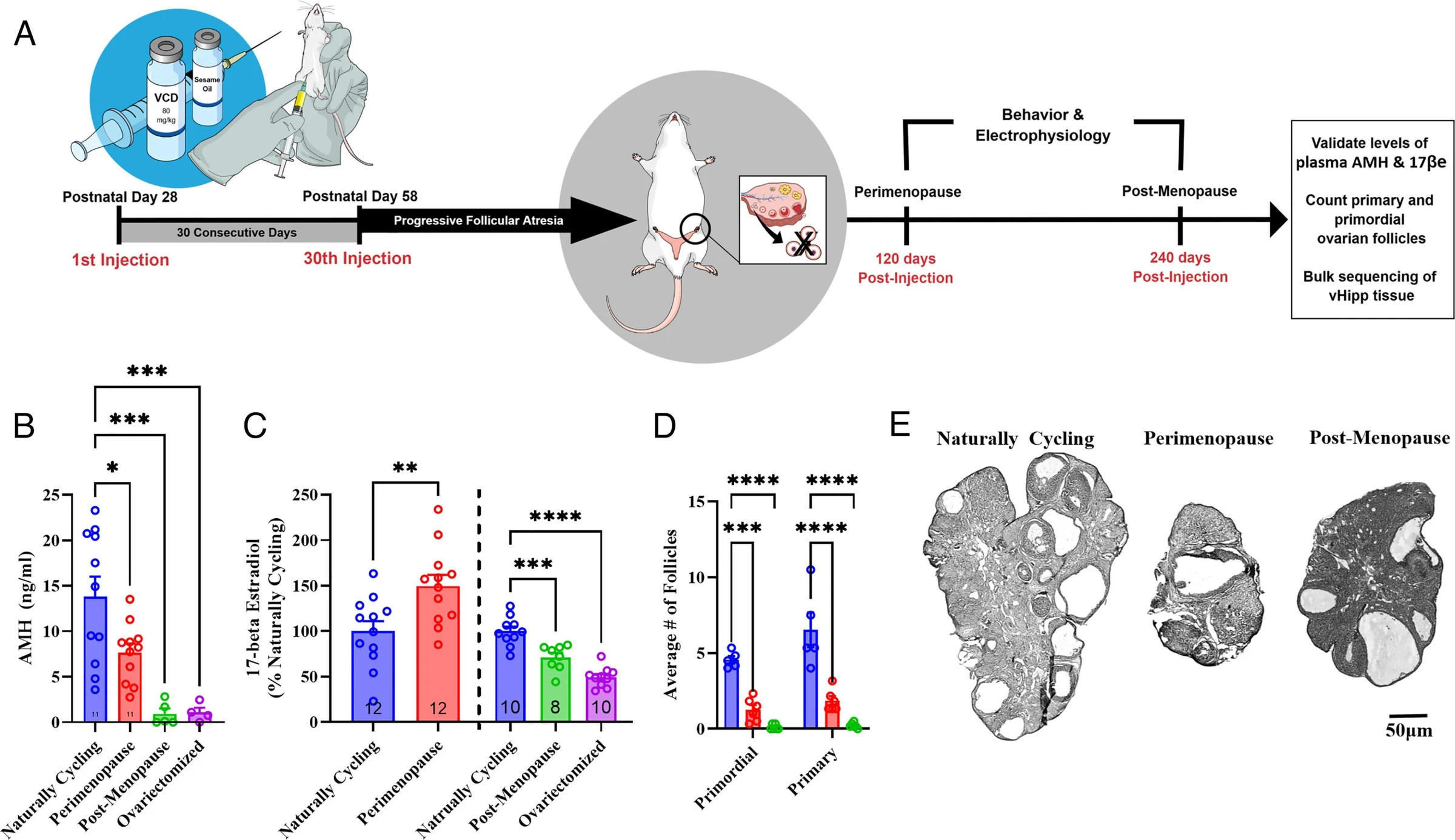
Animals undergoing the gradual transition to menopause developed temporary overactivity in the ventral hippocampus, a brain region, in a study examining reproductive aging. The researchers studied a pathway connecting this region to a dopamine system implicated in psychotic symptoms. Dopamine is a chemical that nerve cells use to communicate.
During perimenopause, the transition toward menopause, hippocampal overactivity drove dysfunction in that dopamine system. This influence was absent after menopause. The authors concluded that the hormonal transition itself, rather than persistently low levels of the hormone estrogen afterward, triggered the circuit instability. They contrasted this with the “estrogen protection hypothesis,” which attributes vulnerability primarily to low hormone levels.
Why it matters
Reproductive aging may involve distinct windows of psychiatric vulnerability. The authors propose that distinguishing these stages could guide psychiatric interventions tailored to the stage of menopause.
Caveats
Brain circuit findings in animals leave open whether the same transition-specific disruption occurs in women.
Where the evidence stands
Sex hormone signaling (estrogen, androgen)
- 19 independent labs in 8 countries
- Funders: National Research Foundation of Korea and others
- 1 of 22 findings with company ties
Synaptic transmission
- 110 independent labs in 29 countries
- 3 findings against
- Funders: National Institutes of Health and others
- 10 of 144 findings with company ties
- Sex hormone signaling (estrogen, androgen)
- Synaptic transmission
- Menopause
- Psychosis
- Perimenopause
- Postmenopause
The paper
A circuit mechanism for psychosis vulnerability during perimenopause
University of Texas San Antonio
PNAS, Nov 17, 2026, CC BY


Comments
Be the first to comment.