Older adults had weaker brain fluid flow waves during sleep
Nighttime scans of 31 young and 41 older adults linked reduced fluid flow to weaker waves of brain activity and blood-volume change.
Our read
Mechanisms- Studied:
- Cross-sectional study of young and older adults, against younger adults
- What changed:
- Brain fluid wave power rose less from wakefulness to sleep in older adults: 1.15 dB against 3.82 dB in younger adults
- The catch:
- Blood pressure, hydration and sleep deprivation history were unmeasured and could affect fluid flow
Editor of record: Boris Djordjevic · AgingResearch.News
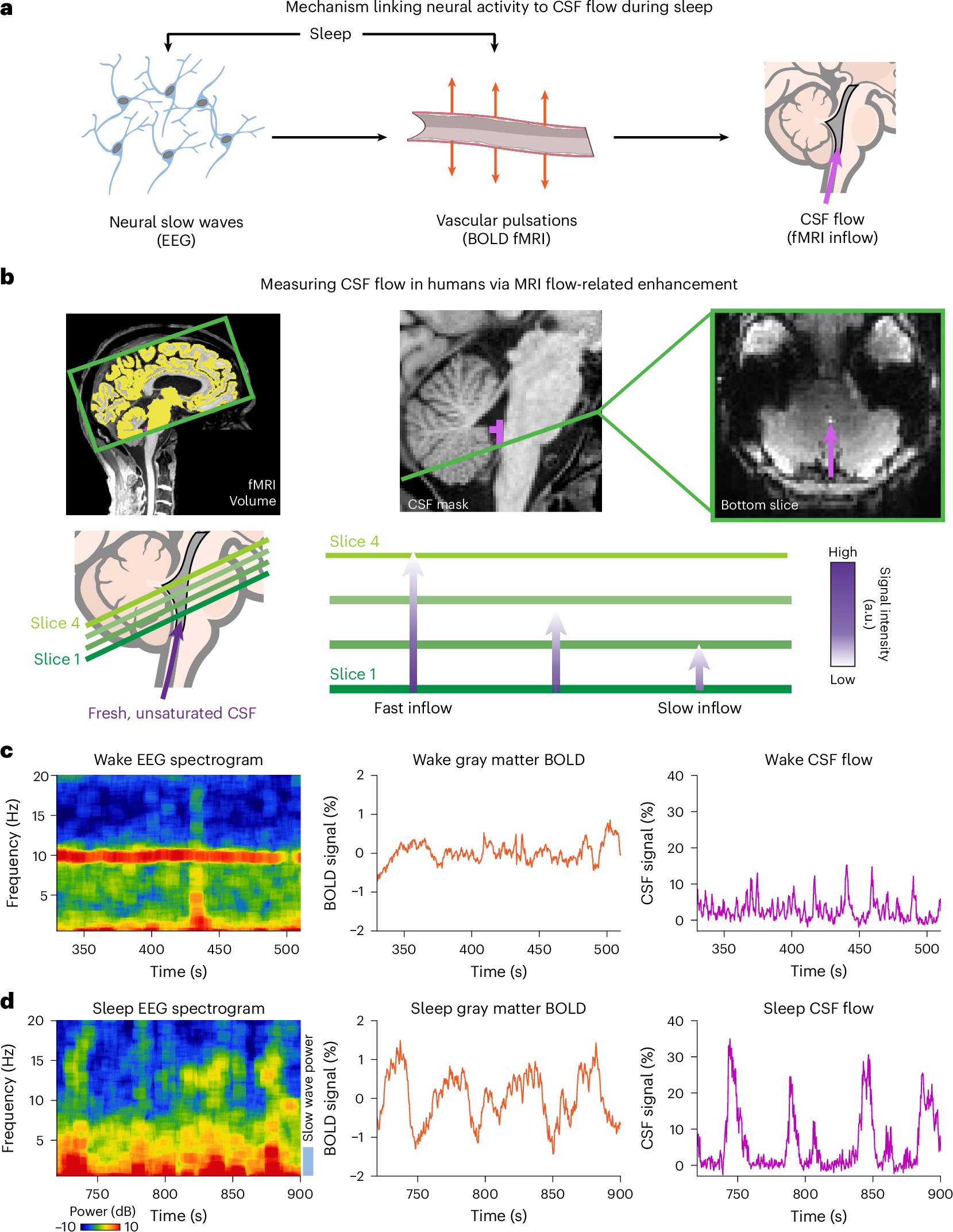
Adults aged 18–39 (31 people) and 60–84 (41 people) underwent nighttime brain scans and recordings of brain electrical activity in an age-group comparison. The scans measured cerebrospinal fluid, the liquid around the brain and spinal cord, flowing into the scanned area. Separate daytime experiments used a flickering checkerboard and breath-holding to probe fluid flow responses.
Older adults had weaker fluid flow waves during sleep without rapid eye movements. Reduced flow was linked to weaker slow brain-wave activity, smaller waves of blood-volume change and less gray matter, brain tissue rich in nerve cell bodies. The age difference in flow was greater during sleep than during wakefulness.
Why it matters
Sleep disruption predicts cognitive decline. Changes in brain fluid circulation offer a possible link between sleep loss and poorer brain health with age.
Caveats
The nighttime scans compared age groups rather than following people as they aged, leaving individual changes over time unresolved. The study excluded people with cognitive impairment or neurological or sleep disorders.
The paper
The aging human brain exhibits reduced hemodynamic and cerebrospinal fluid flow waves during sleep
Nature Aging, Nov 13, 2026, Open access, CC BY

Comments
Be the first to comment.