The impact of frailty syndrome on illness acceptance and treatment adherence in older patients with rheumatoid arthritis: a cross-sectional study
Abstract
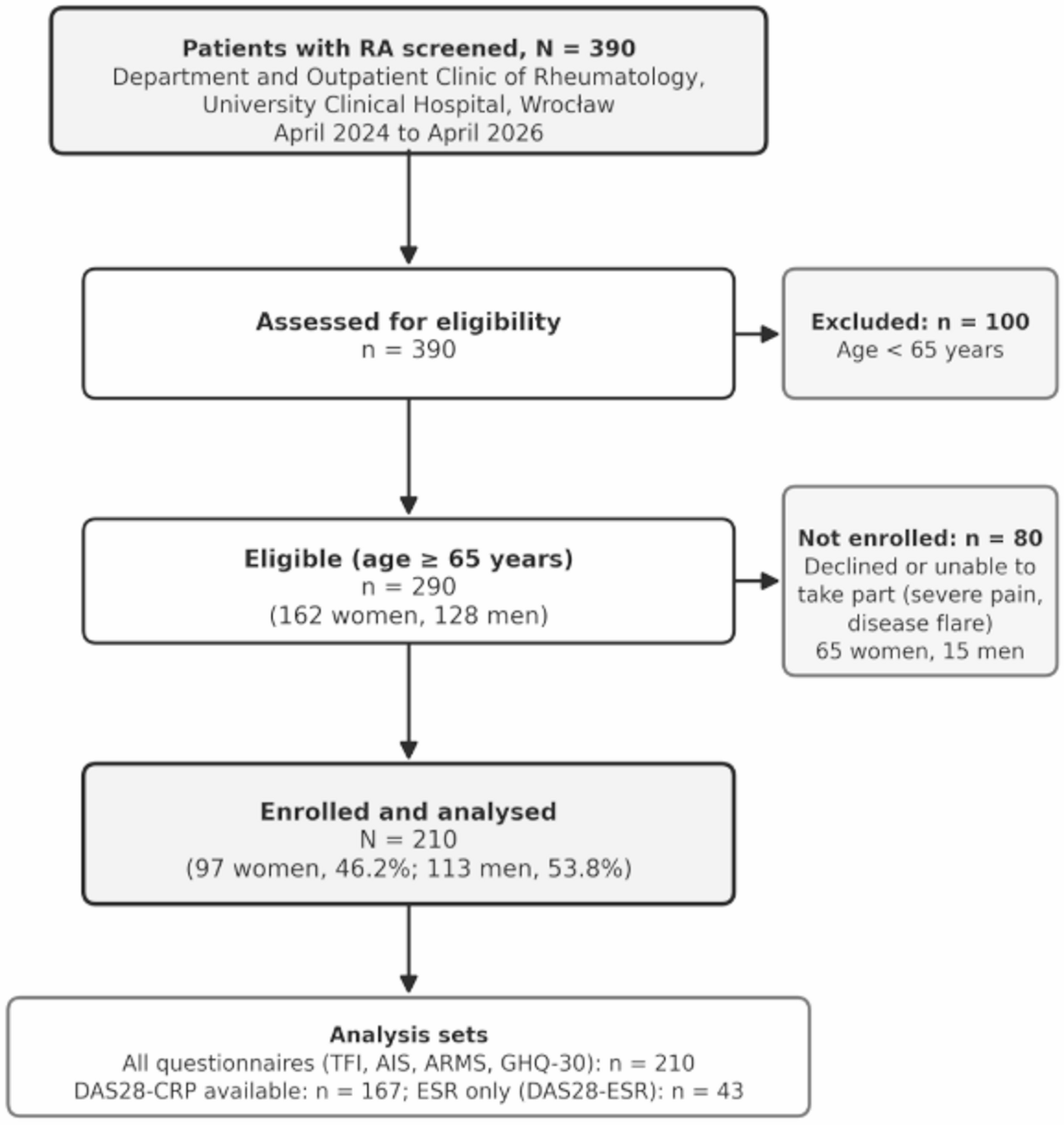
Rheumatoid arthritis (RA) in older adults frequently coexists with frailty syndrome, a condition associated with reduced physiological reserve and increased vulnerability to adverse outcomes. However, limited evidence exists regarding the relationship between frailty, illness acceptance, and treatment adherence in this population. This study evaluated associations between frailty syndrome, illness acceptance, and adherence to treatment in older adults with RA, and examined whether psychological distress statistically mediated these relationships. In this single-centre cross-sectional study, 210 community-dwelling patients with established RA aged ≥ 65 years (mean age 71.3 years; 53.8% men) were assessed using the Tilburg Frailty Indicator (TFI; physical, psychological and social domains, with physical frailty covering mobility, balance, strength, fatigue, sensory function and weight loss), Acceptance of Illness Scale (AIS), Adherence to Refills and Medications Scale (ARMS), GHQ-30, and DAS28-CRP. Frailty (TFI ≥ 5) was present in 75.2% of patients and was more frequent in women than men (84.5% vs. 67.3%; p = 0.004). Higher frailty correlated with lower illness acceptance (ρ = -0.342; p < 0.001), higher disease activity (ρ = +0.304; p < 0.001), and greater psychological distress (ρ = +0.190; p = 0.006). Physical frailty showed the strongest correlation with DAS28-CRP (ρ = +0.500; p < 0.001). In multivariable models, frailty (B = -0.34 AIS points per TFI point; p = 0.005) and disease activity (B = -0.29; p = 0.025) were independently associated with lower illness acceptance. Non-adherence was not correlated with frailty bivariately (ρ = 0.11; p = 0.124); after adjustment a small association of opposite sign emerged (B = -0.24; p = 0.012), consistent with a suppression effect. Non-adherence was associated mainly with lower educational attainment (B = -2.20 per educational level; p < 0.001). Psychological distress did not statistically mediate the frailty-acceptance association. In this cross-sectional sample of older adults with RA, higher frailty and higher disease activity were independently associated with lower illness acceptance, and psychological distress did not account for this association. Medication non-adherence was associated primarily with lower educational attainment rather than with frailty. Routine frailty assessment with the TFI, psychosocial and functional support scaled to the frailty profile, and adherence support adjusted to educational level may therefore be useful in this population.
The paper
Scientific Reports, Oct 17, 2026, Open access, CC BY