Faster biological aging linked to aortic valve narrowing
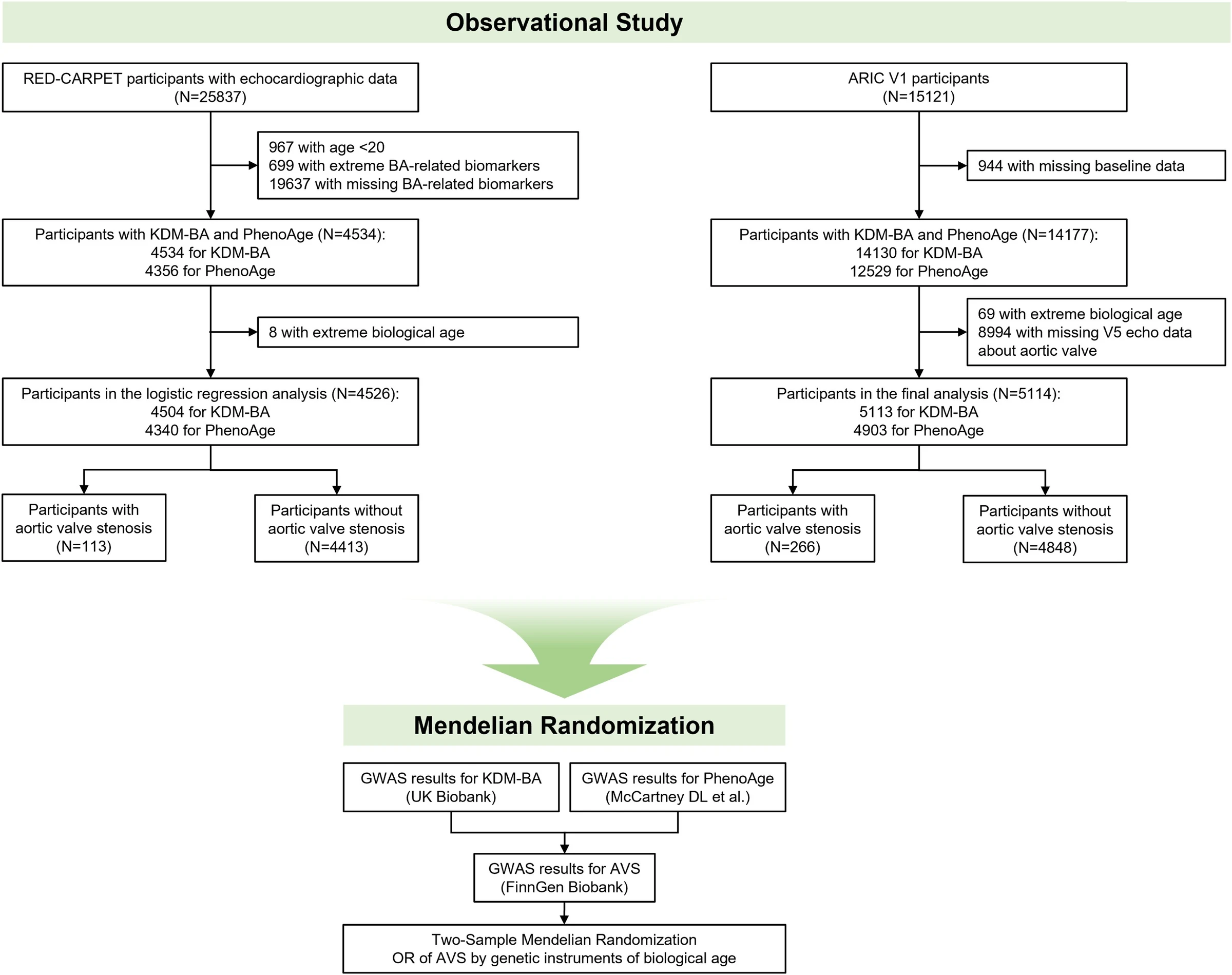
Two observational cohorts of 4,526 and 5,114 adults linked clinical estimates of faster biological aging to higher odds of the heart valve condition.
Our read
Biomarkers- Studied:
- Cohort study of 4,526 adults from RED-CARPET
- What changed:
- Faster biological aging was linked to higher odds of aortic valve narrowing in RED-CARPET (odds ratio 1.29 per standard-deviation increase)
- The catch:
- Valve narrowing could precede accelerated aging; the abstract does not report measurement timing
- In the record:
- The 17th paper on KDM-BA acceleration with results in people; 21 on record in all.
- Why it’s aging research:
- It bears on staying healthy in midlife and later life.
Editor of record: Boris Djordjevic · AgingResearch.News
The 4,526 adults in one observational cohort averaged 60.93 years of age; the 5,114 in the other averaged 51.94. Women made up 33.5% and 56.4%, respectively; 82.3% of the second cohort was White. Researchers used clinical measurements to estimate biological age relative to chronological age. They recorded 113 and 266 cases, respectively, of aortic valve stenosis, a narrowing of the heart’s aortic valve.
Both biological aging measures were associated with higher odds of valve narrowing after adjustment for other factors. For one measure, each standard-deviation increase—a measure of variation—was associated with odds ratios of 1.29 and 1.42, respectively. Values above one indicate higher odds. A Mendelian randomization analysis, which examined genetic differences, also linked that aging measure to valve disease.
Why it matters
Aortic valve stenosis is an age-related disease. The authors suggest that biological aging measures may complement traditional risk factors in identifying people at high risk.
Caveats
Other health differences could partly explain the cohort links. The abstract does not report whether the aging measurements preceded valve narrowing, limiting conclusions about early risk identification.
The paper
The Journal of Nutrition, Health & Aging, Nov 7, 2026, CC BY-NC-ND


Comments
Be the first to comment.