Ultra-processed foods linked to heart failure in US adults
Each additional daily serving was associated with a 5% higher relative risk of heart failure among adults initially free of cardiovascular disease.
Our read
Populations- Studied:
- Cohort study of 6,531 people
- In the record:
- The 142nd paper on ultra-processed foods with results in people; 209 on record in all.
Editor of record: Boris Djordjevic · AgingResearch.News
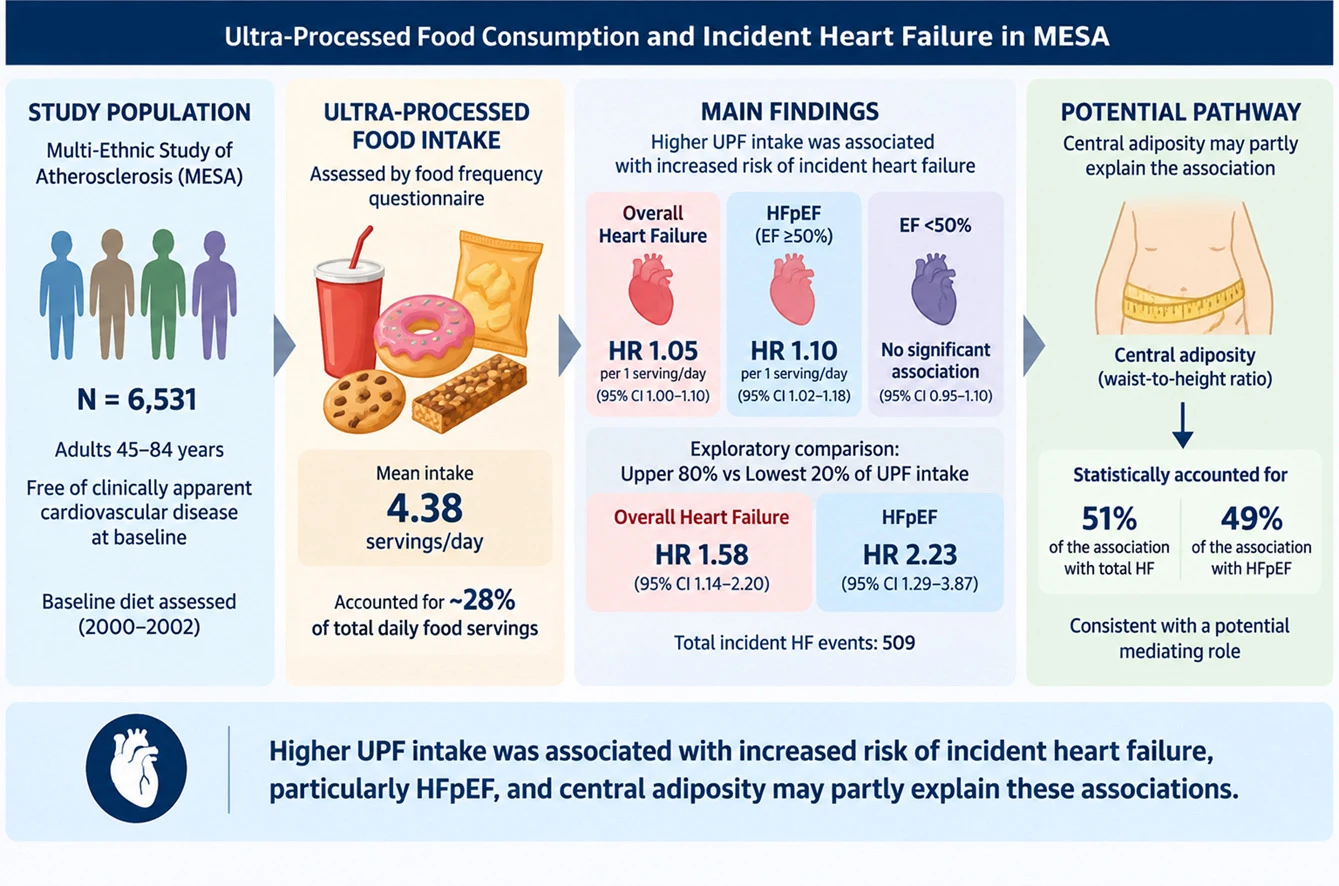
US adults aged 45–84 without cardiovascular disease at enrollment were studied in an observational cohort analysis of 6,531 people. Researchers classified their ultra-processed food intake and examined its association with new cases of heart failure.
Each additional daily serving was associated with a 5% higher relative risk of heart failure after adjustment for other factors. The association was mainly with heart failure with preserved ejection fraction, in which the heart still pumps out a normal share of the blood it holds. There was no statistically significant association with heart failure involving a reduced pumping fraction. Waist-to-height ratio, used to estimate fat around the middle, statistically accounted for approximately 51% of the association with heart failure overall. The authors suggested that obesity-related processes may help link ultra-processed foods to heart failure risk.
Why it matters
For middle-aged and older adults, the findings raise questions about whether changing food choices could affect future heart failure risk.
Caveats
Other eating habits or health differences may have contributed to the association, and the statistical role of waist-to-height ratio does not show that abdominal fat caused the link. The findings concern adults aged 45–84 without cardiovascular disease at enrollment, not people with established disease.
Where the evidence stands
Ultra-processed foods
- 78 independent labs in 26 countries
- 14 findings against
- Funders: National Institutes of Health and others
- 23 of 213 findings with company ties
- Ultra-processed foods
- Heart failure
- Heart failure with preserved ejection fraction
- Waist-to-height ratio
- Heart failure with reduced ejection fraction
- Humans
The paper
JACC Heart Failure, Nov 2026, CC BY



Comments
Be the first to comment.