AADL: a lightweight anti-aliased multi-scale network for CT pulmonary nodule detection
Abstract
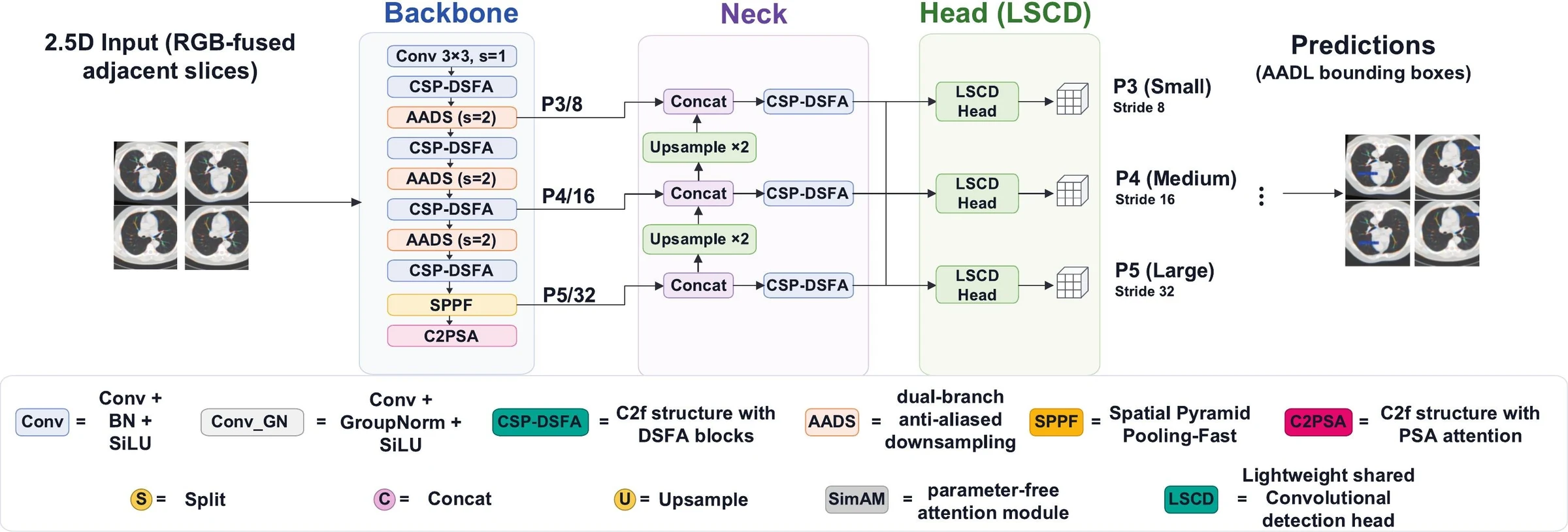
Accurate detection of pulmonary nodules in CT images is important for early lung cancer screening, but remains difficult because nodules vary widely in size, shape, and density. Tiny and low-contrast nodules are particularly challenging, as their weak margins and vessel- or pleura-like appearances often lead to missed detections or false positives. This study proposes AADL, a lightweight pulmonary nodule detector designed to preserve fine details during multi-scale feature extraction. HU normalization and 2.5D slice fusion are first used to incorporate limited inter-slice context into a two-dimensional framework. A CSP-DSFA module with SimAM attention is then introduced to enhance local texture representation and boundary responses for small nodules. To reduce the loss of fine structures during resolution reduction, an anti-aliased downsampling module smooths features before subsampling, replacing conventional strided convolution. A lightweight shared convolutional head is further used to reduce redundant parameters across prediction branches. On LUNA16 and LNDb, AADL achieves mAP@0.5 values of 95.8% and 65.2%, respectively, outperforming the YOLOv11n baseline by 3.7 and 4.4 percentage points while reducing the parameter count to 2.11M. In addition, zero-shot evaluation on the Ali Tianchi dataset shows more stable external performance, suggesting that AADL provides a compact detector with improved cross-domain robustness for CT pulmonary nodule detection.
The paper
Nanjing University of Posts and Telecommunications
Biomedical Signal Processing and Control, 9 Oct 2026, CC BY-NC-ND