Coaching modestly increased steps in adults with limited mobility
At six months, daily steps were 931 higher with coaching than with no intervention, and 571 higher than with text messaging.
Our read
Interventions- Studied:
- Randomized trial in 436 community dwelling adults with mobility limitations, six months (Blinded, registered ACTRN12618001983291)
- What changed:
- Adults receiving coaching averaged 931 more daily steps than the waitlist group at six months
- The catch:
- Knowing the trial’s aims could change participants’ walking while wearing activity monitors
- In the record:
- One of 4 papers on physical activity coaching on record: 2 with results in people.
Editor of record: Boris Djordjevic · AgingResearch.News
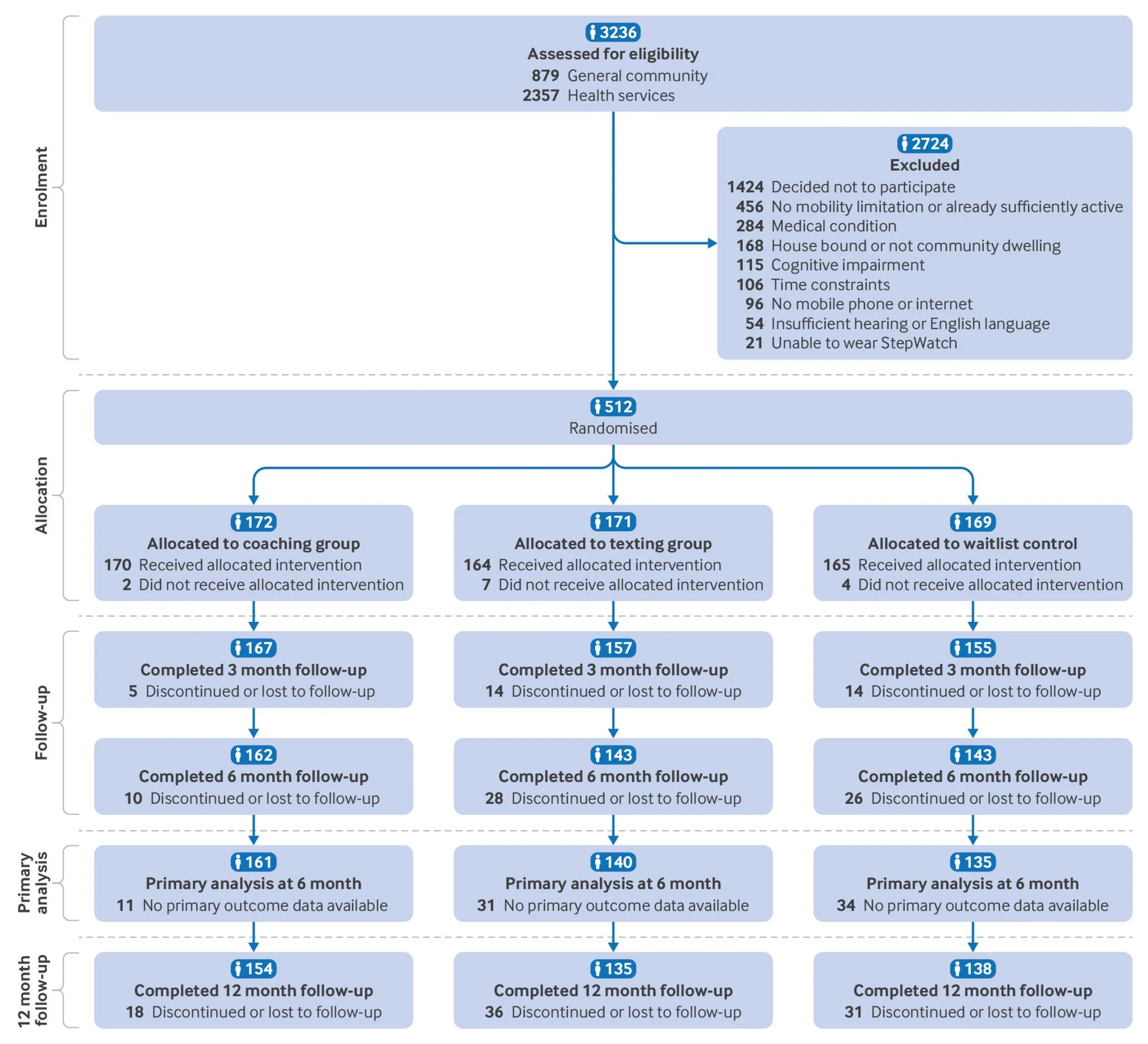
512 community-dwelling adults with self-reported mobility limitations participated in a randomized controlled trial with three groups. Their average age was 69, and 76% were women. They reported difficulty or inability to walk 800 meters but could leave home without another person's physical help.
Participants received six-month multicomponent programs featuring physiotherapist phone coaching every two weeks or regular one-way text messages, or no intervention. At six months, device-measured daily steps were 931 higher with coaching than with no intervention and 571 higher than with texting. Texting's advantage over no intervention was uncertain: the range of likely values included no difference. Adverse events were reported in 11 of 172 coaching participants (6%), seven of 171 texting participants (4%) and 13 of 169 controls (8%). None were serious.
Why it matters
With participants averaging 69 years, the trial addressed how to support physical activity in later life when walking is difficult.
Caveats
The trial included only people able to leave home without another person's physical help. It does not show whether coaching helps people who need that assistance.
Where the evidence stands
Text messaging
- 9 independent labs in 6 countries
- 1 finding against
- Funders: National Cancer Institute and others
- 2 of 20 findings with company ties
Physical activity coaching
- 2 independent labs in 2 countries
- Funders: Comunidad de Madrid and 1 more
From the paper
- Primary outcome
A difference was not detected in mean daily steps between the texting and waitlist groups at six months (between group difference 359 steps, 95% CI -91 to 810 steps; P=0.12).
- Limitation
Secondly, the waitlist control group received the texting intervention at six months, limiting comparisons with a no intervention control at 12 months.
Quoted word for word from the full text on bmj.com.
The paper
The Institute for Musculoskeletal Health
BMJ, Nov 18, 2026


Comments
Be the first to comment.