Muscle-loss categories linked to death risk in dialysis patients
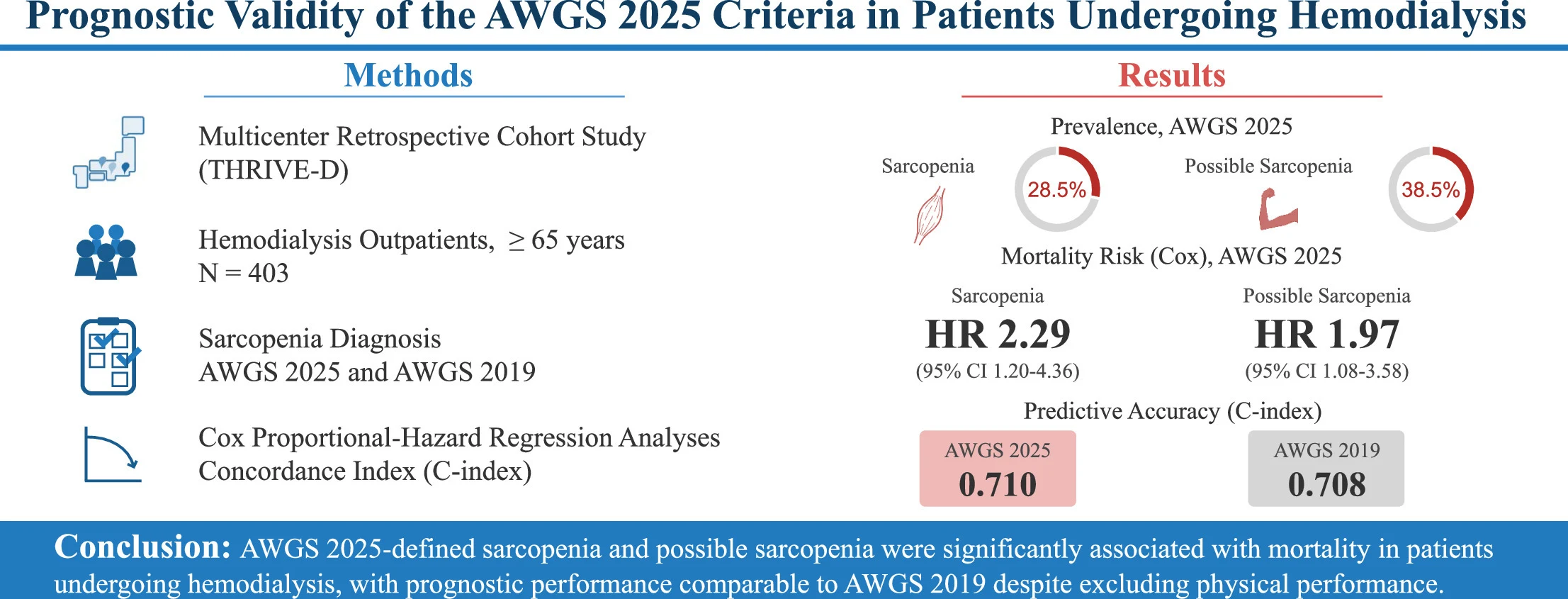
Updated criteria linked sarcopenia and possible sarcopenia to higher mortality in older dialysis patients, with adjusted hazard ratios of 2.29 and 1.97, respectively.
Our read
Biomarkers- Studied:
- Cohort study of 403 older outpatients undergoing hemodialysis, mean 901 days
- What changed:
- Death risk was higher among dialysis patients with sarcopenia (hazard ratio 2.29)
- The catch:
- Patients classified with sarcopenia could have been sicker in other ways despite adjustment
- Why it’s aging research:
- It measures an outcome that worsens with age.
Editor of record: Boris Djordjevic · AgingResearch.News
Among 403 outpatients aged 65 or older receiving hemodialysis, which filters blood through a machine, a retrospective cohort study compared two sets of criteria for sarcopenia, the loss of muscle mass and strength. The Asian Working Group for Sarcopenia’s 2025 criteria excluded physical performance, unlike its 2019 criteria.
Over an average of 901 days, 97 patients (24.1%) died. Sarcopenia and possible sarcopenia under the 2025 criteria were associated with higher mortality after statistical adjustment. Their adjusted hazard ratios—a measure of relative risk over time—were 2.29 and 1.97, respectively. The two sets of criteria had comparable accuracy in predicting death. Poor physical performance remained an independent predictor of mortality. The authors supported continuing to assess it.
Why it matters
Age-related muscle loss is common among people receiving hemodialysis. Evaluating revised diagnostic criteria helps address how clinicians assess survival prospects in this older population.
Caveats
The retrospective analysis could not rule out that patients classified with sarcopenia were already sicker in other ways despite statistical adjustment. The findings concern outpatients aged 65 or older receiving hemodialysis, not younger patients or people without dialysis-dependent kidney disease.
The paper
Hyogo Medical University; Kitasato University
Archives of Gerontology and Geriatrics, Oct 29, 2026, Open access
Comments
Be the first to comment.