Stroke linked to cognitive decline in English adults 50 and older
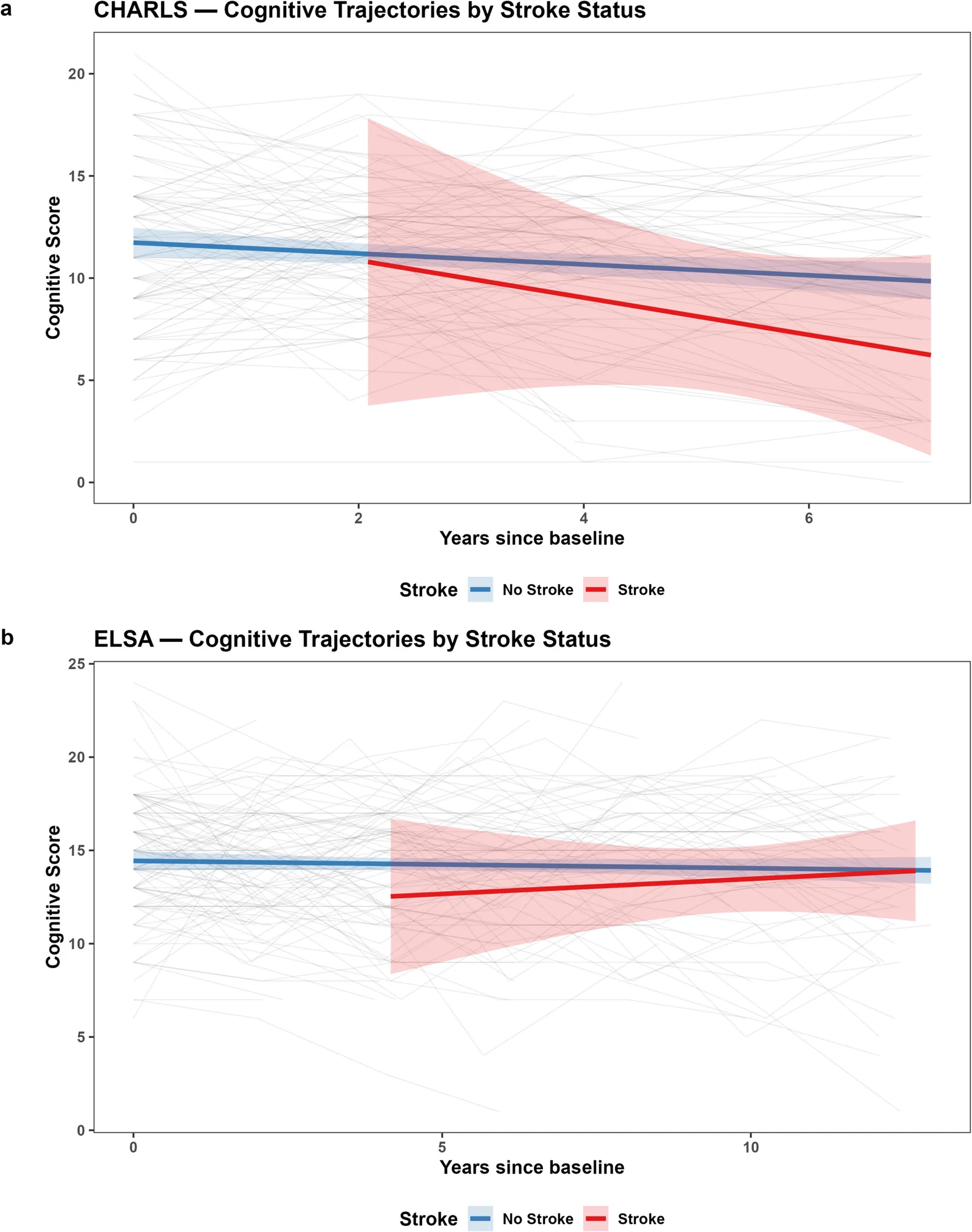
English participants aged 50 and older who reported new strokes declined 0.190 cognitive-test points per year faster than those who remained stroke-free.
Our read
Populations- Studied:
- Cohort study of 5,713 English adults aged 50 and older, against stroke-free participants
- What changed:
- Thinking skills declined approximately 0.19 points per year faster in English stroke survivors than in stroke-free participants
- The catch:
- Cognitive decline could precede stroke; pre-stroke observations were included in the stroke group's decline
- Why it’s aging research:
- Biological age, frailty, function, multimorbidity or death.
Editor of record: Boris Djordjevic · AgingResearch.News
Chinese adults aged 45 and older (11,569; 52.0% women) and English adults aged 50 and older (5,713; 55.2% women) took part in an observational cohort analysis. None reported a stroke at baseline. Follow-up lasted up to 7.2 years in China and 13.0 years in England. Tests assessed word recall and awareness of the date; Chinese participants also copied a drawing.
Stroke was associated with an additional decline of 0.068 test points per year in China and 0.190 in England compared with remaining stroke-free, after adjustment for health and demographic factors. In England, higher family-connection scores—measuring contact with children, relatives and friends—were associated with less stroke-related decline. The corresponding pattern for support from children and grandchildren in China was not statistically significant.
Why it matters
Cognitive health after stroke is a concern as people age. The authors called for investigating social relationships as a potentially modifiable factor in post-stroke cognitive health.
Caveats
Health or social differences not captured by the analysis could have contributed to the associations. After matching stroke and stroke-free participants on measured characteristics, the stroke–decline link remained statistically significant in England but weakened and was no longer statistically significant in China; the English test of whether family connections moderated that link also no longer reached statistical significance.
From the paper
- Result
… stroke was associated with significantly faster cognitive decline in both cohorts (CHARLS: β = −0.068 points/year, 95% CI − 0.123 to − 0.013, p = 0.016; ELSA: β = −0.190, 95% CI − 0.229 to − 0.152, p < 0.001); after propensity-score matching …
- Limitation
First, reliance on self-reported stroke status and social support introduces potential reporting bias.
Quoted word for word from the full text on link.springer.com.
The paper
Tongji Hospital
BMC Public Health, Aug 6, 2026, Open access


Comments
Be the first to comment.