Program did not cut complications after bowel cancer surgery
Complications occurred in 47.5% of the preparation group versus 45.0% receiving standard care in a randomized trial of adults undergoing colon and rectal cancer surgery.
Limit: Complications were assessed without blinding, allowing treatment knowledge to influence their recording
Edited by Boris Djordjevic · AgingResearch.News
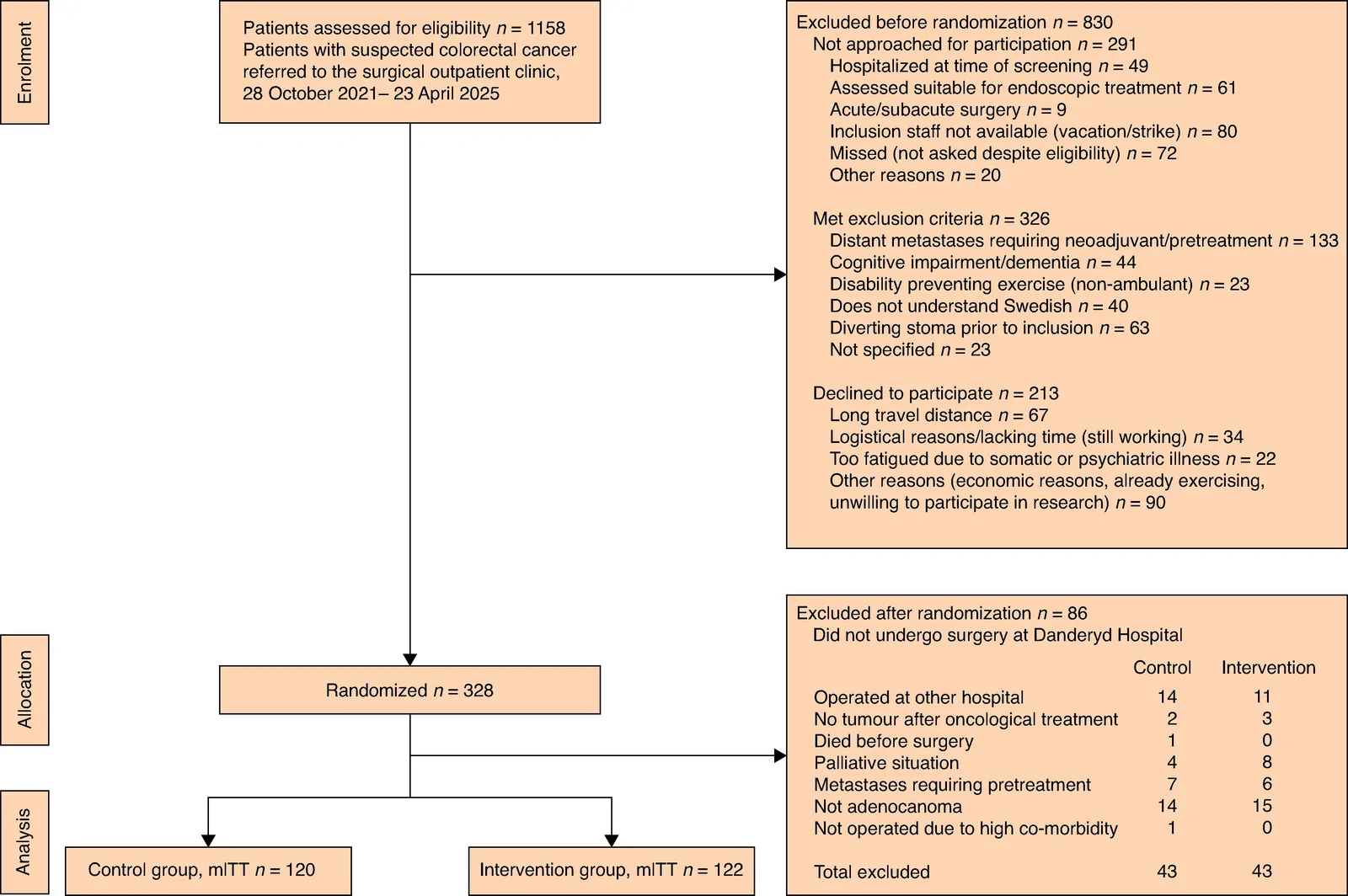
In a randomized trial at one Stockholm hospital, 328 adults with confirmed colorectal cancer—cancer of the colon or rectum—were assigned to a pre-surgery program or standard care. The program combined medication review, nutrition counseling, supervised exercise and measures to address specific health risks. It began within three days of enrollment.
The analysis included 242 people who underwent surgery. The program did not reduce postoperative complications. Hospital stays and repeat-operation rates were also similar. Participants assigned to the program lost less weight after surgery and had modest improvements in physical performance and self-reported physical function at 30 days. Exploratory analyses suggested greater reductions in severe complications among participants with greater disability before surgery.
Why it matters
For aging research, the trial raises a question about whether disability before cancer surgery can help guide support aimed at preserving physical function.
Caveats
The analysis included only 242 of 328 randomized participants, rather than everyone assigned to a group. The disability finding was exploratory, and the trial studied adults scheduled for elective colorectal cancer surgery at one hospital.
From the paper
- Participants
The final mITT population comprised 242 patients who underwent colorectal cancer surgery at the study centre (120 control, 122 intervention).
- Absolute difference
The incidence of complications was 47.5% (58 of 122) in the intervention group and 45.0% (54 of 120) in the control group (Table 2), corresponding to an absolute risk difference of 2.5 percentage points, which was not statistically significant.
Quoted word for word from the full text on academic.oup.com.
The paper
Multimodal prehabilitation in colorectal cancer surgery: randomized clinical trial
Danderyds sjukhus; Karolinska University Hospital
BJS Open, Sep 4, 2026, Open access

