Multimodal assessment of NIBS-induced adaptive plasticity in aging prefrontal networks: ERP and cognitive evidence
8 weeks, sham-controlled
Abstract
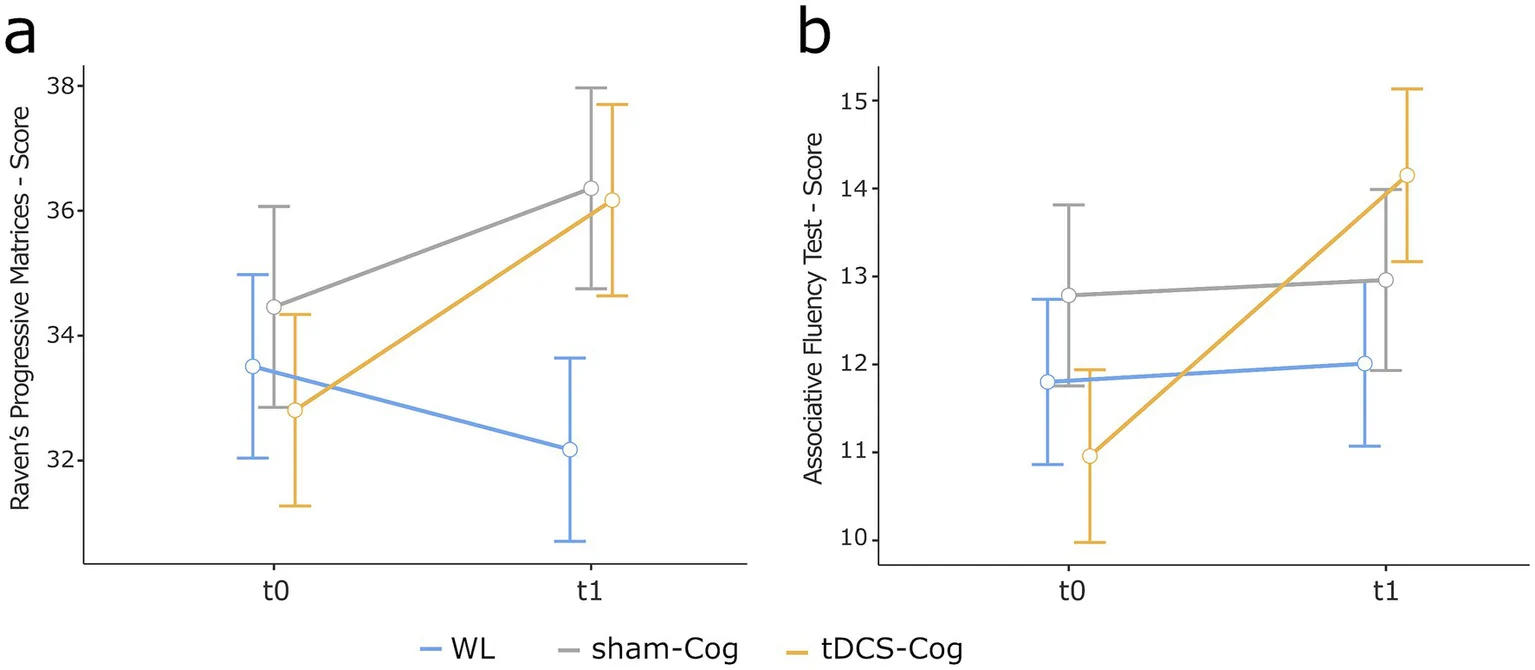
Non-invasive brain stimulation may enhance age-sensitive executive functions by modulating task-engaged prefrontal networks, but behavioral effects remain heterogeneous and their physiological specificity is poorly understood. This pre-post study examined neuropsychological and electrophysiological responses to cognitive training paired with active or sham transcranial direct current stimulation (tDCS) over the dorsolateral prefrontal cortex. Thirty-three older adults were randomly assigned to active tDCS plus cognitive training, sham tDCS plus cognitive training, or wait-list control. Training groups completed 24 sessions across 8 weeks. Before and after intervention, participants underwent neuropsychological assessment and EEG recording during a Stroop-like task; N2 amplitude and latency were extracted at F3, Fz, and F4. Linear mixed-effects models tested Group × Time effects. Significant interactions emerged for non-verbal executive functions and associative fluency, with improvements confined to the active-tDCS group. Other cognitive measures improved over time without group-specific effects. Active tDCS selectively increased N2 amplitude in correspondence to the stimulated site, whereas no comparable change occurred after sham stimulation or in controls. These findings suggest that repeated right-prefrontal tDCS may specifically support higher-order executive functions and induce selective modulation near the stimulation site. Physiological measures may help clarify the anatomical and functional specificity of NIBS-related modulation.
From the paper
- Result
Scores did not change significantly in sham-Cog, from t0 ( M = 34.5, 95% CI [31.2, 37.7]) to t1 ( M = 36.4, 95% CI [33.1, 39.6]; p = 0.183), or in WL, from t0 ( M = 33.5, 95% CI [30.5, 36.5]) to t1 ( M = 32.2, 95% CI [29.2, 35.2]; p = 0.304).
Quoted word for word from the full text on frontiersin.org.
- Cognitive training
- Transcranial direct current stimulation
- Associative fluency
- N2 amplitude
- N2 latency
- Humans
The paper
Università Cattolica del Sacro Cuore
Frontiers in Molecular Neuroscience, Oct 1, 2026, Open access


