Gene variants linked to brain disorder in five people
Sequencing identified changes in both copies of PIKFYVE in five people from three families with a disorder involving too little insulation around nerve fibres.
Limit: Only five people from three families supported the genetic link
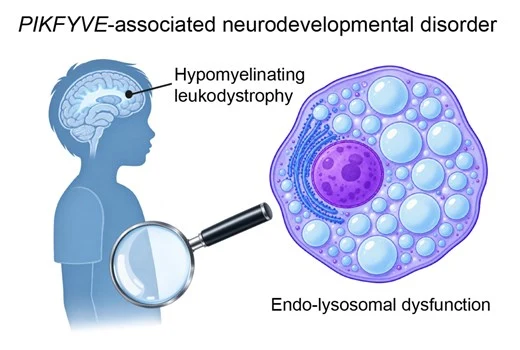
An observational genetic study examined five people from three families with a disorder affecting nervous system development. DNA sequencing linked changes in both copies of PIKFYVE, a gene involved in cellular waste processing, to hypomyelinating leukodystrophy. This condition involves too little insulation around nerve fibres. Those affected had intellectual disability, muscle stiffness and weakness, and involuntary eye movements.
In fibroblasts, cells that help form connective tissue, grown in the lab from affected members of one family, the researchers found enlarged, overly acidic compartments inside cells. The cells also produced less of a particular lipid after exposure to a highly concentrated solution. In separate experiments, rapamycin reduced the build-up of fluid-filled compartments inside cells in zebrafish larvae with a mutation in the corresponding gene.
Why it matters
The work provides a starting point for asking whether faults in cellular waste processing also matter for nerve insulation during aging.
Caveats
The observational human study involved only five people from three families. The rapamycin result came from zebrafish larvae and does not show a benefit in people.
The paper
Biallelic variants in PIKFYVE cause a hypomyelinating leukodystrophy with endolysosomal dysfunction
Düsseldorf University Hospital
Brain, 14 Oct 2026, Open access