Global burden of lip and oral cavity cancer attributable to behavioral risk factors, 1990-2021: a systematic analysis based on the GBD 2021 database
Abstract
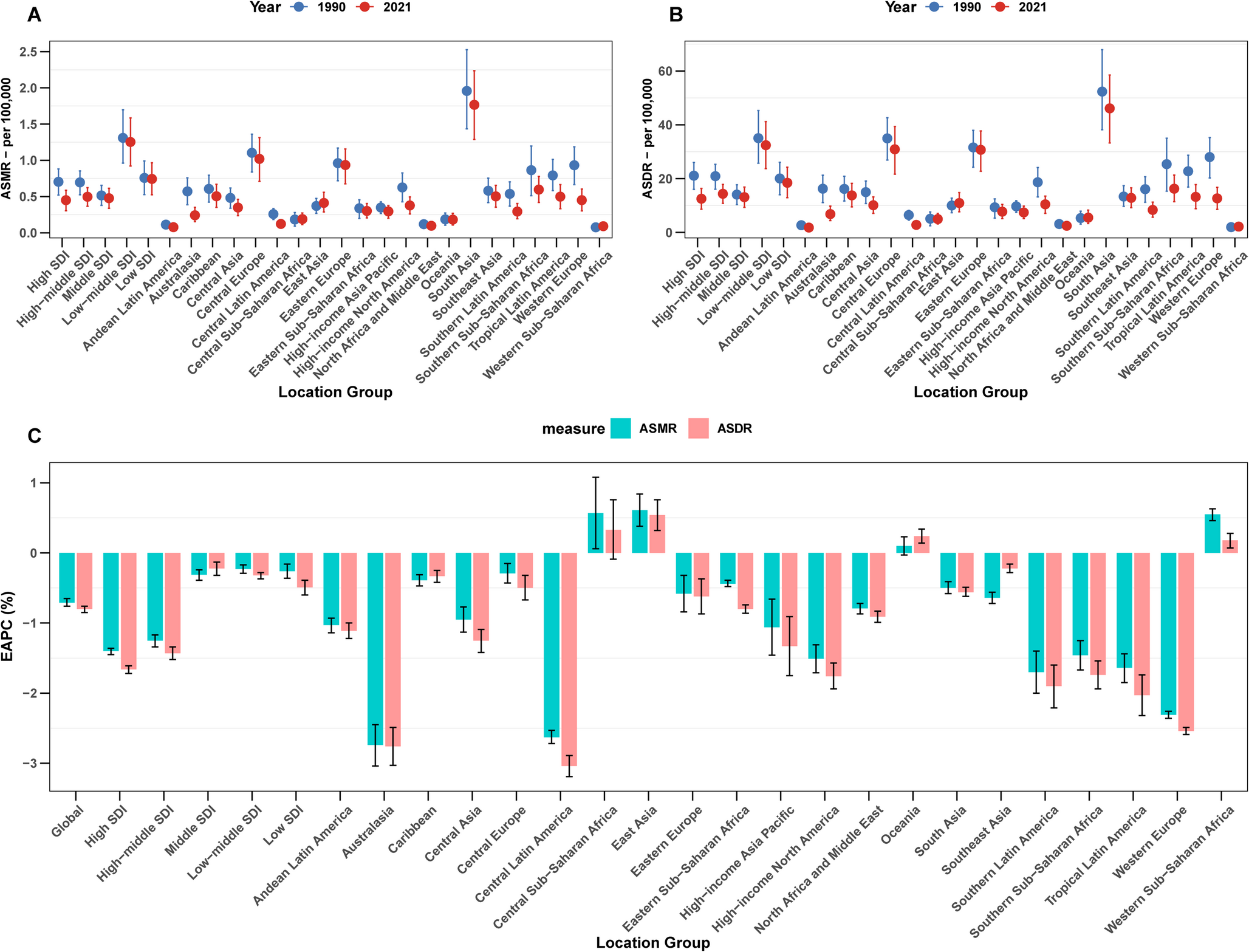
BACKGROUND: Lip and oral cavity cancer (LOC) is a major global public health issue, with tobacco and alcohol as key modifiable behavioral risk factors. This study analyzed global LOC burden trends (1990-2021) and predicted future burden through 2051. METHODS: Data were from the Global Burden of Disease Study (GBD) 2021, including behavioral factor-attributable age-standardized disability-adjusted life year rate (ASDR) and mortality rate (ASMR). Joinpoint regression identified trend changes; Age-Period-Cohort (APC) models assessed age, period, and cohort effects. Health inequalities were evaluated via Slope Index of Inequality (SII) and Concentration Index (CI). A Bayesian APC model projected burden to 2051. RESULTS: In 2021, global ASDR and ASMR were 16.75 (95% uncertainty interval [UI]: 12.76, 20.66) and 0.60 (95% UI: 0.46, 0.75) per 100,000. Males had higher ASDR (26.94; 95% UI:19.27, 34.36) and ASMR (0.97; 95% UI:0.70, 1.24) than females (7.22 ; 95% UI: 5.55, 9.18 and 0.28; 95% UI: 0.21, 0.35). High SDI regions showed ASR declines; low-middle SDI regions had slower reductions or increases. Tobacco was the leading risk factor, with the heaviest burden in low-middle SDI regions and South Asia. Health inequalities shifted burden to lower socio-economic groups. Projections (2051) show males will have higher ASDR (27.59; 95% CI: 5.37, 49.81]) and ASMR (1.04 ; 95% CI: 0.17, 1.91). CONCLUSION: Behavioral risk factors, particularly tobacco, drive global LOC burden. Strengthening tobacco/alcohol control, promoting early detection, and reducing socioeconomic disparities are crucial for prevention.
From the paper
- Result
The DALY rate ratio rose from 1.00 in 1992–1996 to 1.13 (95% CI: 1.10, 1.16) in 2017–2021, while the mortality rate ratio increased from 1.02 to 1.14 (95% CI: 1.12, 1.16).
- Limitation
First, the current analysis focused primarily on two behavioral risk factors—tobacco use and alcohol consumption—and did not incorporate other potential etiological factors, including human papillomavirus (HPV) infection, dietary patterns, genetic susceptibility, and oral hygiene practices.
Quoted word for word from the full text on link.springer.com.
The paper
Jiangsu Cancer Hospital; Jiangsu Cancer Hospital/Jiangsu Institute of Cancer Research
Oral and Maxillofacial Surgery, 10 Oct 2026