Immune-metabolic convergence in skeletal remodeling disorders: shared osteoimmune, senescent and lipid mechanisms across aging-related and immune-mediated bone disease
Abstract
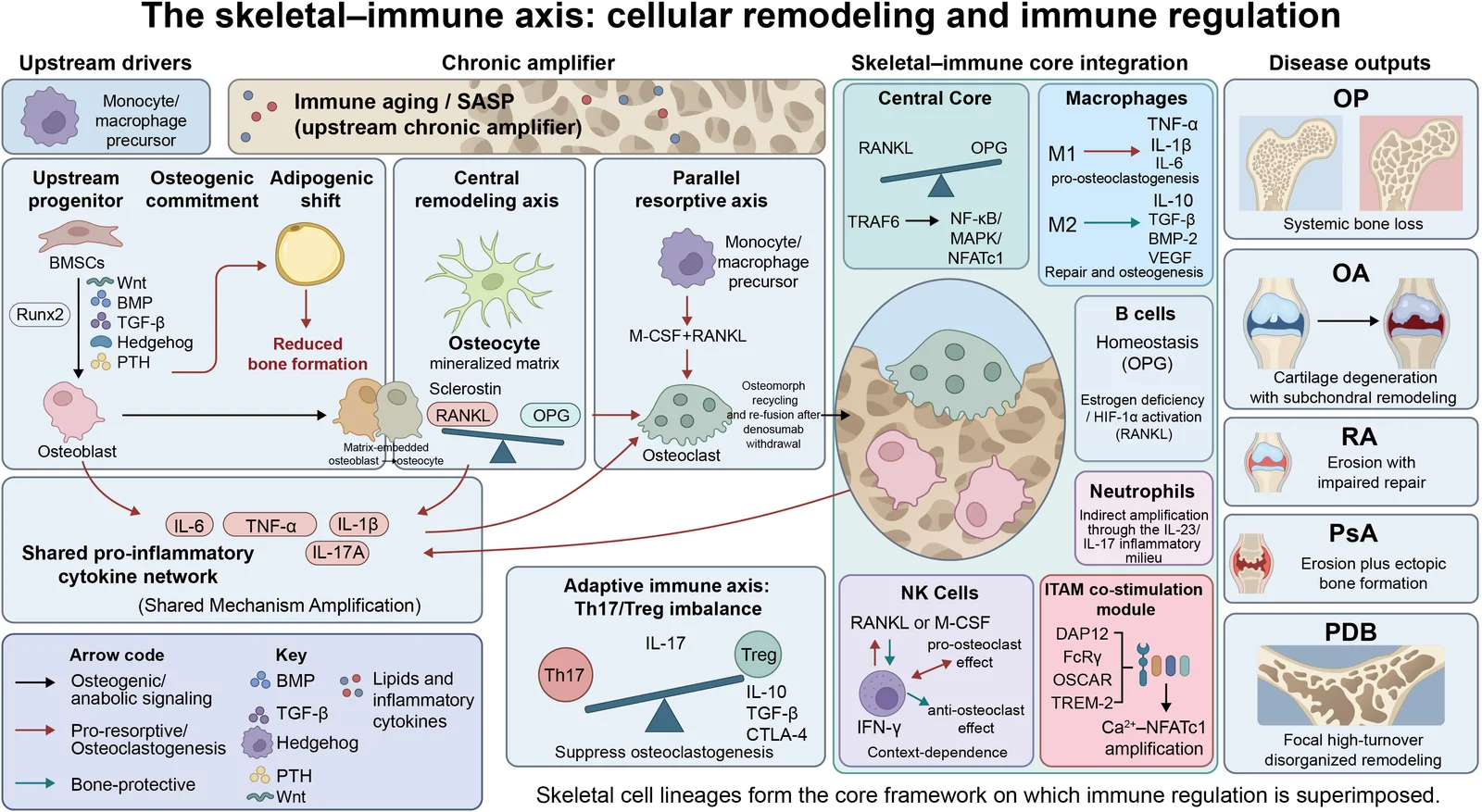
Bone and joint disorders of the aging musculoskeletal system are conventionally treated as separate clinical entities. This disease-centered view aids diagnosis but obscures the immune, inflammatory, senescent and metabolic programs they share. This Review compares five of them, grouped by etiology rather than by age: two aging-driven remodeling disorders, osteoporosis (OP) and osteoarthritis (OA); two immune-mediated arthritides in which aging modifies rather than causes the skeletal outcome, rheumatoid arthritis (RA) and psoriatic arthritis (PsA); and one focal, largely monogenic disorder included as a boundary case, Paget's disease of bone (PDB). RA and PsA are not treated as age-related diseases; they are included because they show most directly that immune activation alone can redirect skeletal remodeling. The review is narrative and mechanism-oriented, based on a structured, auditable search (Section 2); we compare evidence across diseases rather than claim exhaustive synthesis. Skeletal aging, immunosenescence, inflammaging and lipid dysregulation converge on five nodes: the receptor activator of nuclear factor-κB ligand (RANKL)-osteoprotegerin (OPG) axis, the interleukin-17/tumor necrosis factor-α/interleukin-6 network, senescence-associated secretory phenotype (SASP) amplification, phospholipid peroxidation and ferroptosis, and Wnt-sclerostin-Dickkopf-1 (DKK-1) balance. Across diseases these nodes generate different skeletal outputs: systemic bone loss in OP; cartilage degeneration with subchondral remodeling in OA; erosion with impaired repair in RA; erosion combined with ectopic bone formation in PsA; and focal high-turnover remodeling in PDB. Disease identity, we argue, is set by the sign and relative weighting of node activity rather than by which nodes are engaged; the opposing direction of DKK-1 regulation in RA and PsA is the clearest example. Ferroptotic injury is resolved by cell type rather than treated as uniformly harmful, and PDB is retained as a comparator showing that shared-node activation is permissive rather than deterministic. Candidate biomarkers and pathway-directed therapies are summarized with their translational gaps. Every disease × mechanism combination is graded on a four-level evidence scheme (E1, established human evidence, to E4, indirect or in vitro only) defined in Section 2. A cross-disease, mechanism-informed approach may improve risk stratification, identify treatable endotypes, and guide future trials in immune-metabolic skeletal disease.
The paper
Liaoning University of Traditional Chinese Medicine
Frontiers in Immunology, 25 Sep 2026