Gut microbial characteristics and kynurenine-related metabolism across sarcopenia groups: associations with neuromuscular and physical function
Abstract
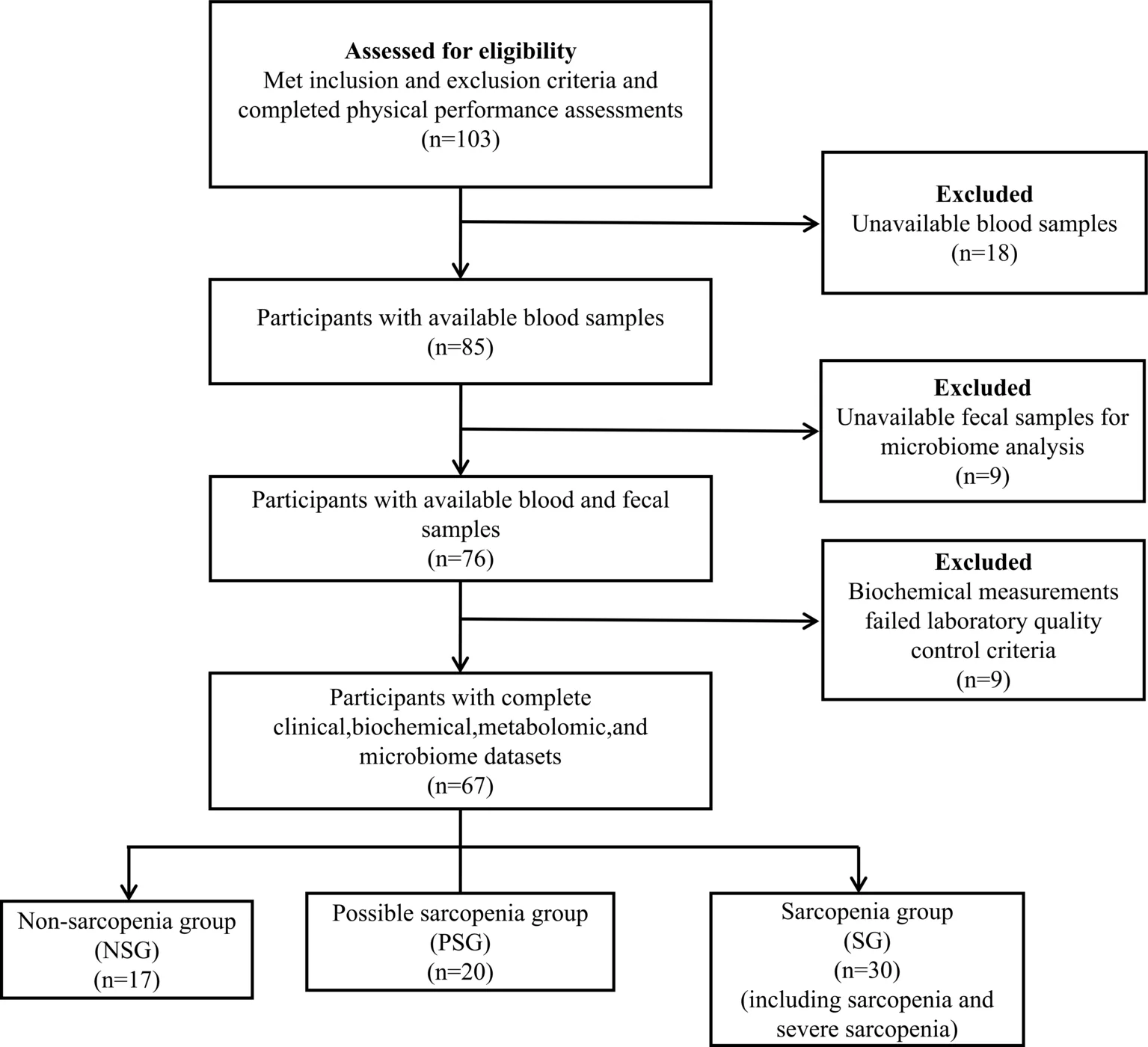
BACKGROUND: Sarcopenia is characterized by heterogeneous alterations in muscle mass, strength, and physical performance and may involve interactions among the gut microbiota, tryptophan metabolism, and neuromuscular function. However, these biological characteristics across different sarcopenia stages remain incompletely understood. This study investigated gut microbial characteristics, kynurenine-related metabolism, circulating biomarkers, and physical function in older adults with different sarcopenia status. METHODS: In this cross-sectional study, 67 older adults were classified according to the Asian Working Group for Sarcopenia 2019 criteria as non-sarcopenia (NSG, n = 17), possible sarcopenia (PSG, n = 20), or sarcopenia (SG, n = 30). Muscle mass, handgrip strength, and multidimensional physical performance were assessed. Serum C-terminal agrin fragment (CAF), tumor necrosis factor-α (TNF-α), amino acids, kynurenine (KYN), and tryptophan (Trp) were measured, and the KYN/Trp ratio was calculated. Gut microbiome composition was characterized by shotgun metagenomic sequencing. Differential abundance was evaluated using MaAsLin2 with adjustment for age and body mass index (BMI), and exploratory correlations among microbial genera, metabolites, circulating biomarkers, and physical function were examined with false discovery rate correction. RESULTS: ASMI was significantly lower in the SG group than in the NSG and PSG groups, whereas several measures of physical performance differed among groups without a uniform stepwise pattern. No significant differences were observed in alpha diversity, beta diversity, or the Firmicutes/Bacteroidetes ratio, and sarcopenia group explained only 3% of the variation in overall microbial community composition (PERMANOVA, R ² = 0.03, p = 0.226). Several genus-level associations were nominally significant after adjustment for age and BMI, but none remained significant after BH-FDR correction. After adjustment for age and BMI, serum KYN concentrations and the KYN/Trp ratio were significantly higher in the SG group than in the NSG group (p = 0.011 and p = 0.043, respectively), whereas Trp and the measured amino acids showed no significant pairwise differences. The unadjusted increase in CAF across sarcopenia groups was attenuated after covariate adjustment, and TNF-α did not differ significantly among groups. Exploratory correlation analyses identified several FDR-significant associations across microbial, metabolic, and functional domains, including negative associations of KYN and KYN/Trp with handgrip strength and a positive association between CAF and 6-m gait speed(GS). CONCLUSION: Established sarcopenia was associated with altered circulating kynurenine-related metabolism despite the absence of pronounced differences in overall gut microbial community structure. Exploratory cross-domain associations further suggest potential interactions among gut microbial characteristics, tryptophan metabolism, and neuromuscular and physical function. These findings support further investigation of host-microbial tryptophan metabolism in sarcopenia but do not establish a causal microbiota-kynurenine-NMJ pathway.
From the paper
- Result
After adjustment for age and BMI, serum KYN concentrations were significantly higher in the SG group than in the NSG group (adjusted mean difference for NSG vs. SG = −339.08, 95% CI: −595.97 to −82.19; p = 0.011).
Results, 3.5 Targeted amino acid and kynurenine pathway metabolite profiles
- Limitation
First, the cross-sectional design precludes causal or temporal inference among gut microbial characteristics, tryptophan metabolism, neuromuscular biomarkers, and sarcopenia-related phenotypes.
Quoted word for word from the full text on frontiersin.org.
The paper
Beijing Sport University; College of Sports and Exercise Rehabilitation
Frontiers in Aging Neuroscience, 25 Sep 2026