Persistent Sex Gaps and the Screening-Treatment Paradox in Hypertension Management: 25 Years of Self-Reported Swiss Health Survey Data
Declared no competing interests
Abstract
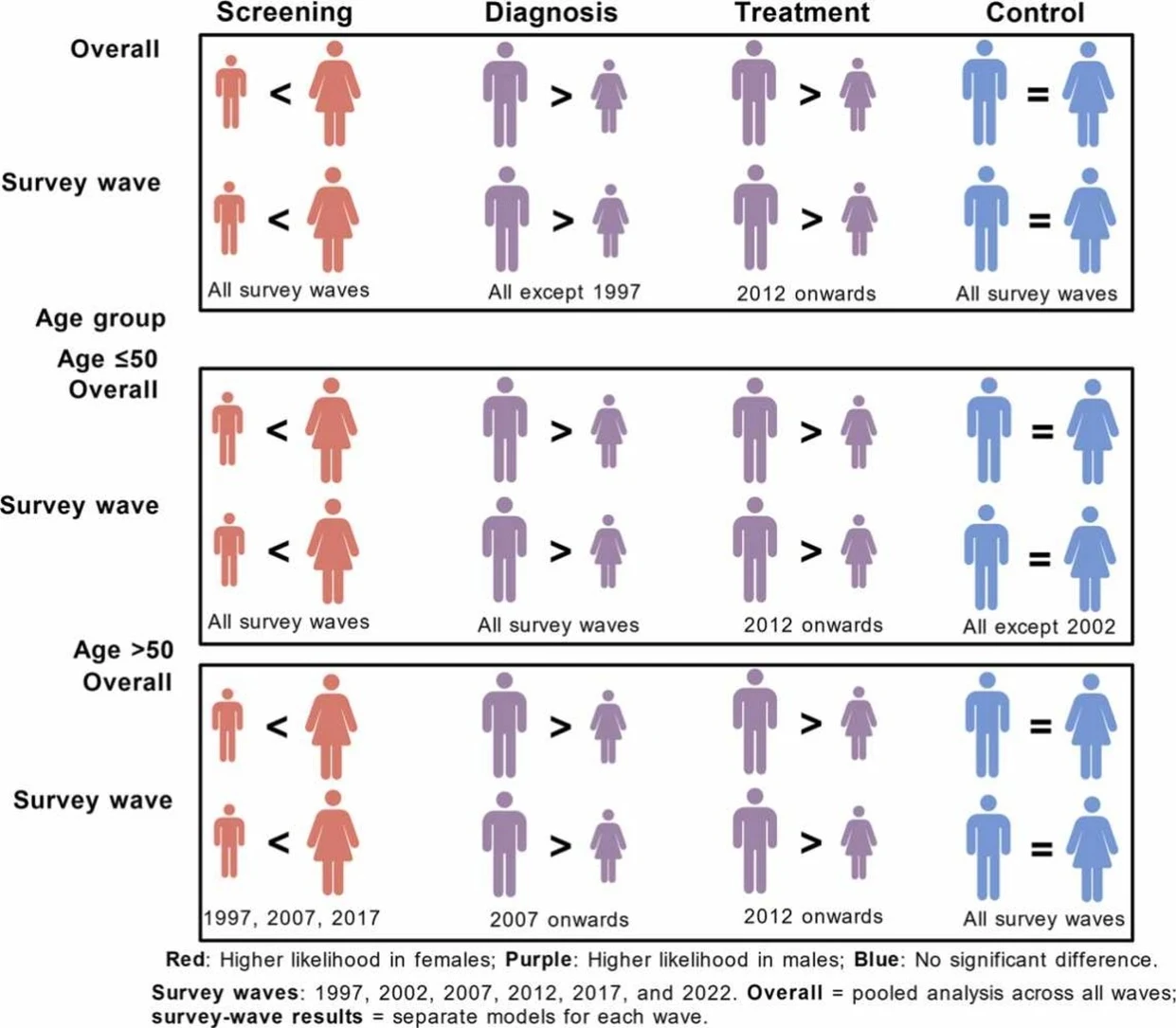
PURPOSE: To assess how sex differences in hypertension management have evolved over a 25-year period in Switzerland, focusing on screening, diagnosis, treatment, and control, and to determine whether age modifies these differences. METHODS: We analyzed self-reported data from six consecutive Swiss Health Surveys (1997-2022) from samples representative of the Swiss population. Multivariable logistic regression models were adjusted for sociodemographic and lifestyle covariates. Age-stratified analyses were conducted using age >50 years as a proxy for menopausal status. RESULTS: Among 94,785 participants (55.3% female), females consistently had a higher likelihood than males of reporting blood pressure screening (e.g., adjusted odds ratio (aOR) 1.62, 95% CI 1.50-1.75 in 2022), with no narrowing of the trend over time. In contrast, from 2012 onward, females had a lower likelihood of reporting a diagnosis of hypertension (e.g., aOR 0.73, 95% CI 0.68-0.79 in 2022) or antihypertensive medication use among those diagnosed (e.g., aOR 0.84, 95% CI 0.74-0.95 in 2022), with gaps widening over time. No sex differences in self-reported blood pressure control were found among those reporting treatment. Age-stratified analyses showed consistent sex differences across both age groups, though the onset and magnitude varied. CONCLUSION: Despite comparable treatment outcomes, our findings show a paradoxical sex difference in earlier stages of hypertension management, higher screening yet lower treatment in females.
The paper
Annals of Epidemiology, 8 Oct 2026