Macrophage CD38 drives age-related placental senescence by depleting NAD+
Targeting CD38 or supplementing NAD+ precursors reduces placental aging and improves offspring metabolic health in models of delayed maternal age.
Nature Communications
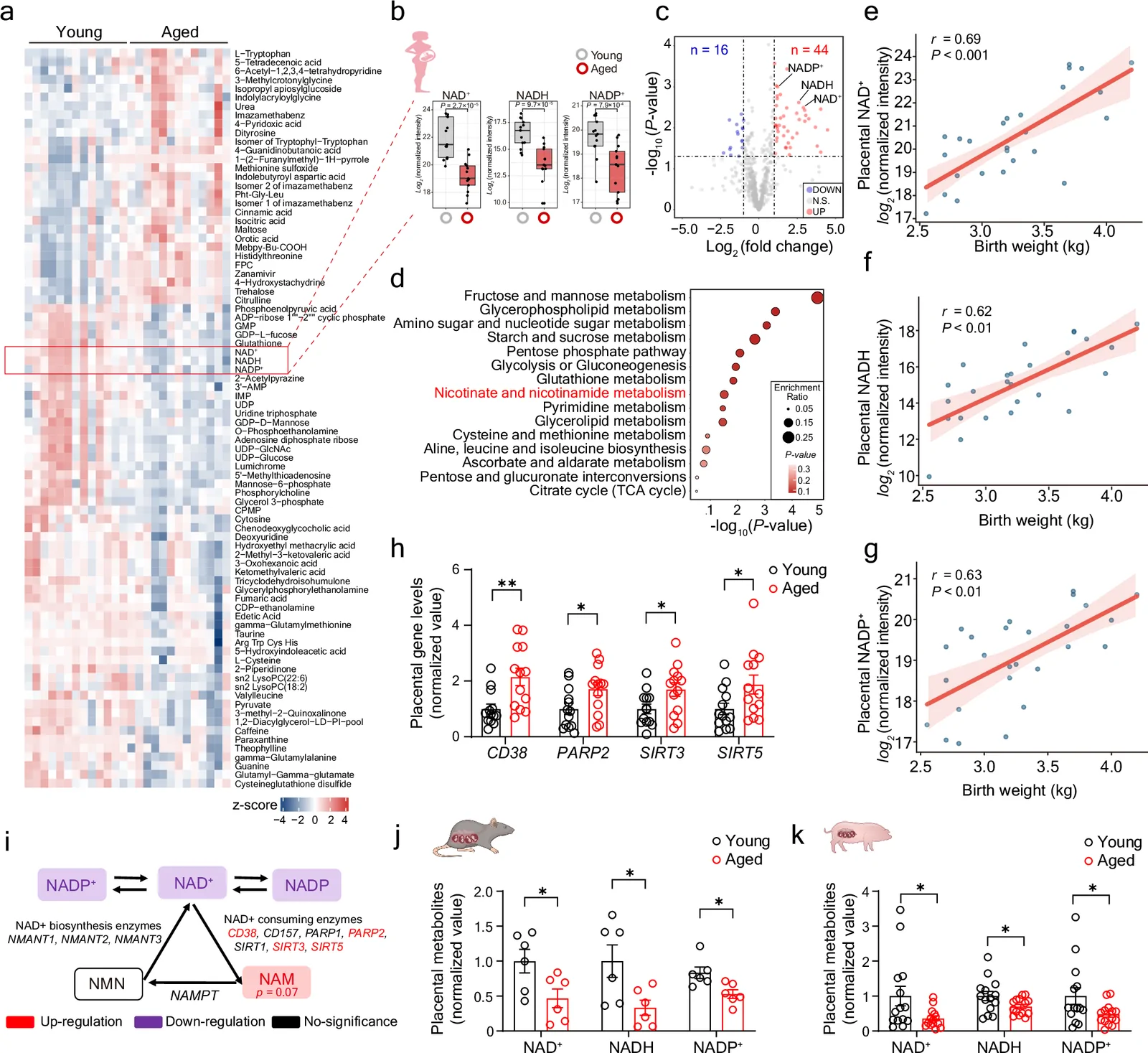
In humans, mice, and pigs, aged placentas exhibit increased macrophage CD38 expression and NAD+ deficiency. Researchers used metabolomics, single-cell RNA sequencing, and spatial transcriptomics to map these conserved features during reproductive aging. Through genetic and pharmacological tests, the team found that CD38 on macrophages depletes NAD+ in neighboring decidual stromal cells, accelerating placental senescence. This CD38 rise is triggered by early-onset inflammation and senescence-associated secretory phenotype activity through the IRF5 pathway. Administering CD38 inhibitors or NAD+ precursors attenuated placental senescence, rescued intrauterine growth restriction, and improved long-term metabolic health in offspring.
Why it matters
The study directly links immune-mediated NAD+ depletion to tissue aging in the placenta. It also highlights CD38 inhibition as a therapeutic concept for age-related reproductive and developmental complications.
Caveats
Although molecular profiling included human tissue, interventional rescue experiments were conducted in animal models. The abstract does not report clinical trials or safety profiles for these interventions during human pregnancy.
The paper
Show 24 more authors
Xintong Yang, Xianyang Jin, Lulu Ma, Wenting Liu, Jing Li, Zhaoli Shen, Luting Liu, Yanni Wu, Yi Yang, Chunli Zhu, Litong Li, Xuemei Jiang, Xingfa Han, Chao Jin, Guangmang Liu, Bin Feng, Lianqiang Che, Shengyu Xu, Yan Lin, Zhengfeng Fang, Long Guo Jin, Ting F Luo, Yan Lin, Mingzhou Li,Sichuan Agricultural University
Nature Communications · 27 Aug 2026 · CC BY-NC-ND