Artificial intelligence detected severe structural heart disease
The analysis increased the share of severe cases detected by 34.6 percentage points compared with the portable device’s standard rhythm reading.
Our read
Biomarkers- Studied:
- Preprint: cross-sectional study of 597 adults undergoing outpatient echocardiography (Independent replication)
- What changed:
- AI-ECG detected severe structural heart disease with 84.6% sensitivity against 50.0% with the device's native interpretation
- The catch:
- Testing patients already referred for echocardiography likely increased disease prevalence and overestimated positive predictive value
- Stake:
- An author founded Ensight-AI. Authors founded Evidence2Health.
Editor of record: Boris Djordjevic · AgingResearch.News
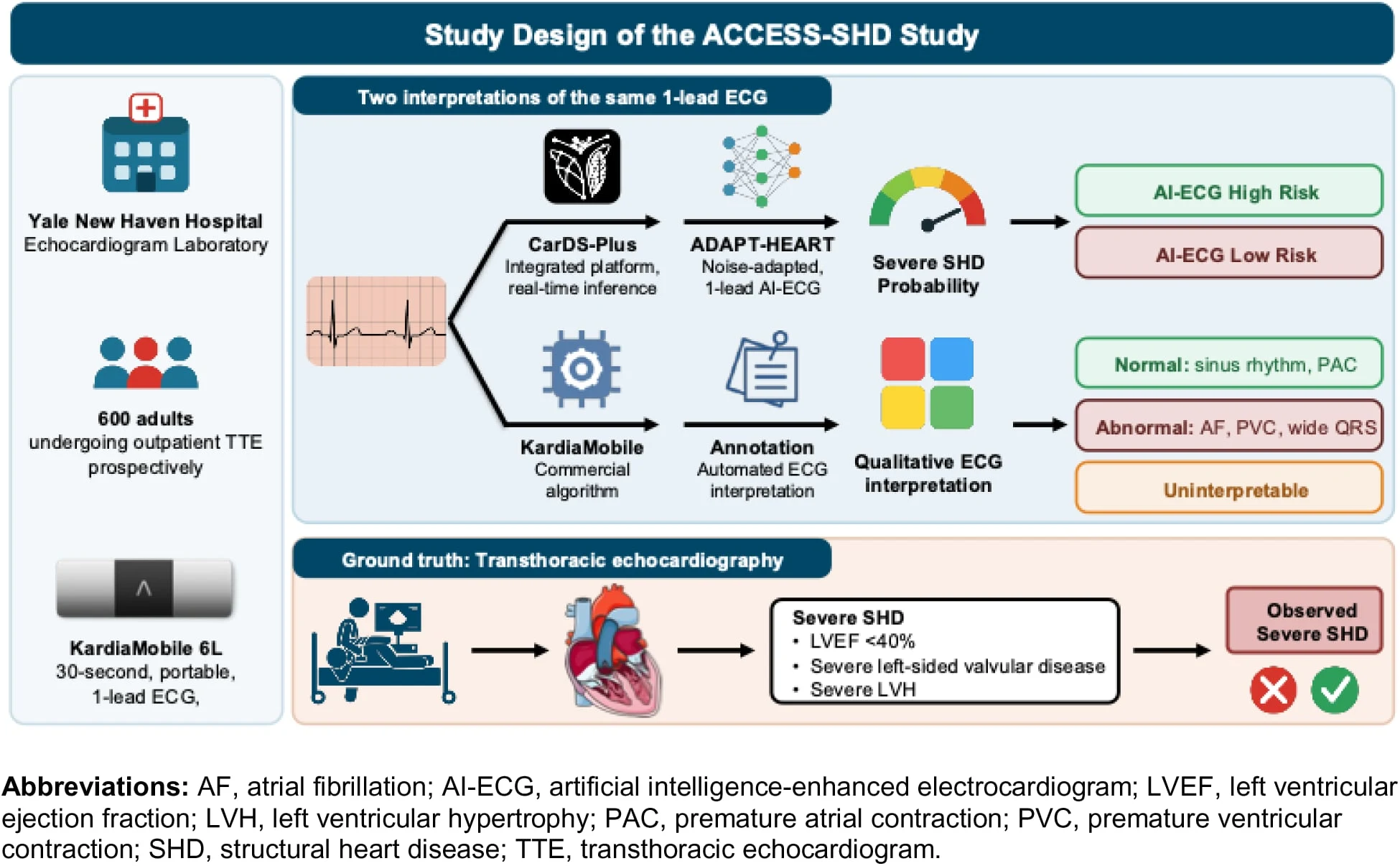
In a prospective observational study, 597 adults undergoing outpatient heart ultrasound at Yale New Haven Hospital recorded 30 seconds of their heart’s electrical activity with a portable device. Their median age was 61.7 years, and 51.4% were women. Ultrasound identified severe structural heart disease—serious problems involving heart pumping, valves or muscle—in 30 participants.
Researchers tested artificial intelligence analysis of the recordings against ultrasound findings. It detected 86.7% of severe cases and correctly classified 72.5% of people without severe disease. Only 14.4% of positive results corresponded to severe disease. Compared with the device’s standard rhythm reading, the analysis detected a larger share of severe cases but also flagged more people without severe disease.
Why it matters
Finding structural heart disease before symptoms develop is a screening question relevant to healthy aging. The authors suggest this approach could help guide screening on a large scale.
Caveats
Participants were already referred for heart ultrasound, so the results do not establish performance in general-population screening; people with implanted pacemakers or defibrillators were excluded. This preprint has not been peer-reviewed.
From the paper
- Result
… AI-ECG detected severe SHD with substantially higher sensitivity than the device’s native interpretation (84.6% vs 50.0%; difference, 34.6 percentage points [95% CI, 13.0 to 56.0]), at the cost of lower specificity (73.0% vs 83.3%; difference, -10.3 percentage points [95% CI, -14.3 to -6.4]) …
- Limitation
First, it was conducted in an echocardiography laboratory among patients already referred for TTE, which likely increased disease prevalence and may have overestimated PPV relative to community screening.
Quoted word for word from the full text on medRxiv.
The paper
Yale University; Yale New Haven Hospital
medRxiv, Sep 15, 2026, Open access, Preprint, not yet peer-reviewed


Comments
Be the first to comment.