Declines in endurance swimming performance with age: Analysis of 40 years of Masters one-hour distance swims
40 years, declared no competing interests
Abstract
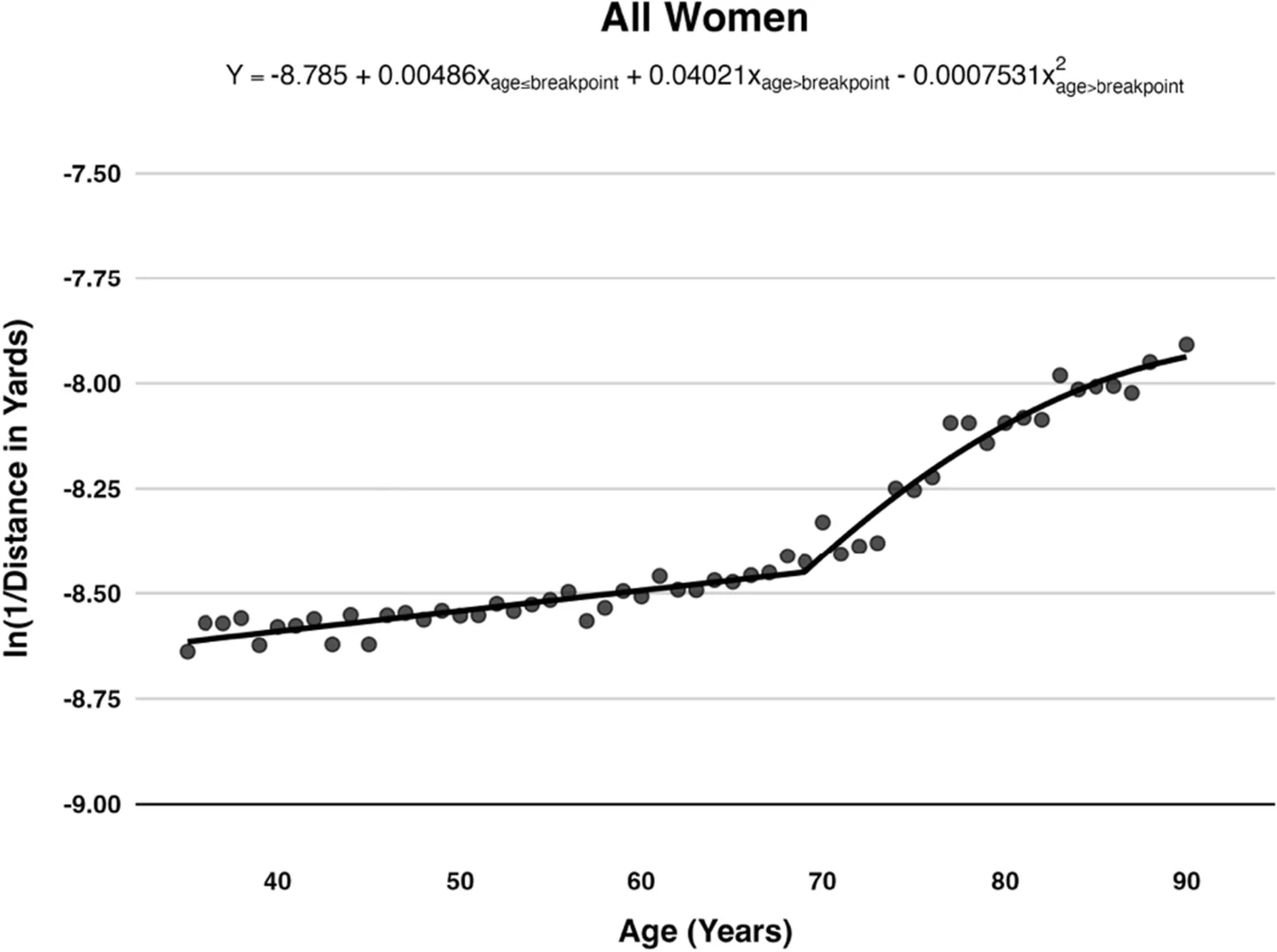
Masters swimmers' sprint performance decrements with age have been <1% per year from ages 30-35 to ages 65-75, with an accelerated decline thereafter. We studied participants in the U.S. Masters swimming 1-hour virtual championship, which represents endurance rather than sprint swimming. We hypothesised a similar pattern of performance decline with age in this endurance event. We analyzed 40 years of 1-hour swims, 1985-2024, >50,000 entries total, using segmented regression analysis. Women's performance decline (distance covered) with age was linear at approximately 0.5% per year until age 69 ± 1.8 (the transition age), after which their decline accelerated in a quadratic fashion. Men's performance decline with age was linear at approximately 0.9% per year until age 75 ± 3.8, after which their decline also accelerated in a quadratic fashion. Our analysis of Masters 1-hour endurance swimming is consistent with earlier studies of Masters sprint swimming. The average transition age was approximately 6 years earlier for women (age 69) than for men (age 75), suggesting better training or tolerance for endurance swims among men. Some of the best swimmers continued their top performances for 10-13 years.
The paper
University of California, Los Angeles; Consultant Statistician
Open Access Journal of Sports Medicine, 7 Mar 2026