Model maps possible immune-cell maturation routes in aging
A computational analysis combined immune-receptor sequences with gene activity to infer candidate B cell maturation routes in healthy aging and lupus.
Our read
AI & data- Studied:
- Computational study of B cells
- What changed:
- In healthy aging, ClonoTrace resolved three candidate age-related B cell maturation routes from naive and memory B cells
- The catch:
- The computationally inferred maturation routes were not experimentally validated
- In the record:
- The 47th paper on systemic lupus erythematosus with results in people; 245 on record in all.
Editor of record: Boris Djordjevic · AgingResearch.News
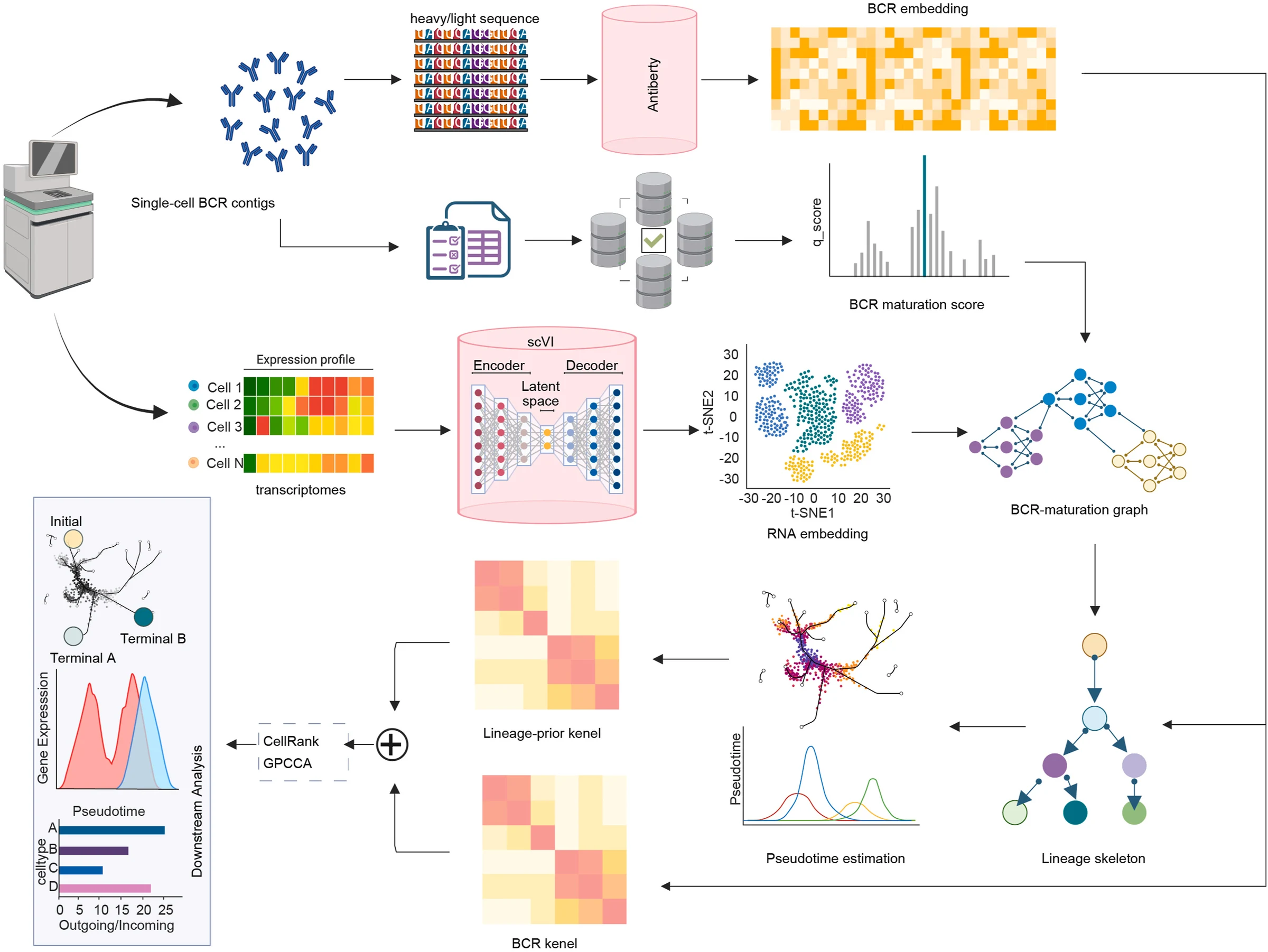
A computational study examined B cells, a type of immune cell, in healthy aging and in patients with systemic lupus erythematosus, an autoimmune disease. The ClonoTrace model combined immune-receptor sequences with gene activity to infer maturation paths. In fetal B cell development and germinal centers, where B cells mature, its inferred ordering matched reference ordering more closely than two existing methods.
In healthy aging, ClonoTrace identified three candidate routes from different B cell starting states. Each passed through a gene-activity state associated with double-negative 2 B cells, ordered before age-associated B cells. The leading candidate transition to age-associated B cells started from memory B cells, which remember previous targets, bearing IgM, a type of antibody. The authors suggested this transition may differ from maturation of double-negative 2 B cells in lupus.
Why it matters
The work addresses how age-associated B cells may arise and whether their development differs from that of disease-associated B cells in lupus.
Caveats
These computationally inferred routes do not establish that cells actually follow those paths. The abstract does not report experimental validation of the proposed transitions.
The paper
Multimodal computational framework resolves B cell maturation in autoimmunity and ageing
Nankai University; Chinese Academy of Medical Sciences & Peking Union Medical College
Journal of Autoimmunity, Aug 28, 2026
Comments
Be the first to comment.