Age differences in clitoral-vestibular bulb anatomy across the adult lifespan
Abstract
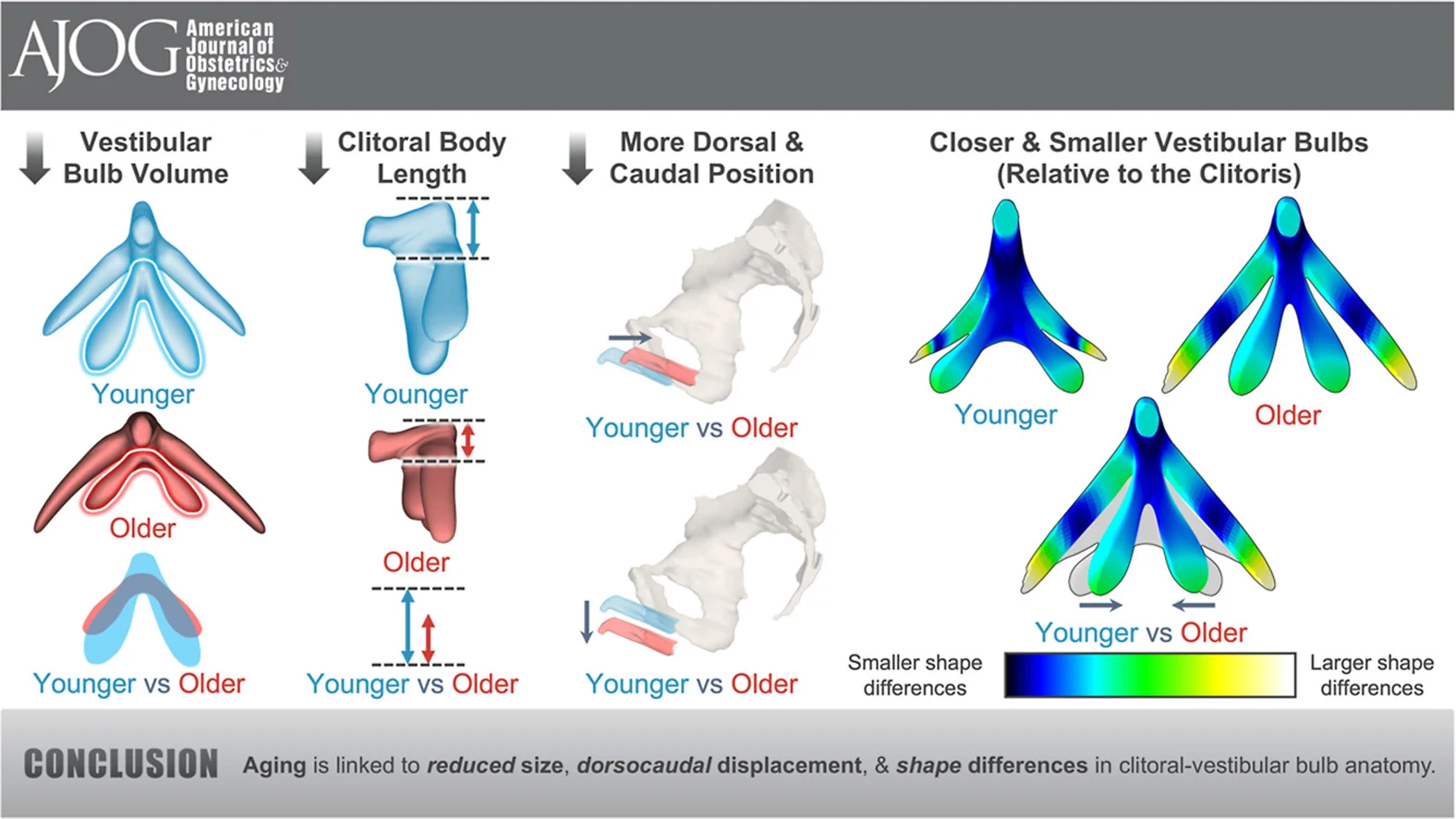
BACKGROUND: There is sparse normative data on clitoral-vestibular bulb anatomy and how it changes with aging, despite growing evidence of the latter playing a notable role in female sexual function and other pelvic symptoms. OBJECTIVE: To identify age-related differences in clitoral-vestibular bulb anatomy (dimensions, position, and shape) among women across the adult lifespan. STUDY DESIGN: This was a retrospective study of pelvic magnetic resonance images of women (≥18 years) without pelvic floor disorder/dysfunction symptom indications (pelvic organ prolapse, urinary incontinence/pain, fecal incontinence/pain, dyspareunia) and with normal pelvic anatomy (radiographically normal reproductive, genitourinary, or gastrointestinal systems). Participants were categorized into the following age groups: Young Adult (18-34 years), Early Midlife (35-49 years), and Older Adult (≥50 years). Axial images of participants in the supine position at rest were acquired for medical indications. The clitoral-vestibular bulb complex, vagina, and urethra were manually segmented to construct 3-dimensional anatomical models. Computational methods quantified clitoral-vestibular bulb dimensions, position, vaginal-urethral distances, and shape (given by principal component scores obtained from a statistical shape model). Age differences in clitoral-vestibular bulb measures were evaluated using Bonferroni-corrected one-way multivariate and univariate analyses of covariance, with adjustments for body mass index and parity. Age-related correlations were assessed using Spearman's rank correlation. RESULTS: A total of 134 women were analyzed (median [range] age, 39 [19-80] years): 47 young adult, 46 early midlife, and 41 older adult women. All young adult and early midlife women were premenopausal, whereas 27 (71%) of older adult women were postmenopausal. Older adult women had a shorter clitoral body length than early midlife women (24.1 mm vs 27.9 mm; P=.006). Overall, smaller vestibular bulb volume was associated with increasing age (P=.04). Older Adult women had a more caudally positioned (lower in the pelvis) clitoral-vestibular bulb complex than Early Midlife women (-21.0 mm vs -17.6 mm; P<.001) and Young Adult women (-21.0 mm vs -17.9 mm; P<.001). Across the entire cohort, increasing age correlated with a shorter clitoral body length (ρ=-0.21; P=.01), smaller vestibular bulb volume (ρ=-0.20; P=.02), and a more dorsally (ρ=-0.22; P=.01) and caudally (ρ=-0.43; P<.001) positioned clitoral-vestibular bulb complex, whereas clitoral volume remained unchanged (ρ=-0.03; P=.73). The shape analysis revealed that age predominantly affected the vestibular bulbs, which became more medially positioned (closer together) (ρ=-0.28; P=.001) and proportionally smaller relative to the clitoris (ρ=-0.28; P=.001) with advancing age. CONCLUSION: Increasing age was weakly correlated with reduced size and moderately correlated with caudal displacement of the clitoral-vestibular bulb complex, with aging primarily affecting the vestibular bulbs compared to the clitoris. Findings suggest age-related atrophy and descent of clitoral-vestibular bulb anatomy, which may contribute to sexual function and other pelvic symptoms.
The paper
Massachusetts Institute of Technology; University of Pittsburgh
American Journal of Obstetrics and Gynecology, 27 Aug 2026