Depressive symptom heterogeneity and mortality in a prospective U.S. cohort
Declared no competing interests
Abstract
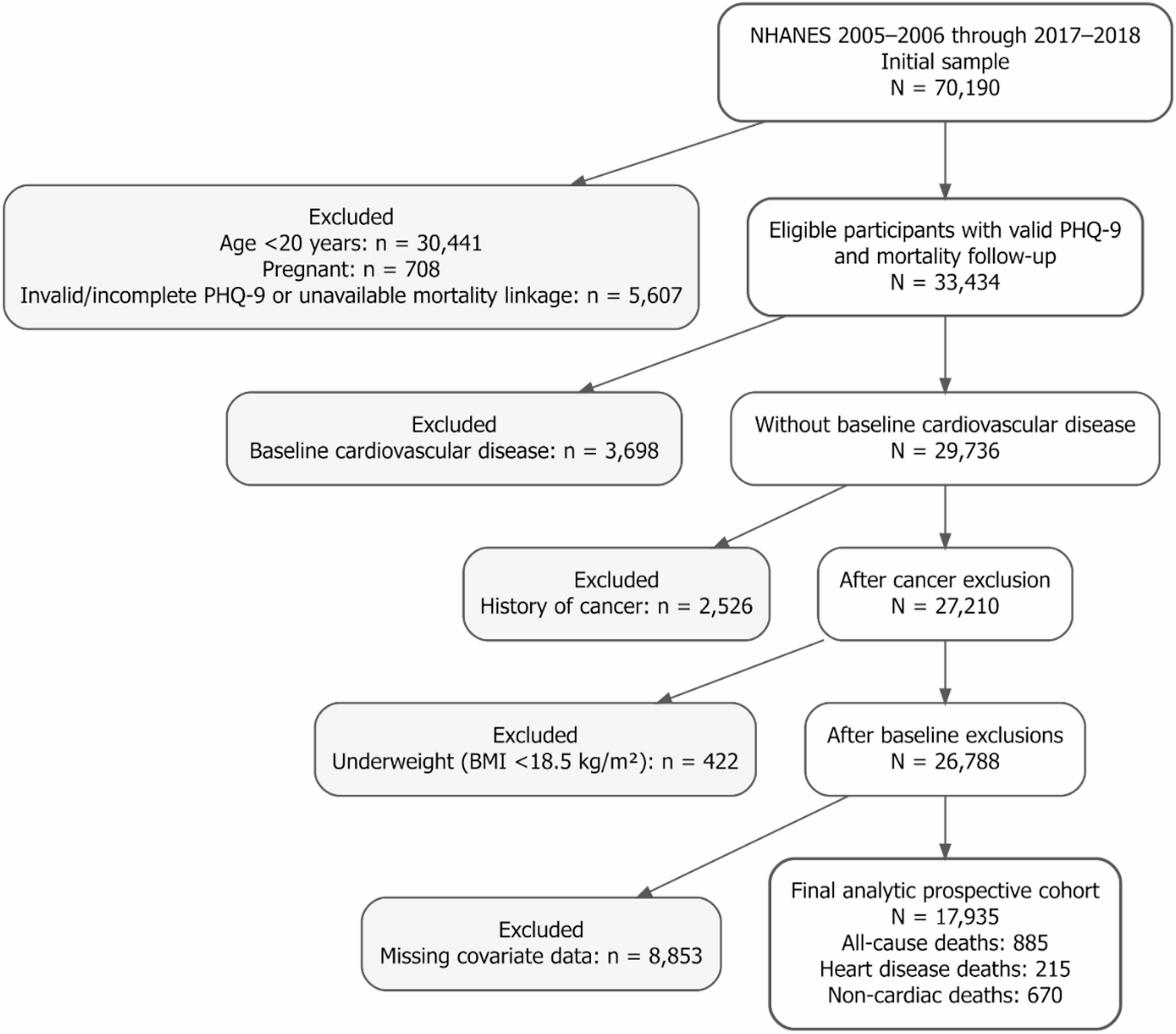
BACKGROUND: Depressive symptoms are associated with increased mortality, but whether individual symptoms differ in their associations with mortality remains incompletely characterized. METHODS: A prospective analysis of U.S. National Health and Nutrition Examination Survey data linked to mortality follow-up through 2019 examined PHQ-9 total score, affective and somatic domains, and individual items in relation to all-cause, heart disease, and non-cardiac mortality using survey-weighted Cox models. Item-level analyses were exploratory and adjusted for multiple comparisons. RESULTS: Among 17,935 participants, 885 deaths occurred. Each 1-point increase in PHQ-9 total score was associated with higher all-cause mortality (hazard ratio [HR], 1.036; 95% confidence interval [CI], 1.012-1.061; P=.003). When affective and somatic domains were modeled simultaneously, only the somatic domain remained modestly associated with all-cause mortality (HR, 1.044; 95% CI, 1.003-1.087; P=.037). In separate item analyses, anhedonia (HR, 1.256), fatigue (HR, 1.215), appetite or weight disturbance (HR, 1.175), and thoughts of death or self-harm (HR, 1.477) were associated with all-cause mortality after false discovery rate correction (adjusted P≤.014). In the mutually adjusted model, anhedonia (HR, 1.20), fatigue (HR, 1.21), and thoughts of death or self-harm (HR, 1.51) remained associated. Item-level models improved in-sample fit (likelihood-ratio P=.001) but minimally improved discrimination (ΔC-index=0.001). CONCLUSIONS: Higher depressive symptom burden was associated with all-cause mortality. Exploratory analyses suggested symptom-level heterogeneity, but item-level modeling did not meaningfully improve discrimination; symptom-specific findings require independent replication.
The paper
Icahn School of Medicine at Mount Sinai
European Archives of Psychiatry and Clinical Neuroscience, 27 Aug 2026