Machine Learning Predicts Functional Decline and Risk Phenotypes in Older Patients With Heart Failure
Abstract
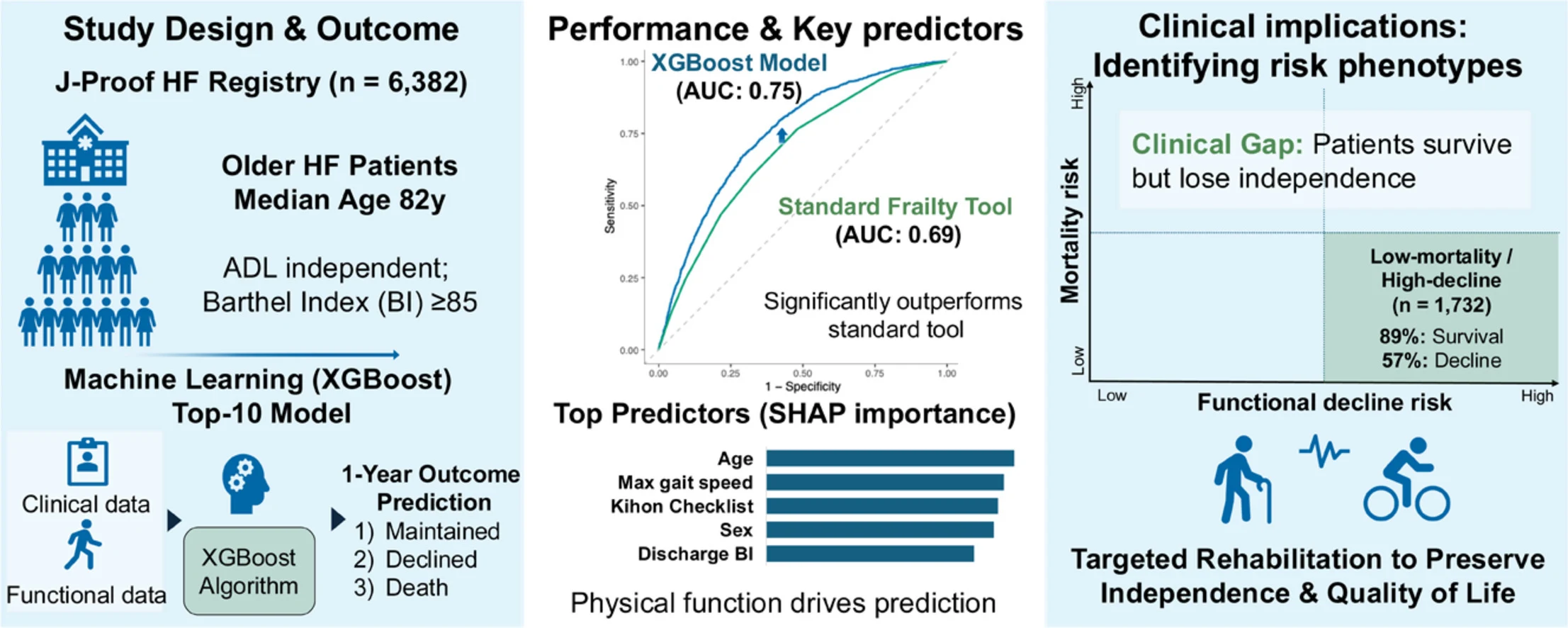
BACKGROUND: Preserving functional independence is critical in older patients with heart failure (HF), yet tools predicting long-term functional trajectories are scarce. AIMS: To develop and validate a machine learning (ML) model predicting functional decline, accounting for the competing risk of mortality. METHODS: We analyzed 6382 older patients (median age, 82 years) from a nationwide prospective cohort (J-Proof HF registry). Patients aged ≥65 years, hospitalized for HF, prescribed rehabilitation, and independent preadmission (Barthel Index [BI] ≥85) were included. An eXtreme Gradient Boosting (XGBoost) model was developed to predict a 1-year 3-class outcome: functional maintenance, functional decline, or death. Functional decline was defined as transitioning to a housebound/bedridden state (equivalent to BI <85) based on a national long-term care scale. Performance was evaluated via nested leave-one-site-out validation and benchmarked against the Kihon Checklist (KCL) frailty screening tool. RESULTS: At 1 year, 32.5% of patients experienced functional decline and 14.5% died. A parsimonious Top-10 XGBoost model (including maximum gait speed, discharge BI, preadmission frailty score, and age) demonstrated good discrimination (area under the receiver operating characteristic curve [AUC], 0.75; 95% confidence interval [CI], 0.74-0.76), significantly outperforming KCL-based scores (AUC, 0.66-0.69; P < .001). The model identified 4 risk phenotypes, including a "low-mortality/high-decline" group (n = 1732) with a 57.0% functional decline rate despite an 89.0% survival probability. CONCLUSION: This ML model accurately identifies older HF patients at high risk for functional decline despite favorable survival, enabling targeted rehabilitation to preserve quality of life.
The paper
Juntendo University
Journal of Cardiac Failure, 20 Aug 2026