Ingestion of 20 g of a Plant-derived Protein Blend With and Without Added Leucine or Whey Protein Does not Increase Muscle Protein Synthesis Rates in Older Males
Double-blind, registered NCT05711095
Abstract
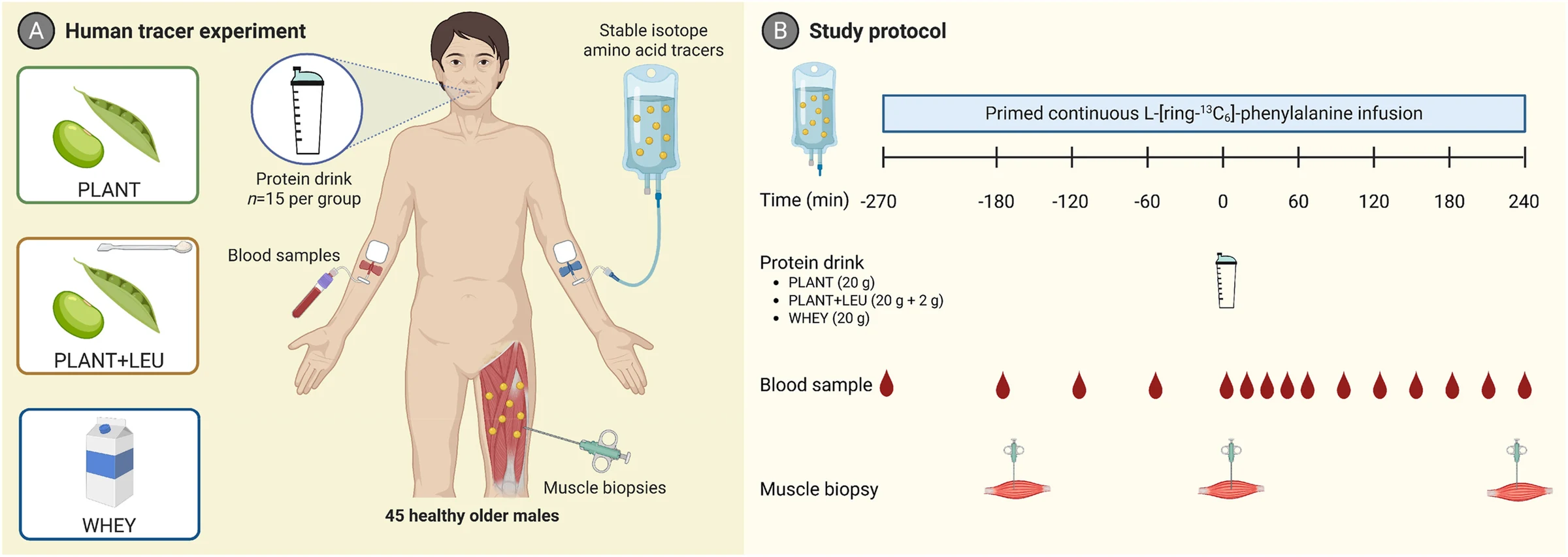
BACKGROUND: Sufficient high-quality protein intake is required to prevent sarcopenia in older adults. Plant-based proteins have been reported to have lower anabolic properties when compared with animal-based proteins. Whether the lower quality of plant-based protein can be improved, thereby resulting in an anabolic response noninferior to an equivalent amount of animal-based protein, remains to be established in older adults. OBJECTIVES: To compare postprandial muscle protein synthesis rates following ingestion of a single bolus of a PLANT, with a PLANT+LEU, or WHEY in older males. METHODS: In this randomized, double-blind, parallel-group design, 45 healthy older males (aged 69 ± 5 y, BMI 26.2 ± 3.2 kg·m‒2) were selected to ingest a 20 g protein blend combining 12 g soy plus 8 g pea protein soy- and pea-derived protein blend (PLANT), 20 g of the soy-pea protein blend fortified with 2 g leucine soy-pea protein blend fortified with free leucine (PLANT+LEU), or 20 g whey protein (WHEY). Primed continuous L-[ring-¹³C₆]-phenylalanine infusions were applied, with blood and muscle sampling ≤4 h after protein ingestion to assess plasma amino acid profiles and muscle protein synthesis rates. RESULTS: WHEY increased plasma essential amino acid concentrations more than PLANT and PLANT+LEU over the 4 h postprandial period (incremental area under curve: 135 ± 20 compared with 99 ± 21 and 105 ± 21 mmol·240 min·L‒1, respectively; P < 0.001). Plasma peak leucine concentrations were higher after PLANT+LEU ingestion compared with PLANT and WHEY (567 ± 74 compared with 310 ± 49 and 471 ± 74 μmol·L‒1, respectively; P < 0.001). Postprandial muscle protein synthesis rates averaged 0.034 ± 0.010, 0.035 ± 0.012, and 0.034 ± 0.010 %·h‒1 following PLANT, PLANT+LEU, and WHEY ingestion, respectively (treatment P = 0.828), and were not increased when compared with postabsorptive values. CONCLUSIONS: Ingestion of 20 g of protein alone, independent of its quality, is not enough to increase muscle protein synthesis rates in older males. More work is needed to define the preferred combination of both protein quality and quantity to stimulate muscle protein synthesis in an older population. This trial was registered at clinicaltrials.gov as NCT05711095.
The paper
Maastricht University Medical Centre
The Journal of Nutrition, 17 Aug 2026