Visuomotor coordination training in dual-motor task improves balance recovery while responding to visuospatial perturbations in older adults
Controlled
Abstract
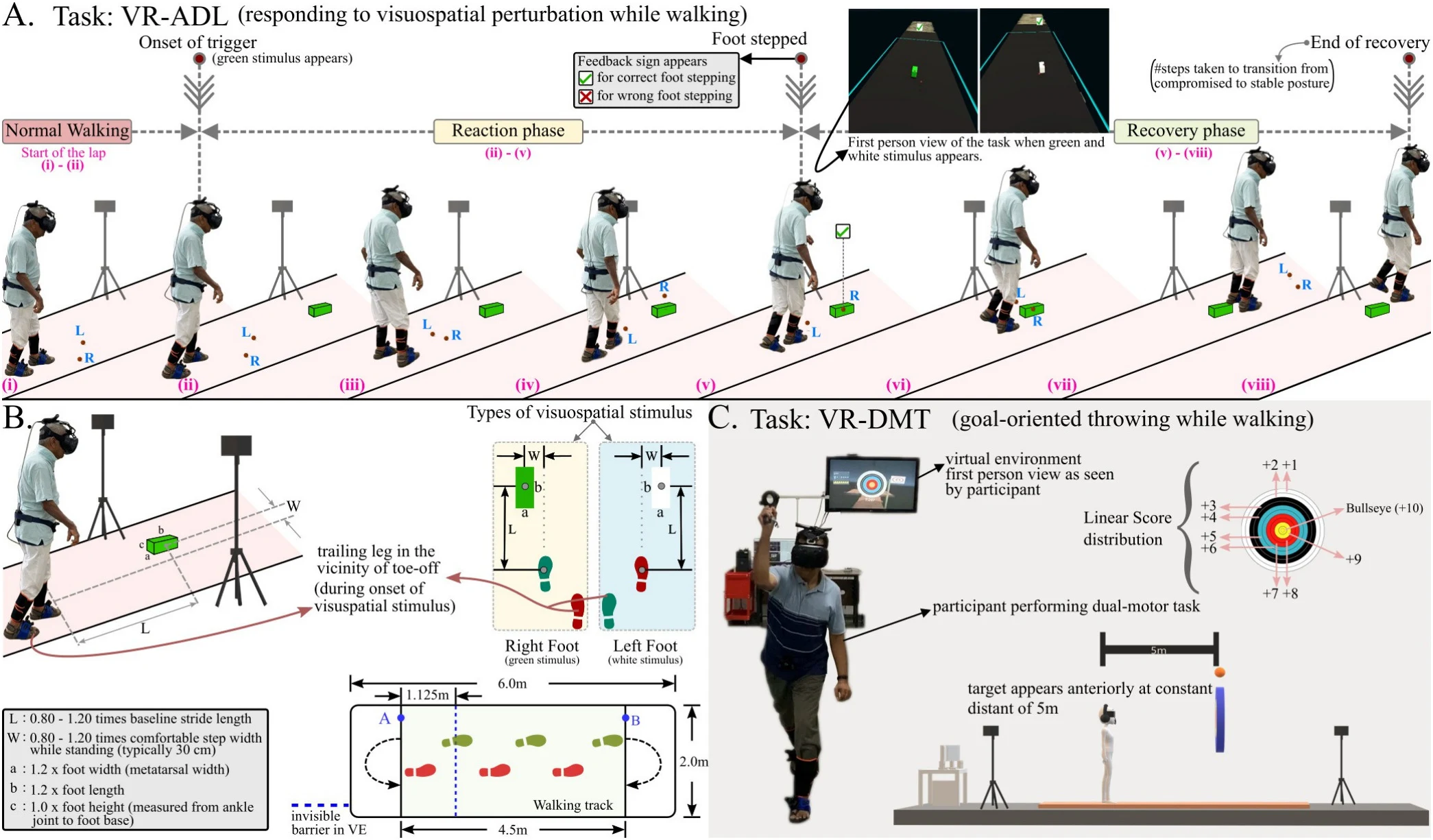
OBJECTIVE: Adapting to a changing environment is crucial for maintaining gait stability and balance, requiring precise visuomotor coordination - manifested through timely modulation of foot placement, step length, and base of support. To address age-related decline in visuomotor coordination that compromises reactive balance during walking, this study investigates the efficacy of a virtual reality-based dual-motor task (DMT) training paradigm in enhancing dynamic gait stability in older adults during visuospatial perturbations. METHODS: Twenty older adults were recruited and divided into a training group (age: 67.0 ± 5.4 years) and a control group (age: 66.1 ± 8.2 years). The training group underwent DMT-based visuomotor coordination exercise using a virtual reality (VR) environment. The efficacy of training was assessed by measuring transfer effects to a separate VR-based walking task involving visuospatial perturbations. Gait performance was evaluated using reaction time, balance recovery time, and margin of stability (MoS). RESULTS: Post-training, the training group exhibited a higher rate of improvement of dynamic stability (MoS) during the recovery steps post-perturbation. Additionally, the training group showed a significant reduction in reaction time and balance recovery time compared to pre-training. In contrast, the control group showed no significant changes in these parameters. CONCLUSION: The DMT training paradigm significantly enhanced visuomotor response and balance recovery in older adults during walking with visuospatial perturbations. SIGNIFICANCE: The proposed VR-based DMT paradigm offers a promising, scalable training approach to improve dynamic balance recovery in older adults in clinical and home settings.
- Virtual reality-based dual-motor task training
- Balance recovery time
- Margin of stability
- Reaction time
- Humans
The paper
Birla Institute of Technology and Science, Pilani; Indian Institute of Technology Gandhinagar
Human Movement Science, 17 Aug 2026
doi.org/10.1016/j.humov.2026.103527PubMed 42607526
Corrected, 9 Oct 2026