Marker linked to age in cognitively intact, amyloid-negative adults
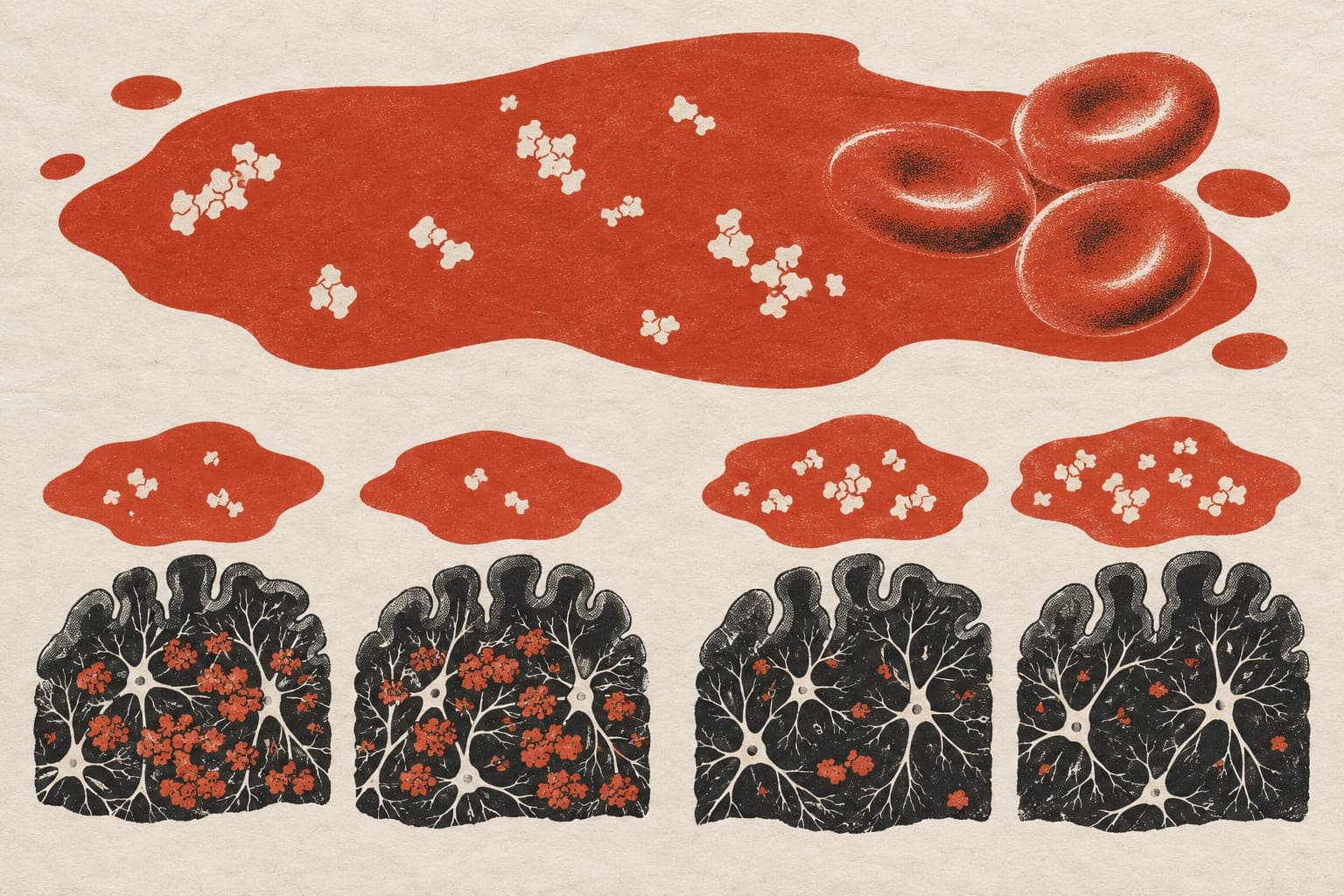
With ALZpath, cognitively unimpaired, amyloid-negative adults had median levels of 0.19 nanograms per liter below age 70 versus 0.34 above 80.
Our read
Biomarkers- Studied:
- Cross-sectional study of 360 cognitively unimpaired, amyloid-negative adults
- What changed:
- Median blood p-tau217 was higher above 80: 0.34 versus 0.19 nanograms per liter below age 70 with ALZpath
- The catch:
- The Lumipulse analysis included only 73 people
- Stake:
- Neurocode USA funded the study; authors work for it and hold shares in it.
- In the record:
- The 890th paper on APOE with results in people; 3,705 on record in all.
- Why it’s aging research:
- It looks at how biology varies with age or lifespan.
Editor of record: Boris Djordjevic · AgingResearch.News
An observational study included 360 cognitively unimpaired adults, averaging 72.5 years old, whose brain scans were negative for amyloid-beta, a protein linked to Alzheimer’s disease. The group included 201 women. Researchers measured blood p-tau217, a modified form of the tau protein, using the ALZpath test in all participants and Lumipulse in 73.
With ALZpath, older age was associated with higher levels and a larger share of results in an intermediate, or inconclusive, range. Men also had higher levels than women with ALZpath, but not Lumipulse. Lumipulse showed an increase in the share of positive results with age, but that trend was not statistically significant.
Why it matters
For efforts to identify Alzheimer’s-related changes before cognitive symptoms appear, the authors emphasized incorporating age and sex into blood-test interpretation.
Caveats
Cross-sectional age comparisons cannot show how the marker changes within individuals over time. These findings concern cognitively unimpaired, amyloid-negative older adults, and the Lumipulse analysis included only 73 people.
The paper
Neurocode USA Inc Bellingham Washington USA; University of British Columbia
Alzheimer's & Dementia, Jun 2026, Open access
Comments
Be the first to comment.