Higher neuroticism links to broad disease risks in Chinese adults
In 25,041 Chinese adults, high neuroticism scores were linked to 1.17- to 1.81-fold higher risks of major physical and mental conditions compared to low scores.
BMC Public Health
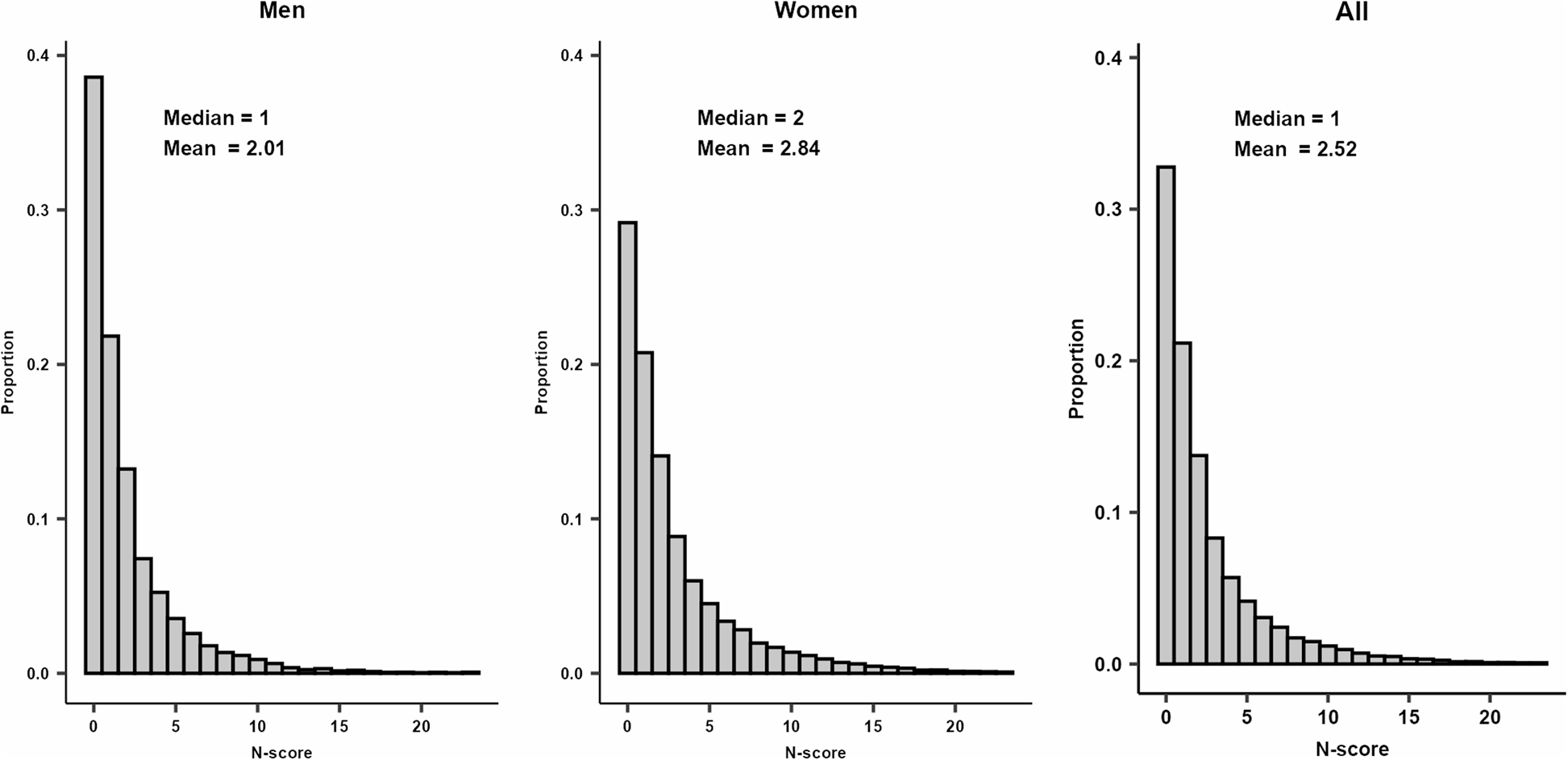
In a prospective study of 25,041 Chinese adults from five urban and five rural regions, researchers evaluated the health patterns associated with neuroticism using China Kadoorie Biobank data. Participants completed the 23-item Eysenck Personality Questionnaire during a 2013–2014 resurvey. The mean neuroticism score was 2.52, trending downward with older age and scoring higher among women, urban residents, unmarried individuals, and those with lower household income. Cross-sectionally, participants with scores of 4 or higher faced higher rates of mental health conditions and poor general health than those scoring 0, with adjusted risk ratios between 1.52 and 41.01. Prospectively, registry tracking showed that higher scores were tied to elevated incidence of stroke, ischaemic heart disease, digestive diseases, nervous system diseases, and mental and behavioural disorders, yielding hazard ratios between 1.17 and 1.81 for the highest scoring group versus the lowest.
Why it matters
Understanding how psychological traits correlate with disease vulnerability across the lifespan provides insight into behavioral and physiological drivers of late-life morbidity. These associations highlight neuroticism as a potential marker for stratified public health interventions targeting both mental and physical health.
Caveats
The observational design precludes causal conclusions, and the findings from this specific Chinese cohort may not generalize to populations with different cultural or socioeconomic backgrounds.
The paper
Show 155 more authors
Baihan Wang, Ling Yang, Pei Pei, Dianjianyi Sun, Jun Lv, Canqing Yu, Xiaoming Yang, Xiaohui Sun, Junshi Chen, Liming Li, Zhengming Chen, Yiping Chen, for the China Kadoorie Biobank Collaborative Group, Robert Clarke, Rory Collins, Richárd Pető, Robin Walters, Daniel Avery, Maxim Barnard, Derrick Bennett, Ruth Boxall, Ka Hung Chan, Zhengming Chen, Charlotte Clarke, Robert Clarke, Ahmed Edris Mohamed, Hannah Fry, Simon Gilbert, Pek Kei Im, Andri Iona, Maria Kakkoura, Christiana Kartsonaki, Kshitij Kolhe, Hubert Lam, Kuang Lin, James Liu, Mohsen Mazidi, Iona Millwood, Sam Morris, Qunhua Nie, Alfred Pozarickij, Maryam Rahmati, Paul Ryder, Dan Schmidt, Becky Stevens, Iain Turnbull, Robin Walters, Lin Wang, Neil Wright, Pang Yao, Xiao Han, Can Hou, Qingmei Xia, Chao Liu, Lang Pan, Zengchang Pang, Ruqin Gao, Shanpeng Li, Haiping Duan, 少杰 王, Yongmei Liu, Ranran Du, Yajing Zang, Liang Cheng, Xiaocao Tian, Hua Zhang, Yaoming Zhai, Feng Ning, Feifei Li, Silu Lv, Junzheng Wang, Wei Hou, Wei Sun, Shichun Yan, Xiaoming Cui, Chi Wang, Zhenyuan Wu, Yanjie Li, Quan Kang, Huiming Luo, Tingting Ou, Zheng Xiangyang, Zhendong Guo, Shukuan Wu, Yilei Li, Huimei Li, Ming Wu, Yonglin Zhou, Jinyi Zhou, Ran Tao, Jie Yang, Jian Su, Fang Liu, Jun Zhang, Yihe Hu, Yan Lu, Liangcai Ma, Aiyu Tang, Shuo Zhang, Jianrong Jin, Jingchao Liu, Lin Mei, Zhenzhen Lu, Lifang Zhou, Changping Xie, Jian Lan, Tingping Zhu, Yun Liu, Liuping Wei, Zhou Liyuan, Ningyu Chen, Yulu Qin, Sisi Wang, Xianping Wu, Ningmei Zhang, Xiaoyu Chang, Mingqiang Yuan, Xia Wu, Wei Jiang, Jiaqiu Liu, Qiang Sun, Faqing Chen, Xiaolan Ren, Caixia Dong, Hui Zhang, Enke Mao, Xiaoping Wang, Tao Wang, Xi Zhang, Kai Kang, Shixian Feng, Huizi Tian, Lei Fan, XiaoLin Li, Huarong Sun, Pan He, Xukui Zhang, Min Yu, Ruying Hu, Hao Wang, Xiaoyi Zhang, Yuan Cao, Kaixu Xie, Lingli Chen, Dun Shen, Xiaojun Li, Donghui Jin, Li Yin, Huilin Liu, Zhongxi Fu, Xin Xu, Hao Zhang, Jianwei Chen, Yuan Peng, Libo Zhang,Shanghai Jiao Tong University
BMC Public Health · 2 Oct 2026 · CC BY