Exercise and insulin boosted galactose uptake in older men
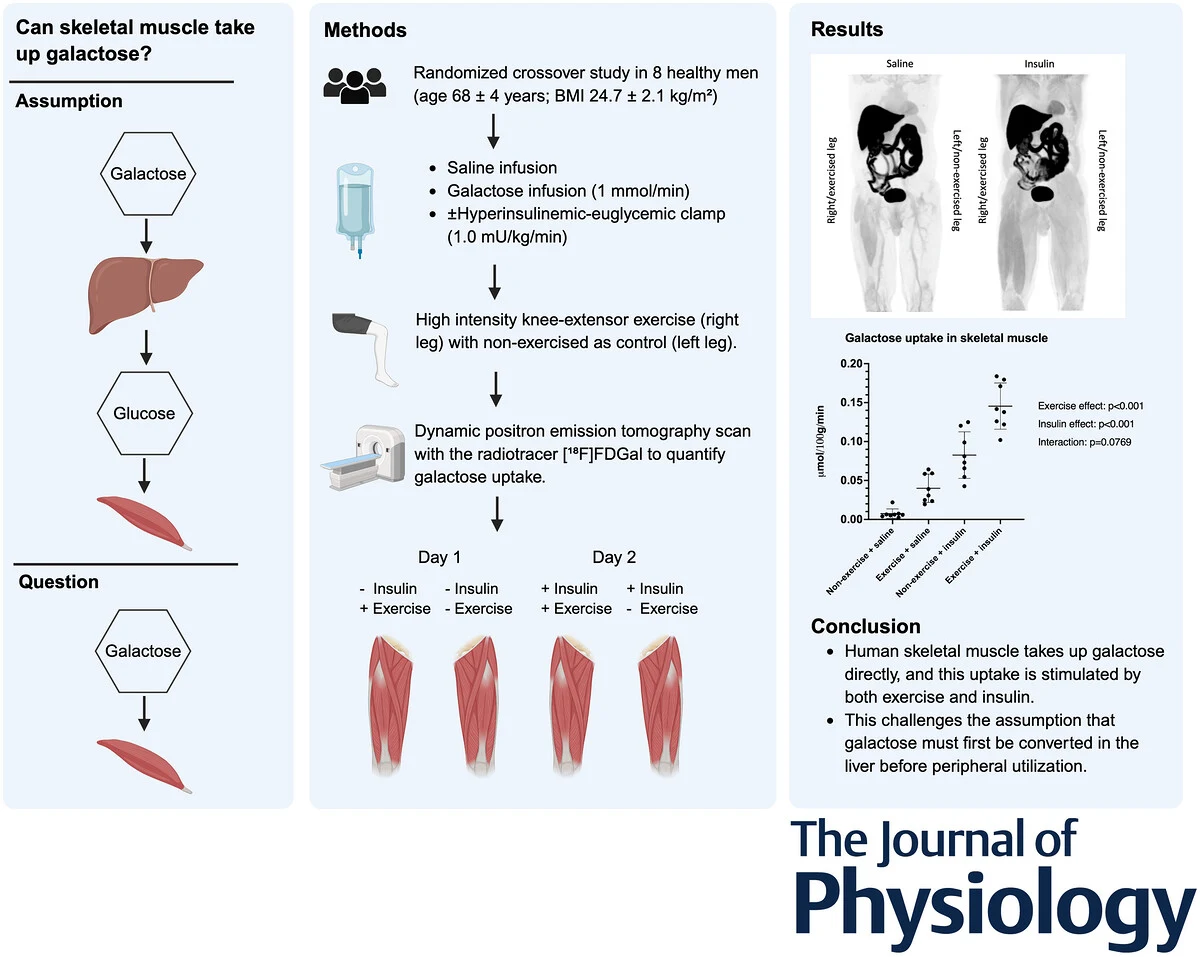
A randomized crossover trial in eight healthy men averaging 68 years old found that muscles could directly take up galactose, a sugar.
Our read
Interventions- Studied:
- Randomized trial in 8 healthy older men, 4 h, against non-exercised legs during saline infusion
- What changed:
- Muscle galactose uptake rose with exercise plus insulin: 0.15 versus 0.01 µmol/100 g/min without exercise or insulin
- The catch:
- Tracer-based uptake estimates used an assumed correction factor rather than a muscle-validated value
Editor of record: Boris Djordjevic · AgingResearch.News
Eight healthy men averaging 68 years old completed a randomized, controlled crossover trial testing how exercise and insulin affected muscle uptake of galactose, a sugar. They attended two four-hour sessions, with and without insulin infused at 1.0 milliunits per kilogram per minute while blood glucose was held steady. Both sessions included intravenous galactose: an initial 1,081-milligram dose followed by 180 milligrams per minute. Each man performed seven one-minute bouts of high-intensity knee extensions with one leg; the other rested.
Scans using a radioactive galactose-like tracer showed that exercise and insulin each increased muscle galactose uptake. Exercise mainly increased entry into muscle, while insulin increased trapping inside cells. Blood measurements across the legs did not detect differences in galactose exchange between conditions. The authors concluded that muscle can take up galactose without prior conversion to glucose in the liver.
Why it matters
Muscle sugar handling in older adults is relevant to carbohydrate choices when blood-sugar regulation is impaired. The authors say future studies should test whether muscle stores meaningful amounts of galactose as glycogen, its carbohydrate reserve.
Caveats
The authors note that intravenous galactose bypassed the gut and initial liver processing, so these results do not directly describe responses to eating galactose. All eight participants were healthy older men; the findings do not establish responses in women or people with impaired blood-sugar regulation.
From the paper
- Limitation
First, current LC estimates are derived from hepatic measurements, and whether these translate to skeletal muscle remains to be established.
Quoted word for word from the full text on physoc.onlinelibrary.wiley.com.
- Insulin
- High-intensity knee-extension exercise
- Galactose
- Intracellular trapping
- Leg galactose arteriovenous exchange
- Humans
The paper
Exercise and insulin independently stimulate galactose uptake into human skeletal muscle
Department of Nuclear Medicine Aarhus University Hospital Aarhus Denmark; Steno Diabetes Center Aarhus Aarhus University Hospital Aarhus Denmark
The Journal of Physiology, Nov 15, 2026, Open access, CC BY
Comments
Be the first to comment.